

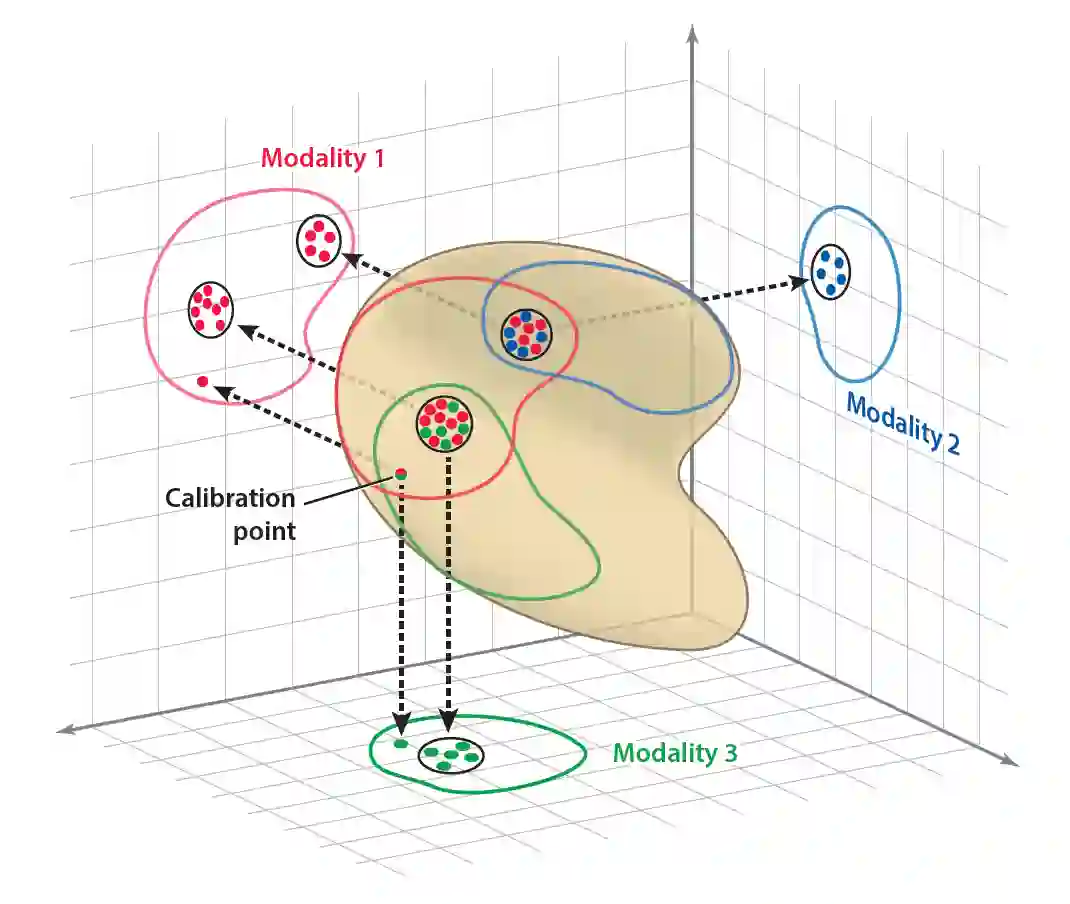
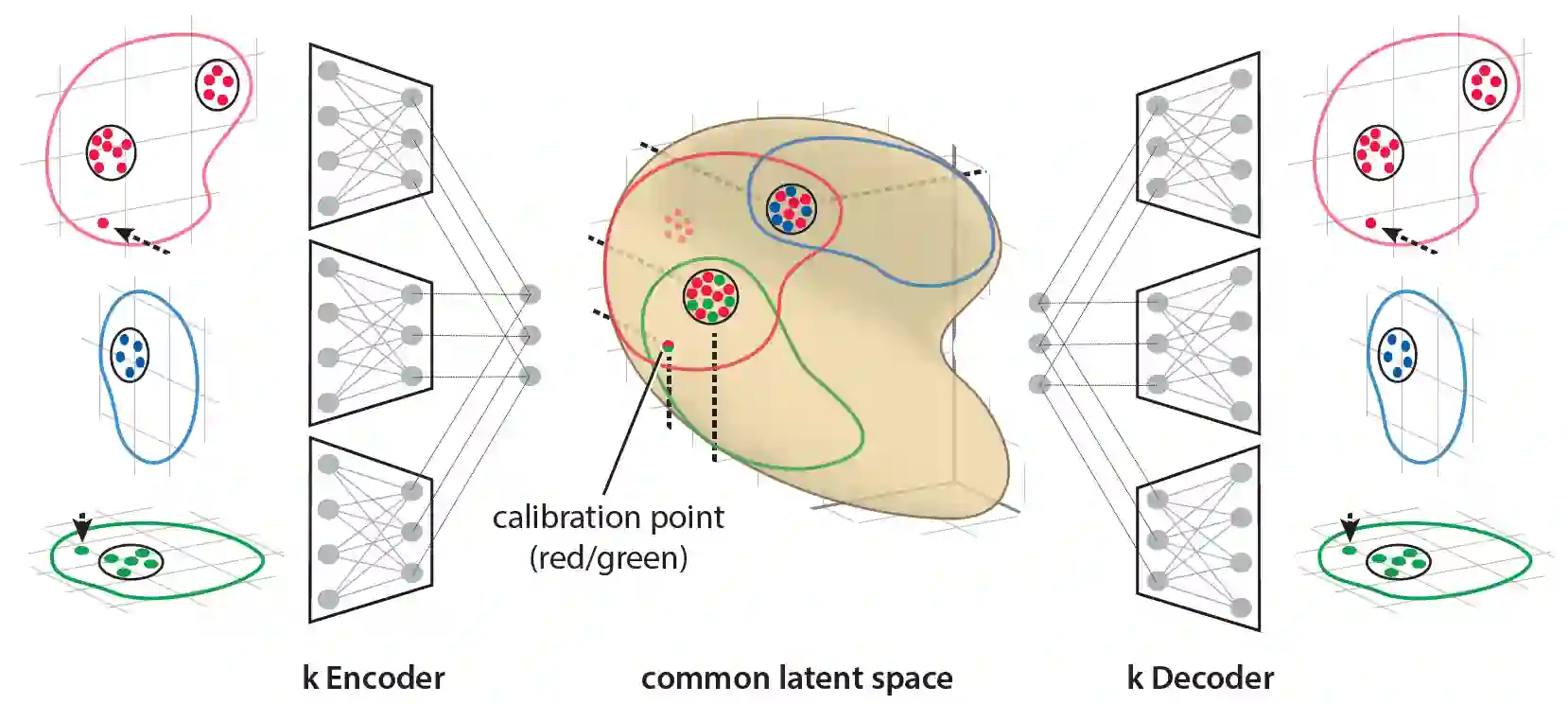
Fusing measurements from multiple, heterogeneous, partial sources, observing a common object or process, poses challenges due to the increasing availability of numbers and types of sensors. In this work we propose, implement and validate an end-to-end computational pipeline in the form of a multiple-auto-encoder neural network architecture for this task. The inputs to the pipeline are several sets of partial observations, and the result is a globally consistent latent space, harmonizing (rigidifying, fusing) all measurements. The key enabler is the availability of multiple slightly perturbed measurements of each instance:, local measurement, "bursts", that allows us to estimate the local distortion induced by each instrument. We demonstrate the approach in a sequence of examples, starting with simple two-dimensional data sets and proceeding to a Wi-Fi localization problem and to the solution of a "dynamical puzzle" arising in spatio-temporal observations of the solutions of Partial Differential Equations.
翻译:融合来自多个异构、部分观测源的测量数据,这些观测源共同监测同一对象或过程,由于传感器数量和类型的日益增多而面临挑战。本文提出、实现并验证了一种端到端计算流程,该流程采用多自编码器神经网络架构解决上述问题。该流程的输入为若干组部分观测数据,输出为一个全局一致的潜空间,用于协调(刚化、融合)所有测量数据。其关键推动因素在于每个实例存在多个轻微扰动的测量值,即局部测量"突发"数据,这使得我们能够估计每个仪器引起的局部畸变。我们通过一系列示例验证了该方法,从简单的二维数据集开始,逐步扩展到Wi-Fi定位问题,以及求解偏微分方程时空观测中出现的"动力学难题"。




相关内容




 微信扫码咨询专知VIP会员