

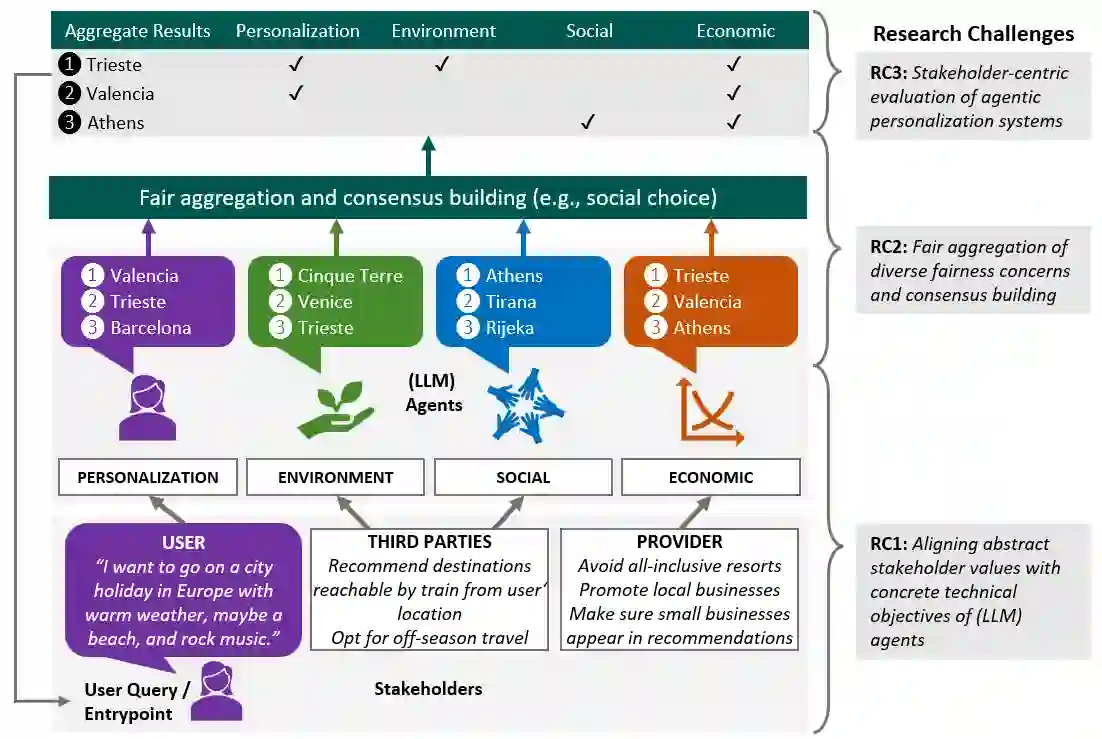
LLM agents are increasingly used for personalization due to their ability to communicate directly with users in natural language, integrate external knowledge bases, and negotiate with other (possibly human) agents. Especially in multistakeholder AI systems with multiple distinct objectives, LLM agents are used to independently optimize for each stakeholder's goals. Here, stakeholder alignment is essential to identify and map these goals to provide LLM agents with quantifiable objectives. Plus, the way in which the outputs of the LLM agents are aggregated is fundamental to ensuring fair outcomes for all agents and, therefore, stakeholders. In this work, we identify open research challenges and propose a conceptual framework for designing fair multi-agent multistakeholder personalization systems that balance competing stakeholder objectives. Our framework integrates (i) methods to align stakeholder objectives and LLM agents, (ii) aggregation strategies, e.g., based on social choice theory, to form fair collective decisions, and (iii) stakeholder-centric evaluation procedures for both individual and collective agent behavior. We showcase our framework through a tourism use case and discuss possible applications in other domains, such as education and healthcare. Finally, we discuss domain-specific fairness tensions and review datasets for evaluating multistakeholder fairness and multi-agent personalization systems.
翻译:由于大语言模型智能体能够以自然语言与用户直接交互、整合外部知识库,并与其他(可能为人类)智能体协商,其正越来越多地被用于个性化任务。尤其在具有多个不同目标的跨利益相关者人工智能系统中,大语言模型智能体被用于独立优化每个利益相关者的目标。在此类场景中,利益相关者对齐至关重要——需识别并映射这些目标,为大语言模型智能体提供可量化的优化指标。此外,大语言模型智能体输出的聚合方式,对于确保所有智能体及其关联利益相关者获得公平结果具有根本性意义。本研究识别了开放研究挑战,并提出了一个概念框架,用于设计能平衡多方利益相关者竞争目标的公平多智能体多利益相关者个性化系统。该框架整合了:(i) 利益相关者目标与大语言模型智能体对齐的方法;(ii) 基于社会选择理论等的聚合策略,以形成公平的集体决策;(iii) 面向利益相关者的评估流程,涵盖个体与集体智能体行为。我们通过旅游场景案例展示该框架,并探讨其在教育、医疗等领域的潜在应用。最后,我们讨论了领域特有的公平性矛盾,并梳理了用于评估跨利益相关者公平性与多智能体个性化系统的数据集。




相关内容


 微信扫码咨询专知VIP会员