

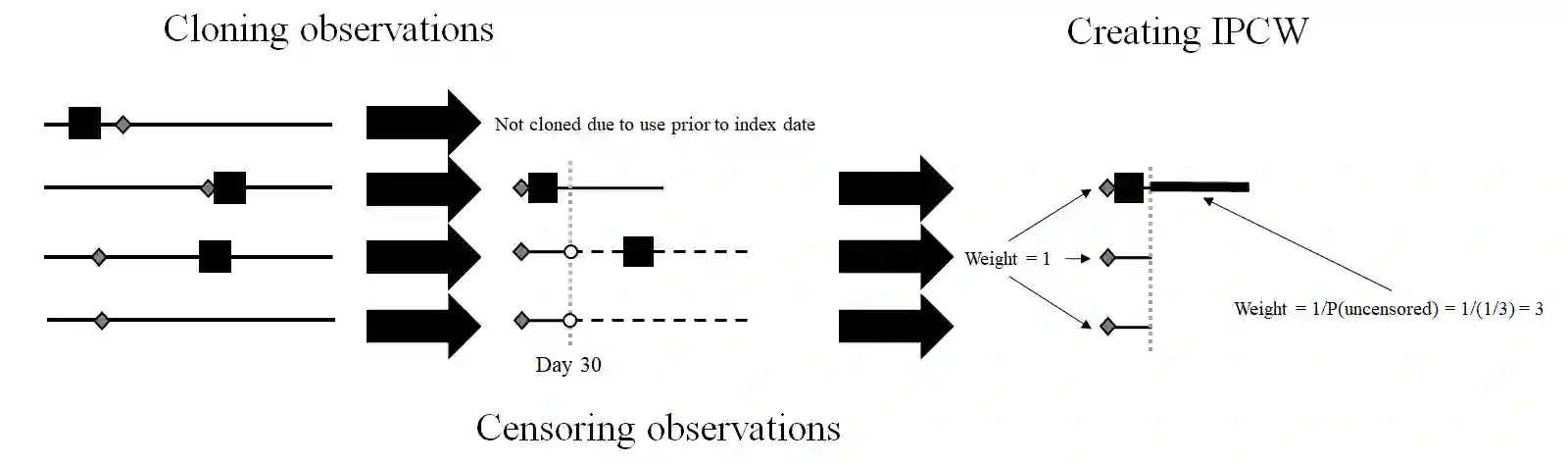
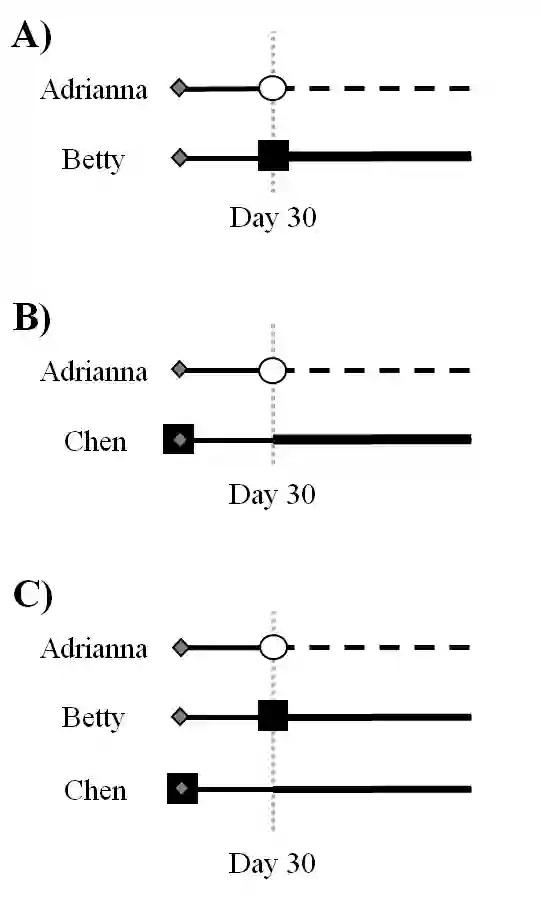
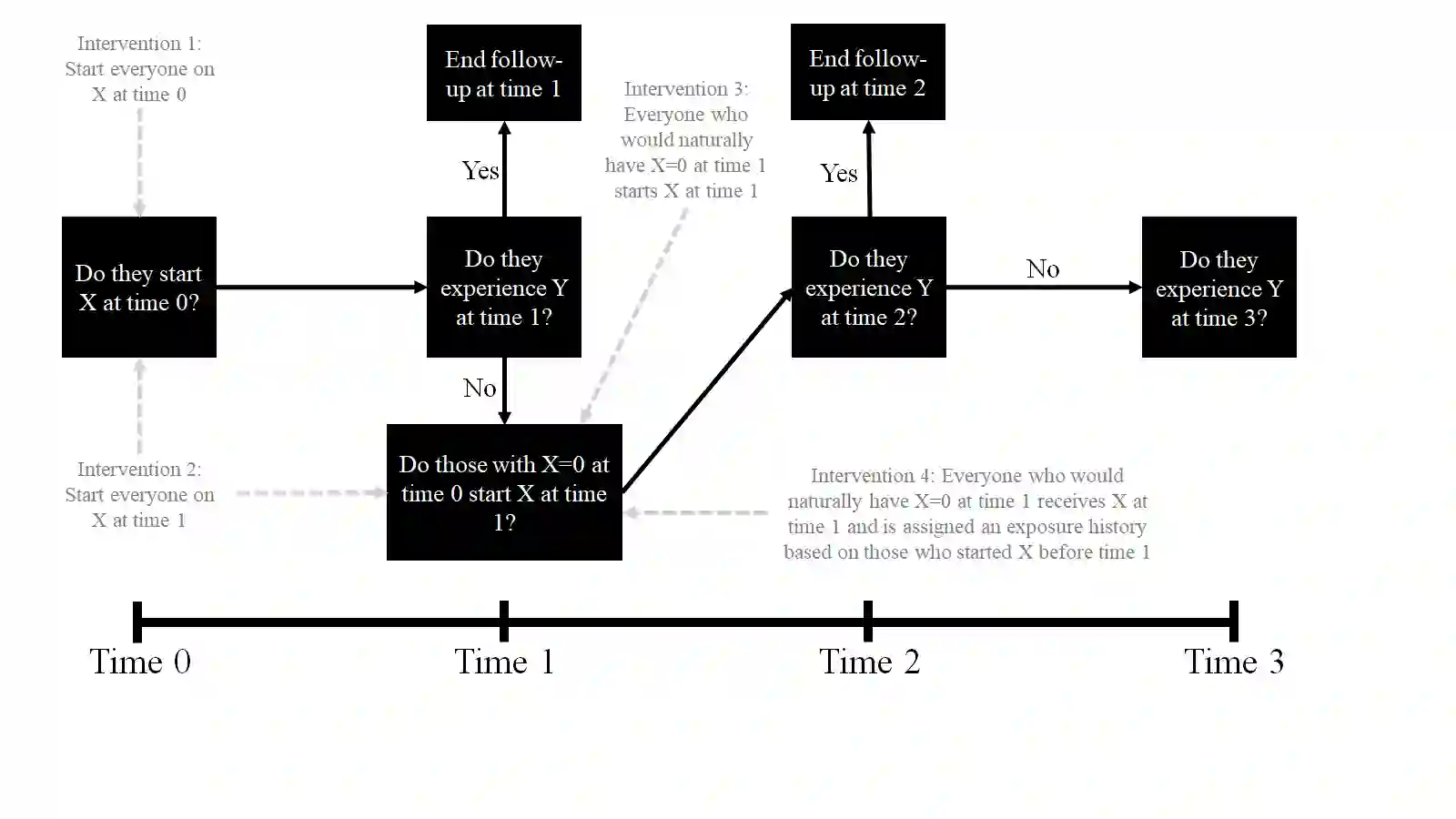
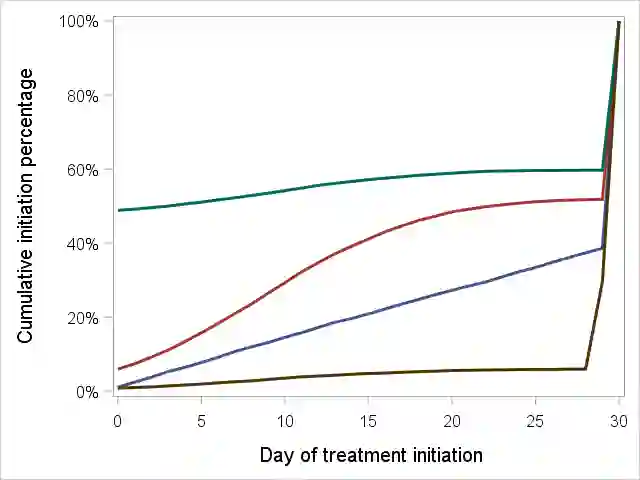
Clone-censor-weighting (CCW) is an analytic method for studying treatment regimens that are indistinguishable from one another at baseline without relying on landmark dates or creating immortal person time. One particularly interesting CCW application is estimating outcomes when starting treatment within specific time windows in observational data (e.g., starting a treatment within 30 days of hospitalization). In such cases, CCW estimates something fairly complex. We show how using CCW to study a regimen such as "start treatment prior to day 30" estimates the potential outcome of a hypothetical intervention where A) prior to day 30, everyone follows the treatment start distribution of the study population and B) everyone who has not initiated by day 30 initiates on day 30. As a result, the distribution of treatment initiation timings provides essential context for the results of CCW studies. We also show that if the exposure effect varies over time, ignoring exposure history when estimating inverse probability of censoring weights (IPCW) estimates the risk under an impossible intervention and can create selection bias. Finally, we examine some simplifying assumptions that can make this complex treatment effect more interpretable and allow everyone to contribute to IPCW.
翻译:克隆-删失-加权(CCW)是一种分析方法,用于研究基线期无法区分的治疗方案,而无需依赖标记日期或创建不朽人时。其中一个特别有趣的CCW应用是,在观察性数据中估计特定时间窗口内启动治疗的结果(例如,在住院30天内启动治疗)。在这种情况下,CCW估计的是一个相当复杂的量。我们展示了如何使用CCW研究“在第30天前启动治疗”的方案,估计的是假设干预的潜在结果:A)在第30天前,所有人都遵循研究人群的治疗启动分布;B)到第30天尚未启动治疗的人在第30天启动。因此,治疗启动时间的分布为CCW研究的结果提供了关键背景。我们还表明,如果暴露效应随时间变化,那么在估计逆概率删失权重(IPCW)时忽略暴露史,会估计出一种不可能干预下的风险,并可能产生选择偏倚。最后,我们探讨了一些简化假设,这些假设可以使这一复杂治疗效应更具可解释性,并允许所有人对IPCW做出贡献。




相关内容




 微信扫码咨询专知VIP会员