

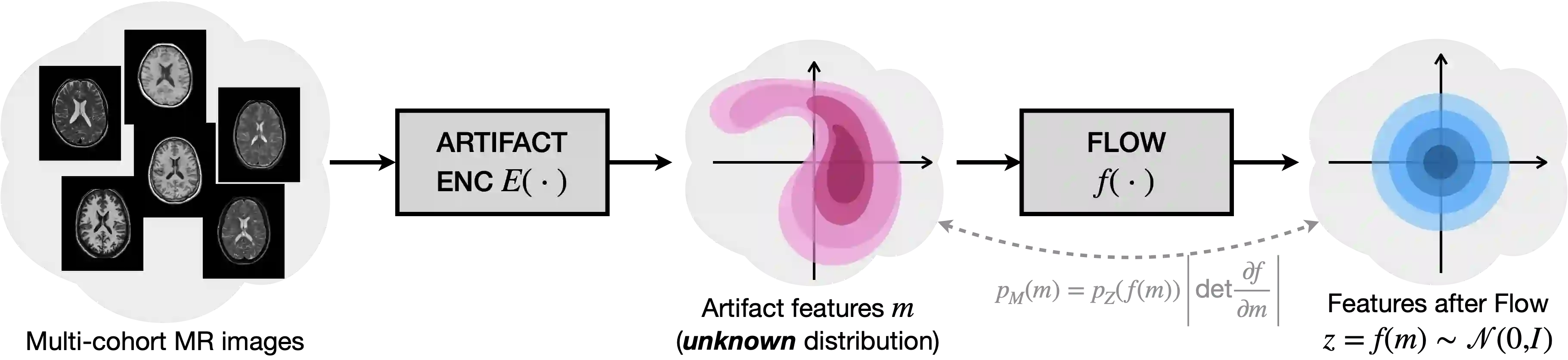
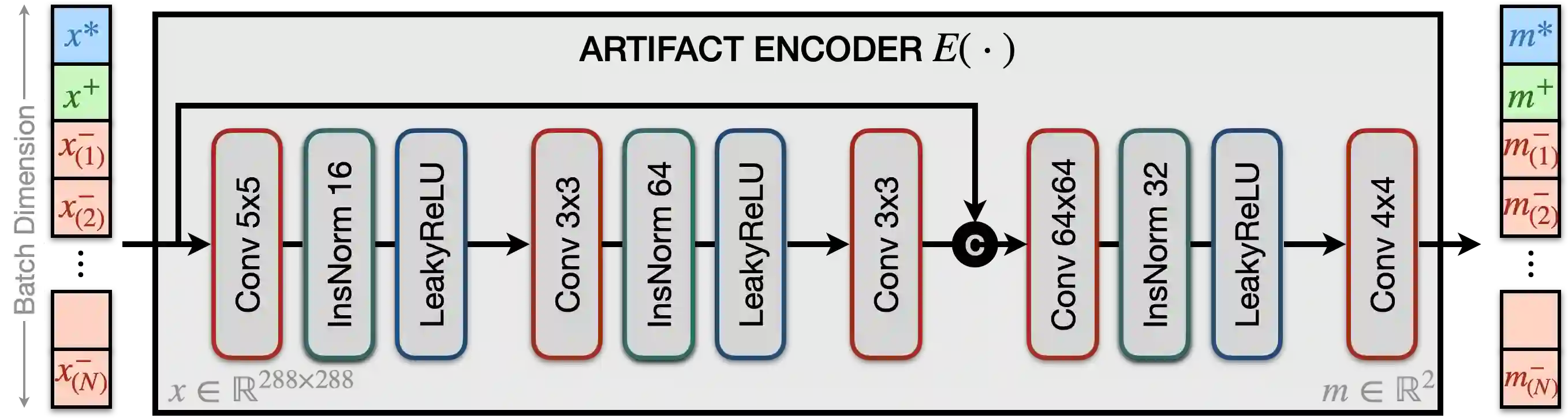
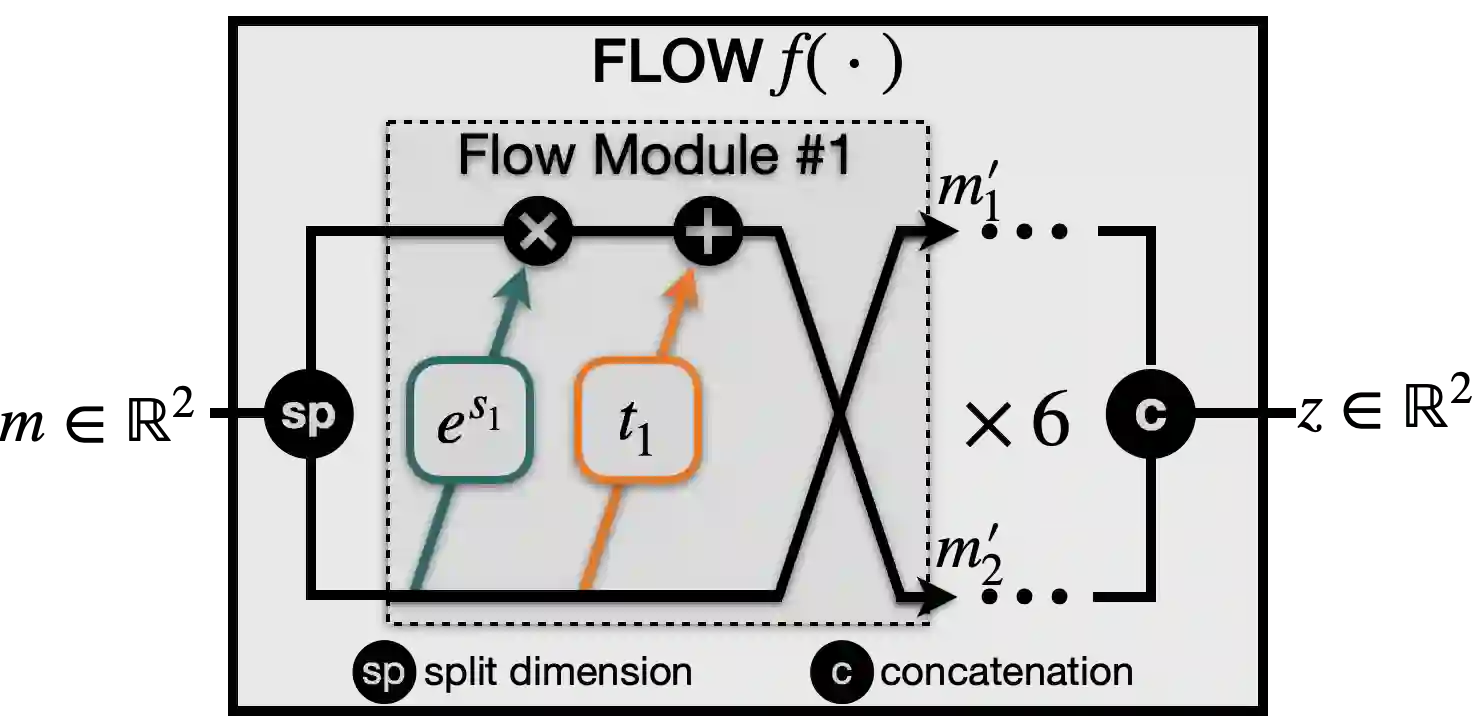
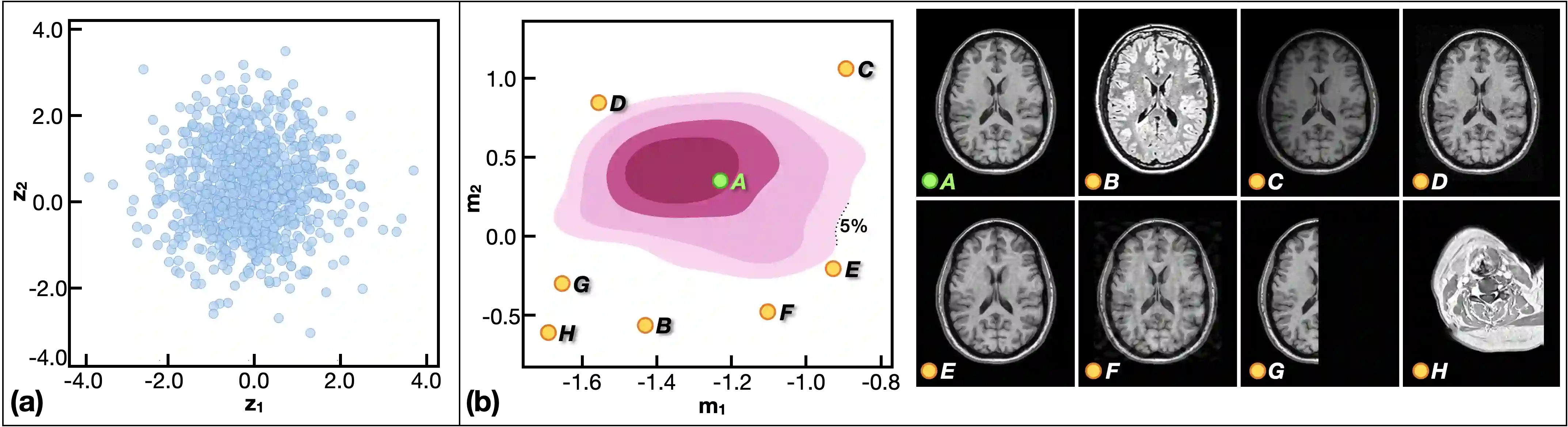
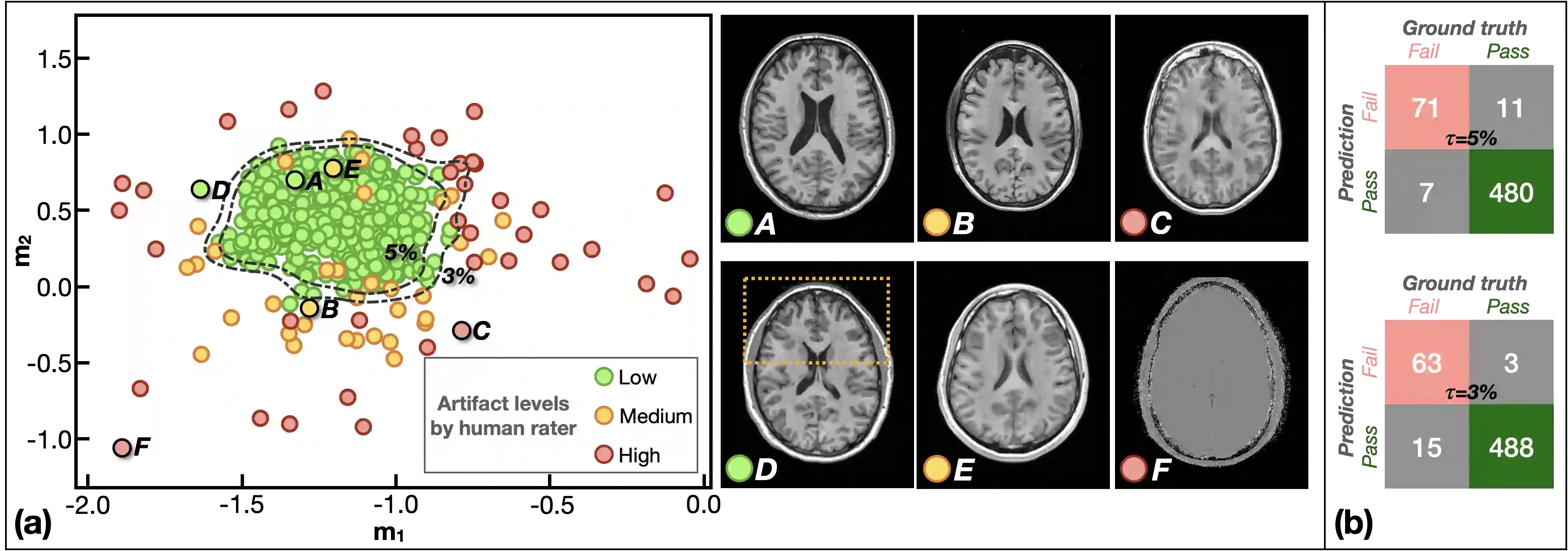
Image quality control (IQC) can be used in automated magnetic resonance (MR) image analysis to exclude erroneous results caused by poorly acquired or artifact-laden images. Existing IQC methods for MR imaging generally require human effort to craft meaningful features or label large datasets for supervised training. The involvement of human labor can be burdensome and biased, as labeling MR images based on their quality is a subjective task. In this paper, we propose an automatic IQC method that evaluates the extent of artifacts in MR images without supervision. In particular, we design an artifact encoding network that learns representations of artifacts based on contrastive learning. We then use a normalizing flow to estimate the density of learned representations for unsupervised classification. Our experiments on large-scale multi-cohort MR datasets show that the proposed method accurately detects images with high levels of artifacts, which can inform downstream analysis tasks about potentially flawed data.
翻译:图像质量控制(IQC)可用于自动化磁共振(MR)图像分析,以排除因采集不良或伪影图像导致的错误结果。现有的MR成像IQC方法通常需要人工构建有效特征或标注大型数据集以进行监督训练。由于基于图像质量标注MR图像属于主观任务,人工参与可能带来负担和偏差。本文提出一种无需人工标注的自动IQC方法,通过评估MR图像中伪影程度实现质量控制。具体而言,我们设计了一个基于对比学习学习伪影表征的伪影编码网络,并利用归一化流估计学习表征的密度分布以实现无监督分类。在大规模多队列MR数据集上的实验表明,该方法能准确检测出具有高伪影水平的图像,从而为下游分析任务提供关于潜在异常数据的预警信息。




相关内容



 微信扫码咨询专知VIP会员