

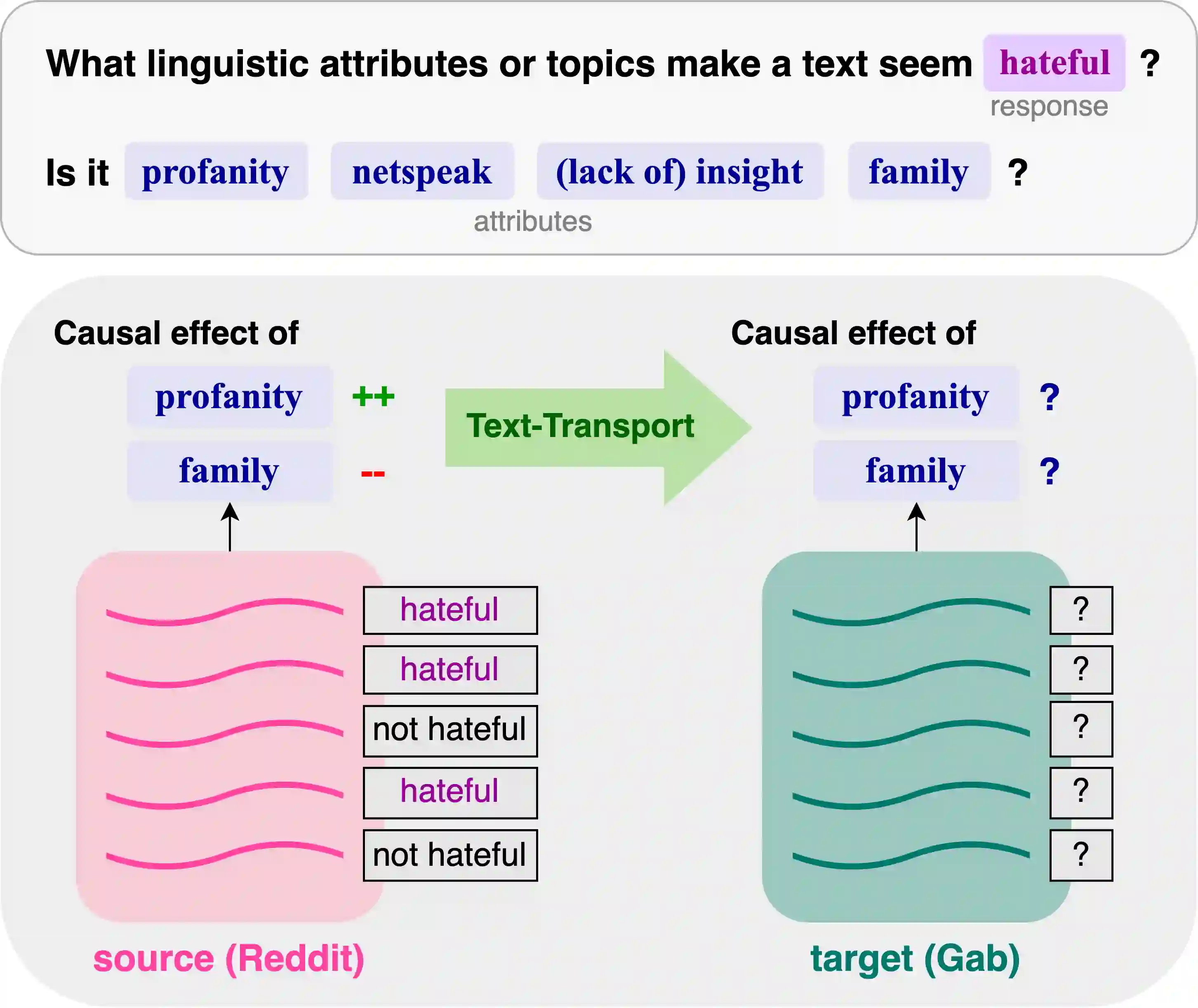
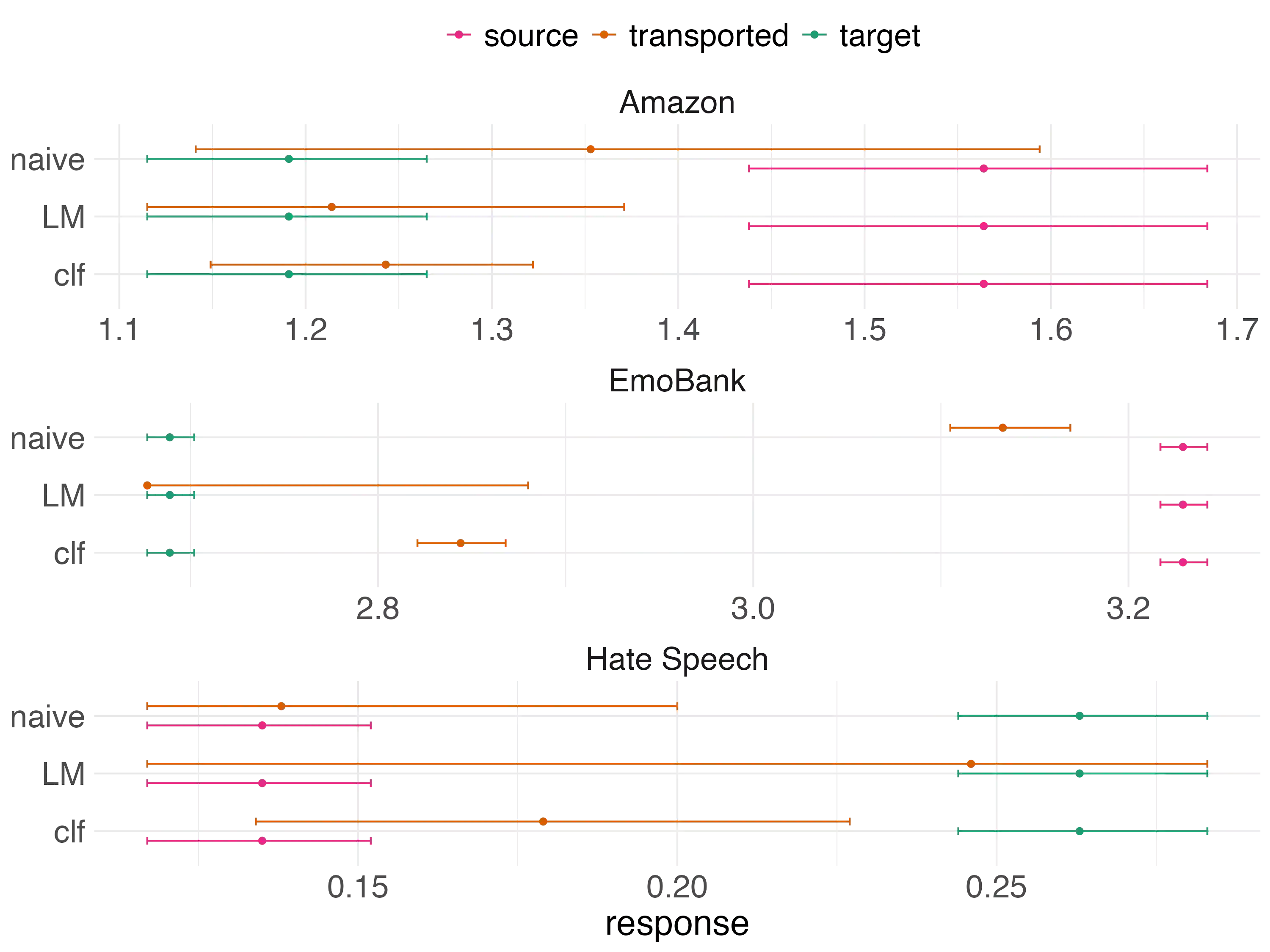
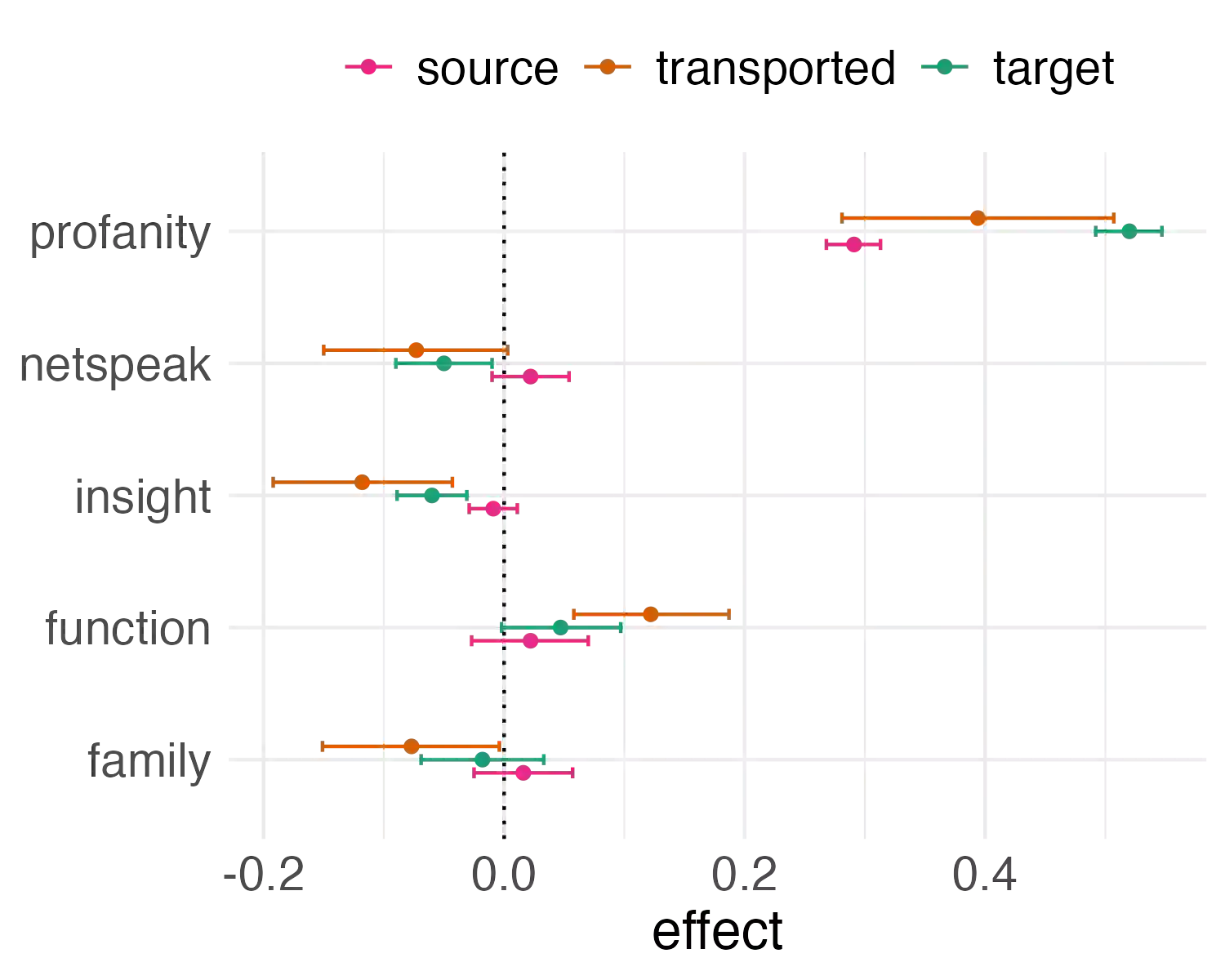
As language technologies gain prominence in real-world settings, it is important to understand how changes to language affect reader perceptions. This can be formalized as the causal effect of varying a linguistic attribute (e.g., sentiment) on a reader's response to the text. In this paper, we introduce Text-Transport, a method for estimation of causal effects from natural language under any text distribution. Current approaches for valid causal effect estimation require strong assumptions about the data, meaning the data from which one can estimate valid causal effects often is not representative of the actual target domain of interest. To address this issue, we leverage the notion of distribution shift to describe an estimator that transports causal effects between domains, bypassing the need for strong assumptions in the target domain. We derive statistical guarantees on the uncertainty of this estimator, and we report empirical results and analyses that support the validity of Text-Transport across data settings. Finally, we use Text-Transport to study a realistic setting--hate speech on social media--in which causal effects do shift significantly between text domains, demonstrating the necessity of transport when conducting causal inference on natural language.
翻译:随着语言技术在实际场景中日益突出,理解语言变化如何影响读者感知变得至关重要。这可以被形式化为改变语言属性(例如情感)对读者文本响应的因果效应。在本文中,我们提出文本传输(Text-Transport),一种在任何文本分布下从自然语言中估计因果效应的方法。当前有效的因果效应估计方法需要对数据做出强假设,这意味着可用于估计有效因果效应的数据通常不代表实际感兴趣的目标领域。为解决这一问题,我们利用分布偏移的概念描述了一种估计器,该估计器在领域之间传输因果效应,从而绕过了对目标领域强假设的需求。我们推导了该估计器不确定性的统计保证,并报告了支持文本传输在不同数据设置下有效性的实证结果和分析。最后,我们使用文本传输研究了一个现实场景——社交媒体上的仇恨言论——其中因果效应在文本领域之间确实显著变化,这证明了在自然语言上进行因果推断时进行传输的必要性。





相关内容



 微信扫码咨询专知VIP会员