

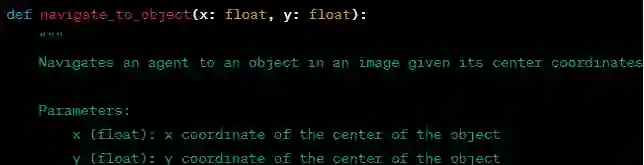
Humans have the remarkable ability to navigate through unfamiliar environments by solely relying on our prior knowledge and descriptions of the environment. For robots to perform the same type of navigation, they need to be able to associate natural language descriptions with their associated physical environment with a limited amount of prior knowledge. Recently, Large Language Models (LLMs) have been able to reason over billions of parameters and utilize them in multi-modal chat-based natural language responses. However, LLMs lack real-world awareness and their outputs are not always predictable. In this work, we develop NavCon, a low-bandwidth framework that solves this lack of real-world generalization by creating an intermediate layer between an LLM and a robot navigation framework in the form of Python code. Our intermediate shoehorns the vast prior knowledge inherent in an LLM model into a series of input and output API instructions that a mobile robot can understand. We evaluate our method across four different environments and command classes on a mobile robot and highlight our NavCon's ability to interpret contextual commands.
翻译:人类具有非凡的能力,仅凭先验知识和环境描述就能在陌生环境中导航。为了让机器人执行同类导航任务,它们需要能够在有限先验知识下将自然语言描述与其对应的物理环境关联起来。近年来,大语言模型(LLMs)已能够对数十亿参数进行推理,并将其应用于多模态的对话式自然语言响应中。然而,LLMs缺乏对现实世界的感知,其输出并不总是可预测的。在本研究中,我们开发了NavCon——一种低带宽框架,通过在LLM与机器人导航框架之间构建以Python代码形式存在的中间层,解决了这一现实世界泛化能力缺失的问题。我们的中间层将LLM模型中固有的海量先验知识整合为移动机器人能够理解的一系列输入输出API指令。我们在移动机器人上的四个不同环境和命令类别中评估了该方法,并突出了NavCon解释上下文命令的能力。








相关内容





 微信扫码咨询专知VIP会员