

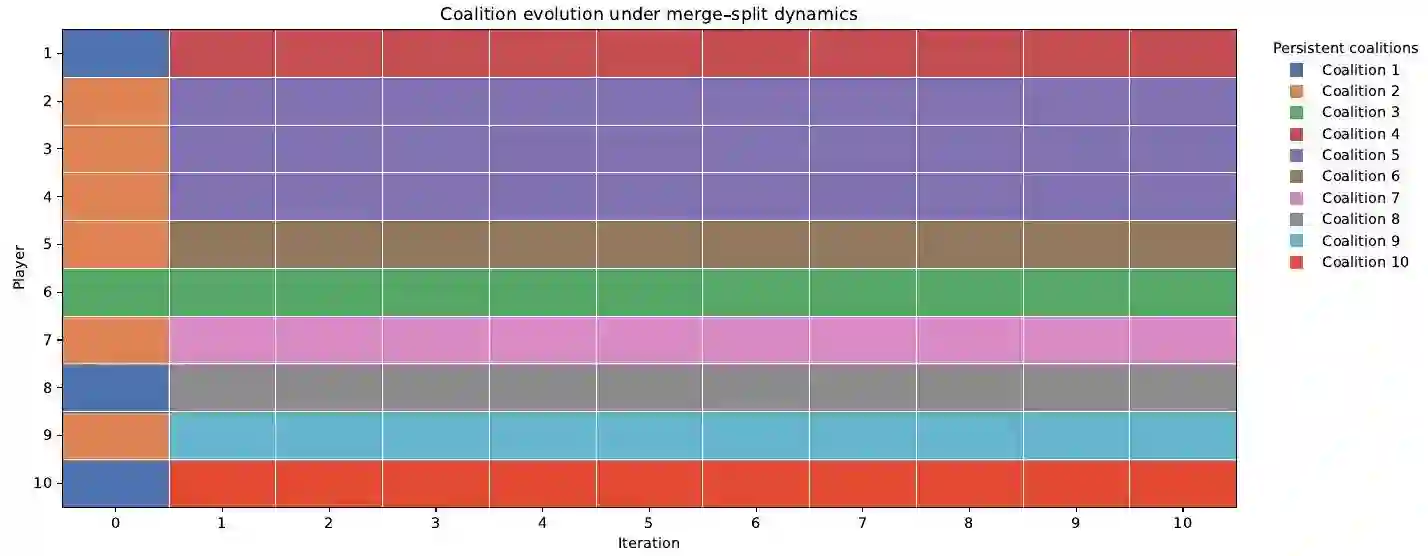
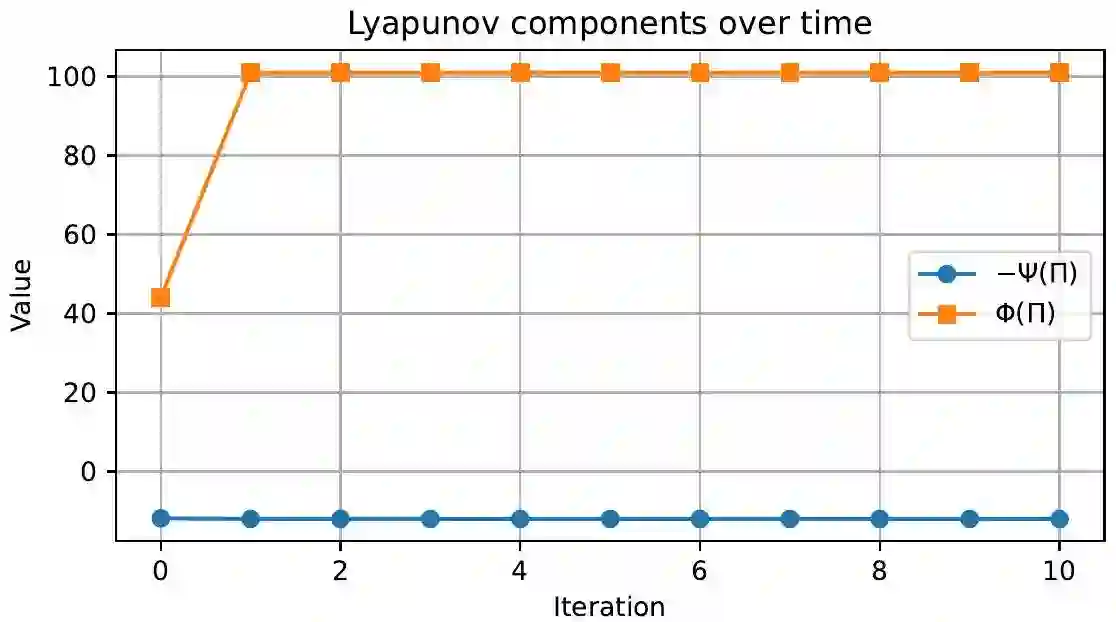
Coalition formation is often modeled as a static equilibrium problem, neglecting the dynamic processes governing how agents self-organize. This paper proposes a dynamic split-and-merge framework that balances two conflicting economic forces: individual fairness and collective efficiency. We introduce a control-theoretic mechanism where topological operations are driven by distinct signals: splits are triggered by fairness violations (specifically, negative Shapley values representing "agent-responsible inefficiency"), while merges are driven by strict surplus improvements (superadditivity). We prove that these dynamics converge in finite time to a specific class of steady states termed Shapley-Fair and Merge-Stable (SFMS) partitions. Convergence is established via a vector Lyapunov function tracking aggregate fairness deficits and system surplus, leveraging a discrete-time LaSalle invariance principle. Numerical case studies on a 10-player game demonstrate the algorithm's ability to resolve fairness tensions and reach stable configurations, providing a rigorous foundation for endogenous coalition formation in dynamic environments.
翻译:联盟形成通常被建模为静态均衡问题,忽略了支配智能体自组织过程的动态机制。本文提出了一种动态分割与合并框架,以平衡两种相互冲突的经济力量:个体公平性与集体效率。我们引入了一种控制理论机制,其中拓扑操作由不同的信号驱动:分割由公平性违反触发(具体而言,由代表“智能体责任性低效”的负Shapley值触发),而合并则由严格的剩余改进(超可加性)驱动。我们证明这些动态过程会在有限时间内收敛到一类特定的稳态,称为Shapley公平且合并稳定(SFMS)划分。收敛性通过追踪总体公平性赤字与系统剩余的向量李雅普诺夫函数建立,并利用了离散时间LaSalle不变性原理。在一个10人博弈上的数值案例研究展示了该算法解决公平性冲突并达到稳定构型的能力,为动态环境中的内生联盟形成提供了严格的理论基础。




相关内容


 微信扫码咨询专知VIP会员