

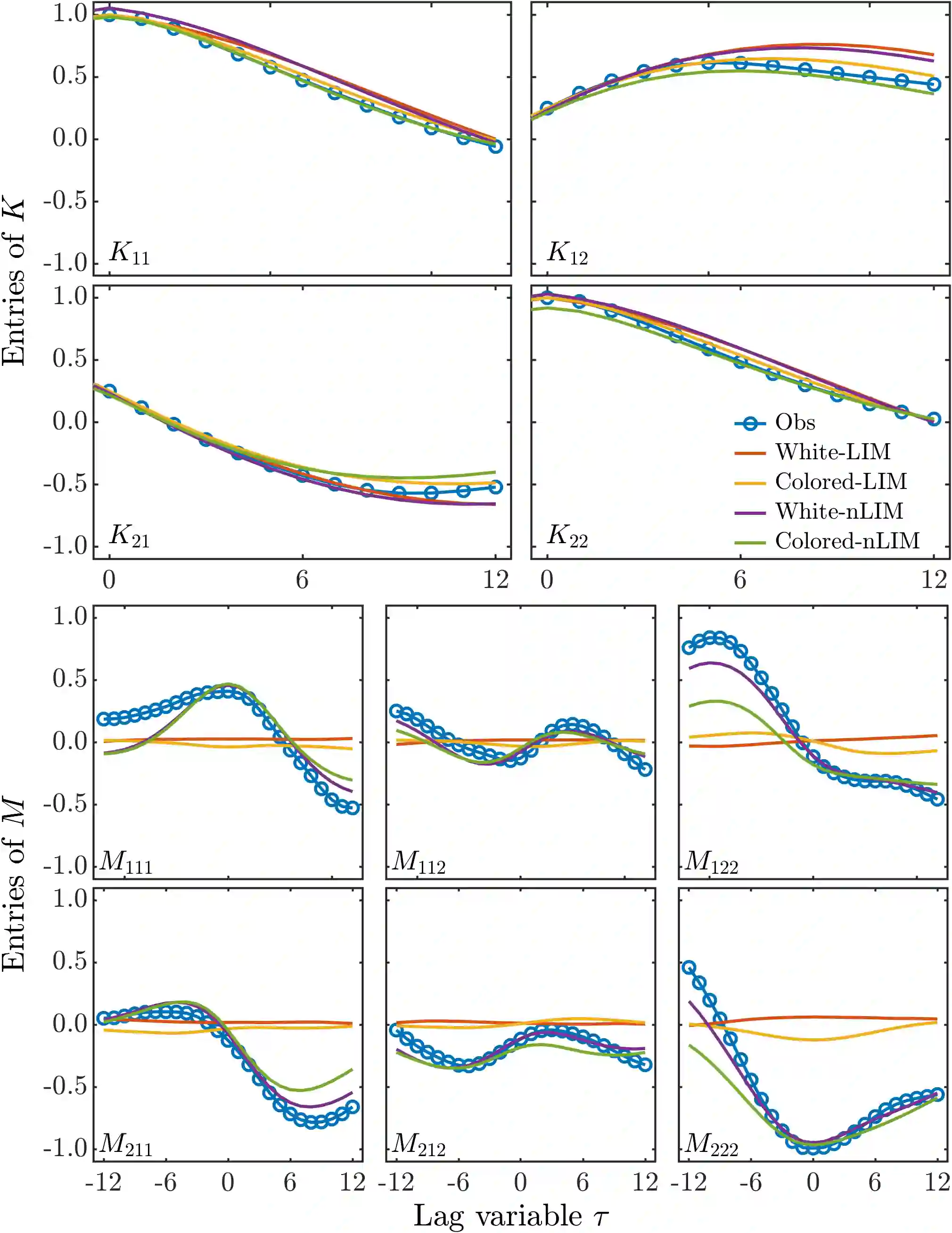
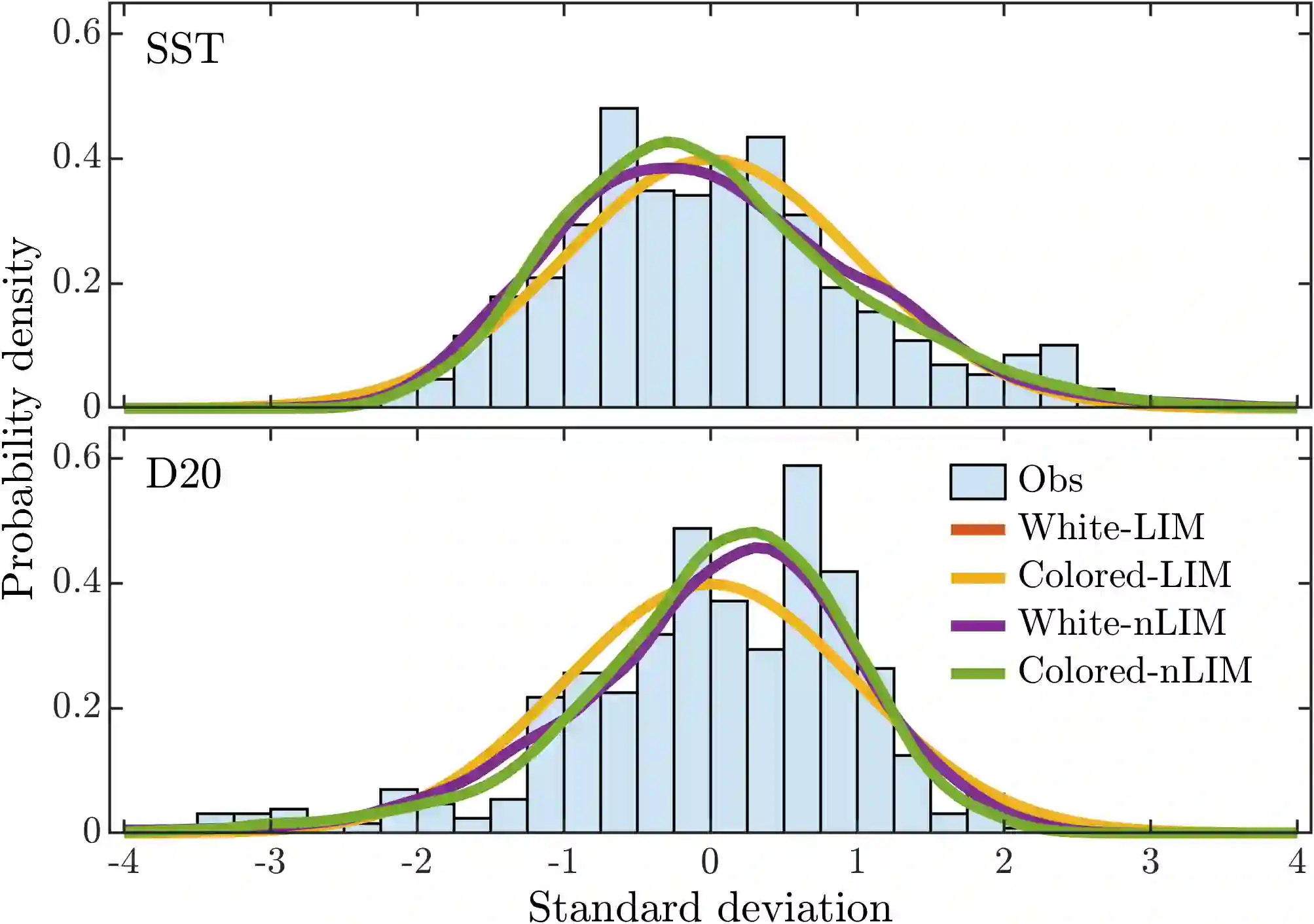
The Linear Inverse Model (LIM) is a class of data-driven methods that construct approximate linear stochastic models to represent complex observational data. The stochastic forcing can be modeled using either Gaussian white noise or Ornstein-Uhlenbeck colored noise; the corresponding models are called White-LIM and Colored-LIM, respectively. Although LIMs are widely applied in climate sciences, they inherently approximate observed distributions as Gaussian, limiting their ability to capture asymmetries. In this study, we extend LIMs to incorporate nonlinear dynamics, introducing White-nLIM and Colored-nLIM which allow for a more flexible and accurate representation of complex dynamics from observations. The proposed methods not only account for the nonlinear nature of the underlying system but also effectively capture the skewness of the observed distribution. Moreover, we apply these methods to a lower-dimensional representation of ENSO and demonstrate that both White-nLIM and Colored-nLIM successfully capture its nonlinear characteristic.
翻译:线性逆模型(LIM)是一类数据驱动方法,通过构建近似线性随机模型来表示复杂的观测数据。其随机强迫项可采用高斯白噪声或Ornstein-Uhlenbeck有色噪声进行建模,对应的模型分别称为White-LIM与Colored-LIM。尽管LIM在气候科学中应用广泛,但其本质是将观测分布近似为高斯分布,这限制了模型捕捉非对称特征的能力。本研究将LIM拓展至非线性动力学框架,提出了White-nLIM与Colored-nLIM,能够以更灵活、更精确的方式从观测数据中表征复杂动力学行为。所提出的方法不仅考虑了底层系统的非线性特性,还能有效捕捉观测分布的偏态特征。此外,我们将这些方法应用于ENSO的低维表征,并证明White-nLIM与Colored-nLIM均能成功捕捉其非线性特征。




相关内容



 微信扫码咨询专知VIP会员