

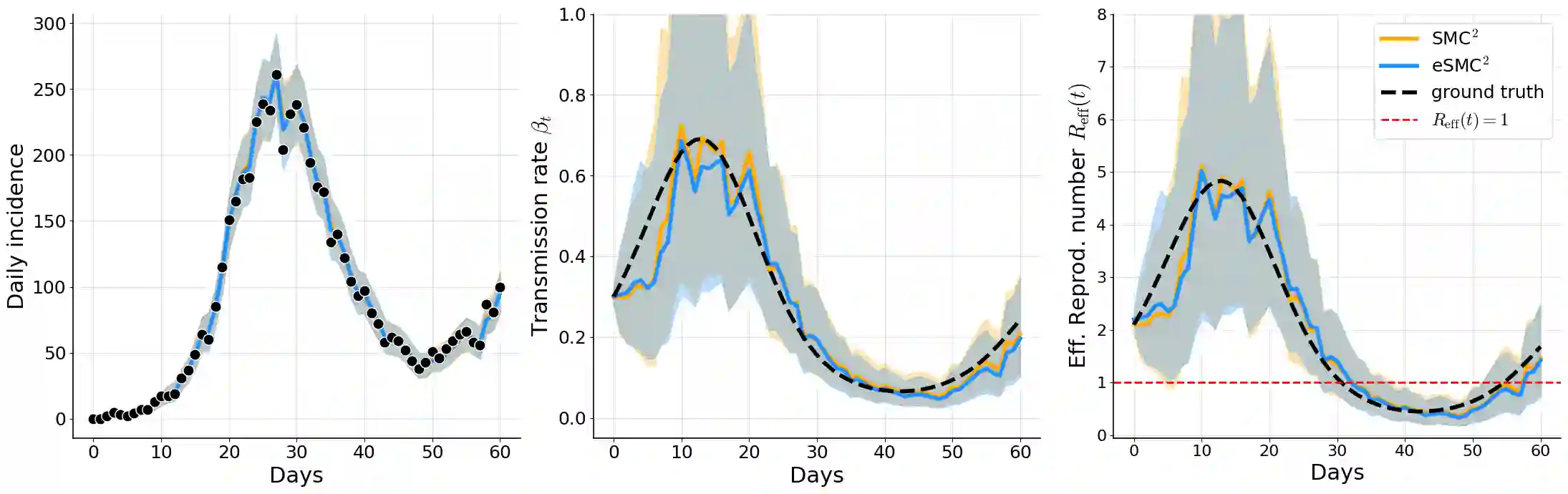
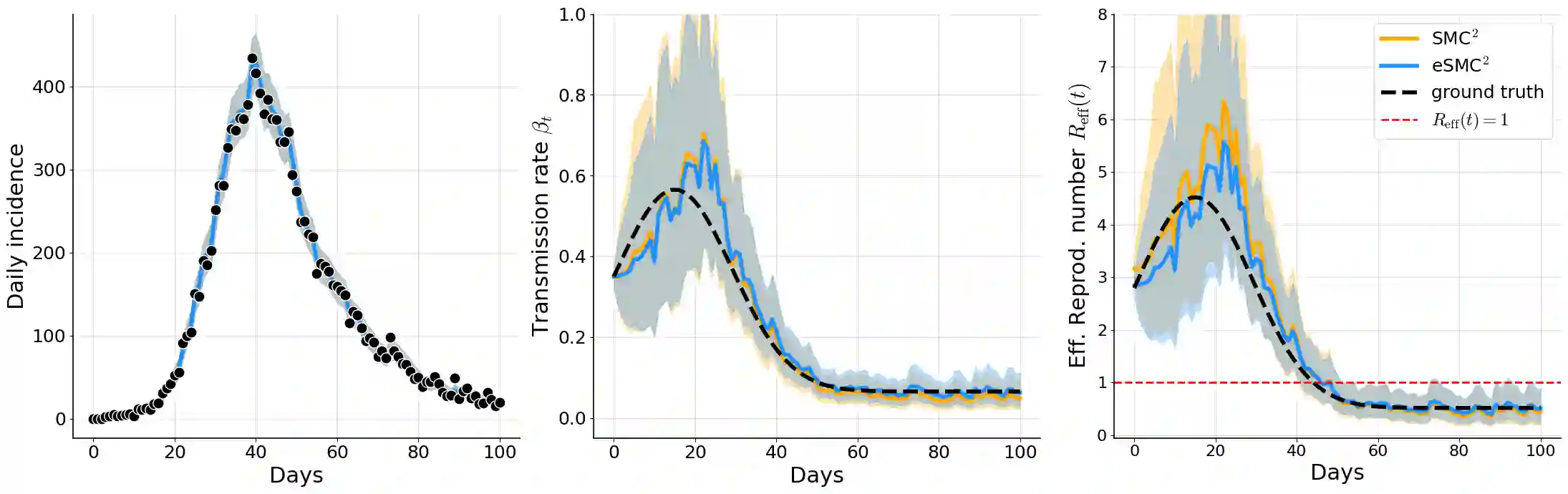
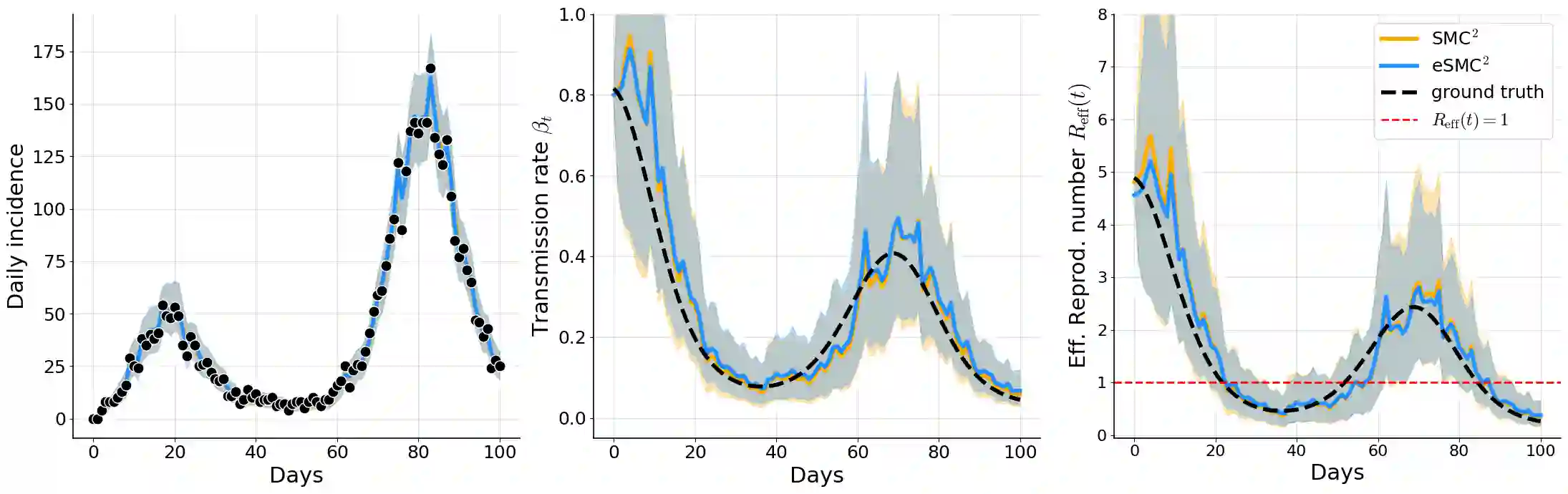
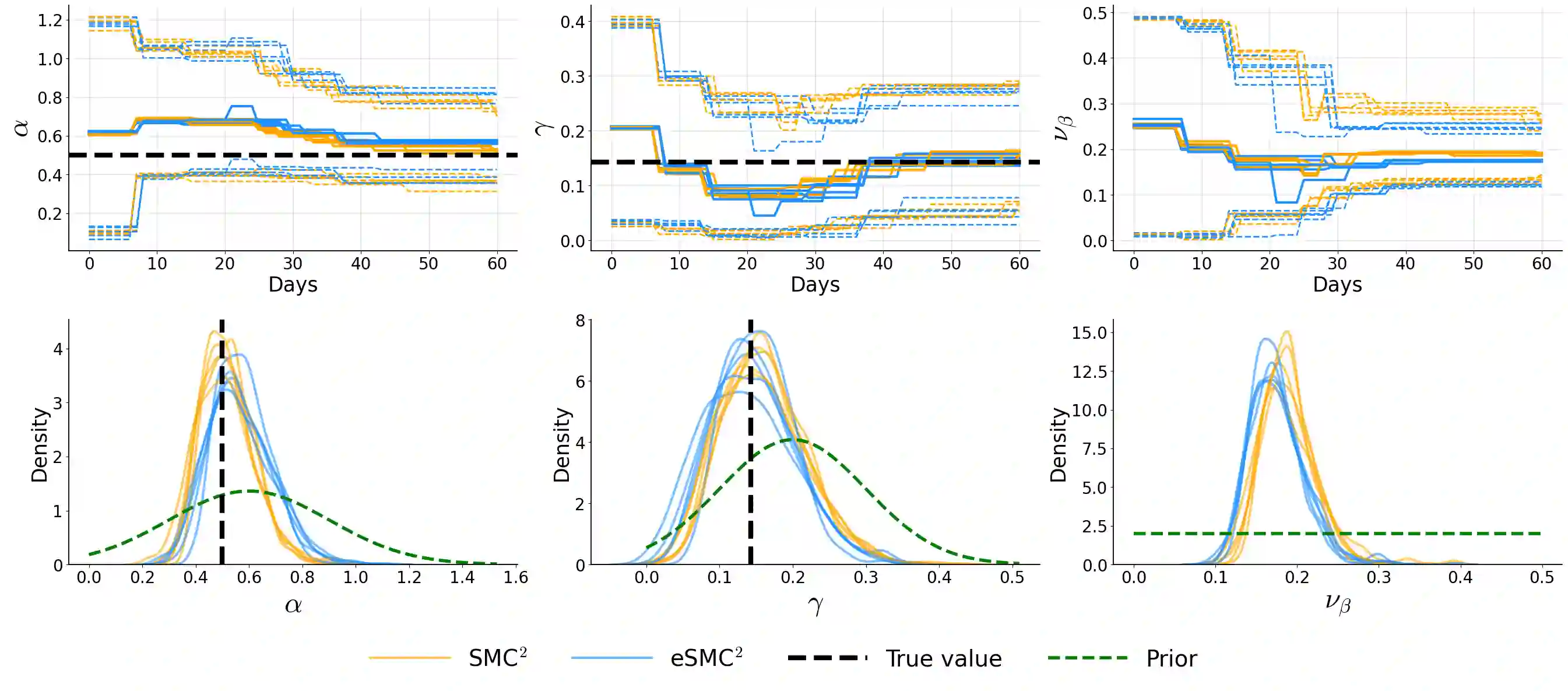
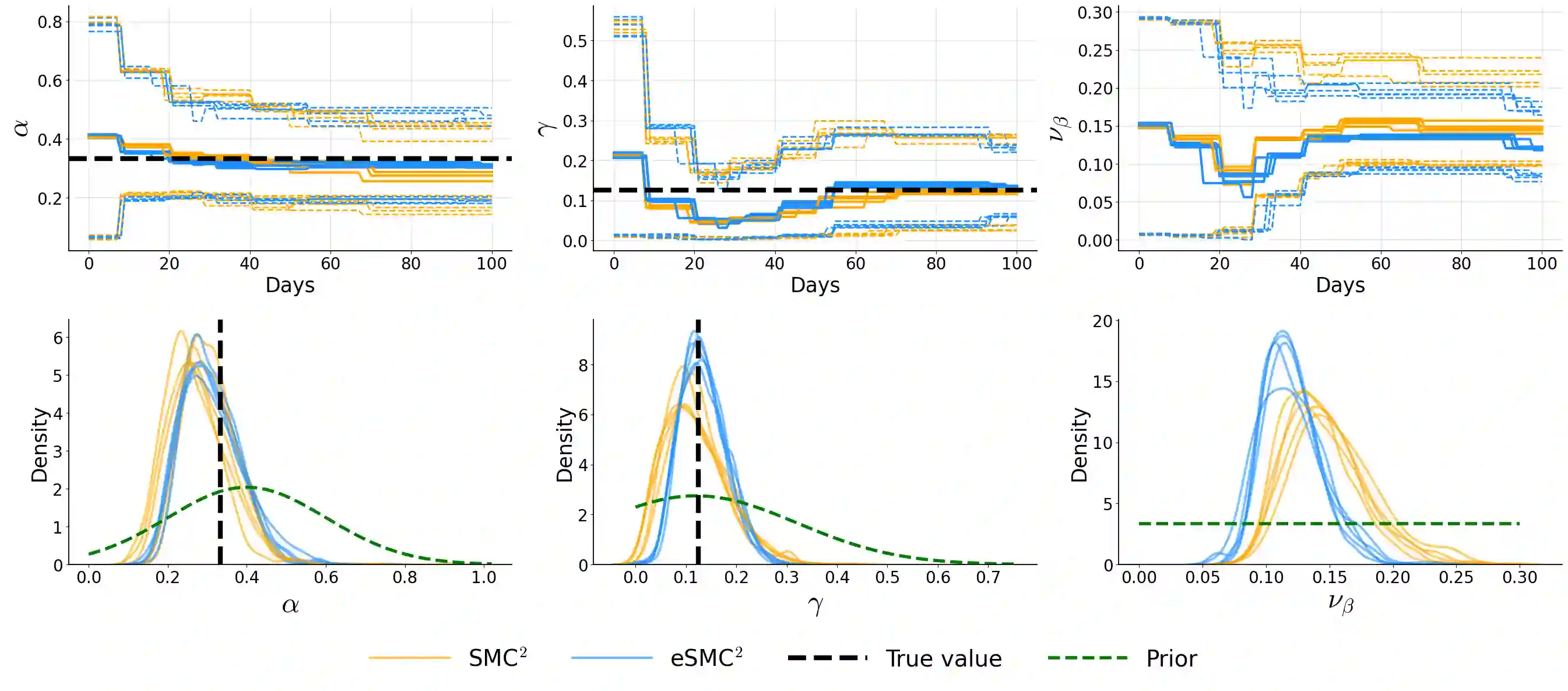
Estimating latent epidemic states and model parameters from partially observed, noisy data remains a major challenge in infectious disease modeling. State-space formulations provide a coherent probabilistic framework for such inference, yet fully Bayesian estimation is often computationally prohibitive because evaluating the observed-data likelihood requires integration over a latent trajectory. The Sequential Monte Carlo squared (SMC$^2$) algorithm offers a principled approach for joint state and parameter inference, combining an outer SMC sampler over parameters with an inner particle filter that estimates the likelihood up to the current time point. Despite its theoretical appeal, this nested particle filter imposes substantial computational cost, limiting routine use in near-real-time outbreak response. We propose Ensemble SMC$^2$ (eSMC$^2$), a computationally efficient variant that replaces the inner particle filter with an Ensemble Kalman Filter (EnKF) to approximate the incremental likelihood at each observation time. While this substitution introduces bias via a Gaussian approximation, we mitigate finite-sample effects using an unbiased Gaussian density estimator and adapt the EnKF for epidemic data through state-dependent observation variance. This makes our approach particularly suitable for overdispersed incidence data commonly encountered in infectious disease surveillance. Simulation experiments with known ground truth and an application to 2022 United States (U.S.) monkeypox incidence data demonstrate that eSMC$^2$ achieves substantial computational gains while producing posterior estimates comparable to SMC$^2$. The method accurately recovers latent epidemic trajectories and key epidemiological parameters, providing an efficient framework for sequential Bayesian inference from imperfect surveillance data.
翻译:从部分观测且含噪声的数据中估计潜在的流行状态和模型参数,仍然是传染病建模中的一个主要挑战。状态空间公式为此类推断提供了一个连贯的概率框架,然而完全贝叶斯估计在计算上往往难以实现,因为评估观测数据似然需要对潜在轨迹进行积分。序贯蒙特卡洛平方(SMC$^2$)算法为联合状态与参数推断提供了一种原理性方法,它将一个在参数空间上的外部SMC采样器与一个内部粒子滤波器相结合,后者估计截至当前时间点的似然。尽管其理论上有吸引力,但这种嵌套粒子滤波器带来了巨大的计算成本,限制了其在近实时疫情响应中的常规应用。我们提出了集合SMC$^2$(eSMC$^2$),这是一种计算高效的变体,它用集合卡尔曼滤波器(EnKF)替代了内部的粒子滤波器,以近似每个观测时间点的增量似然。虽然这种替代通过高斯近似引入了偏差,但我们使用无偏高斯密度估计器来减轻有限样本效应,并通过状态依赖的观测方差调整EnKF以适应流行病数据。这使得我们的方法特别适用于传染病监测中常见的过度离散的发病率数据。在已知真实情况的模拟实验以及对2022年美国猴痘发病率数据的应用中,eSMC$^2$在产生与SMC$^2$相当的后验估计的同时,实现了显著的计算增益。该方法能准确恢复潜在的流行轨迹和关键的流行病学参数,为从不完善的监测数据中进行序贯贝叶斯推断提供了一个高效的框架。




相关内容




 微信扫码咨询专知VIP会员