

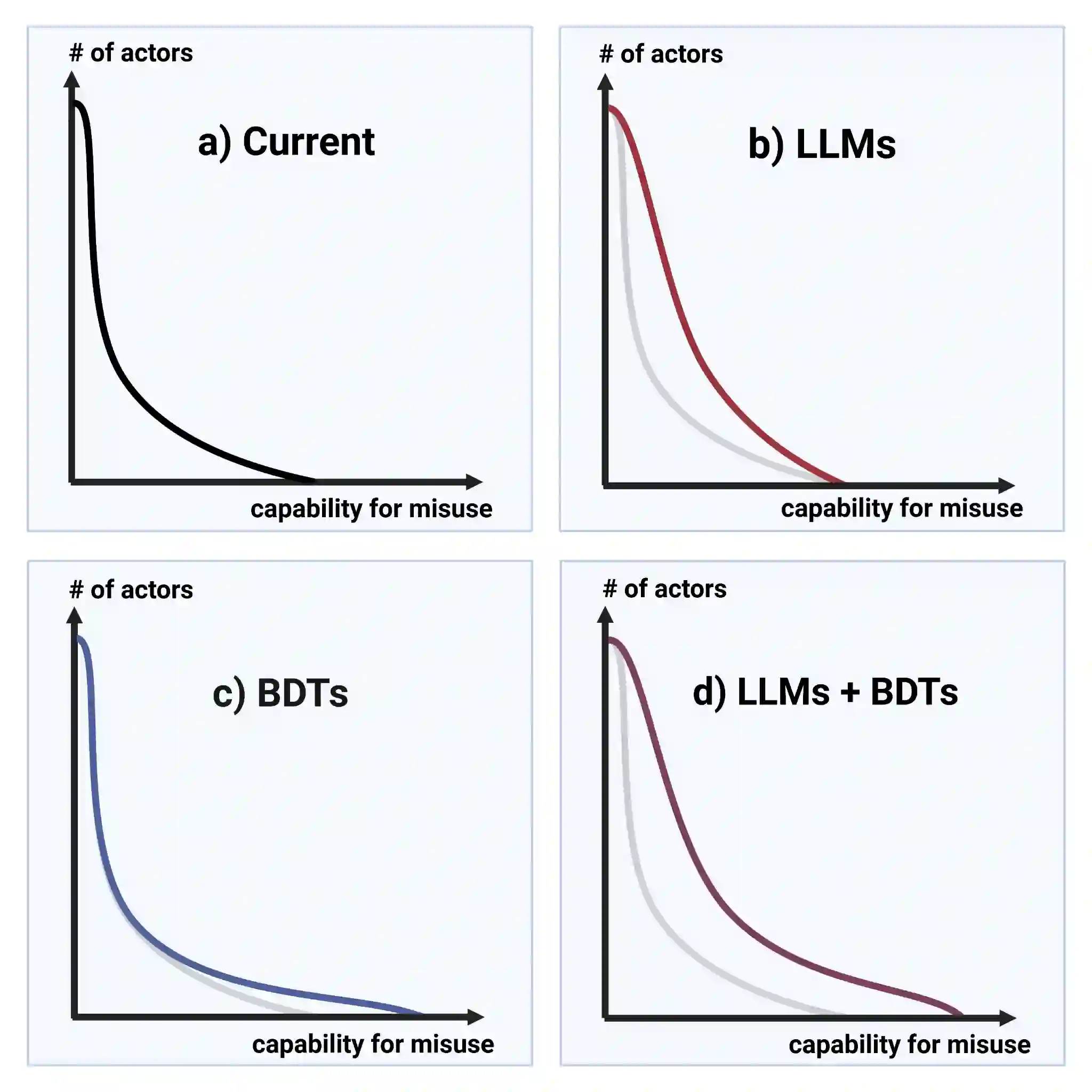
As advancements in artificial intelligence (AI) propel progress in the life sciences, they may also enable the weaponisation and misuse of biological agents. This article differentiates two classes of AI tools that pose such biosecurity risks: large language models (LLMs) and biological design tools (BDTs). LLMs, such as GPT-4, are already able to provide dual-use information that removes some barriers encountered by historical biological weapons efforts. As LLMs are turned into lab assistants and autonomous science tools, this will further increase their ability to support research. Thus, LLMs will in particular lower barriers to biological misuse. In contrast, BDTs will expand the capabilities of sophisticated actors. Concretely, BDTs may enable the creation of pandemic pathogens substantially worse than anything seen to date and could enable forms of more predictable and targeted biological weapons. In combination, LLMs and BDTs could raise the ceiling of harm from biological agents and could make them broadly accessible. A range of interventions would help to manage risks. Independent pre-release evaluations could ensure that developers have eliminated dangerous capabilities of new models. Risks from powerful science tools might be mitigated through providing differentiated access to legitimate researchers. Lastly, essential for mitigating risks will be universal and enhanced screening of gene synthesis products.
翻译:随着人工智能(AI)的进步推动生命科学的发展,它也可能助长生物制剂的武器化和误用。本文区分了两类带来此类生物安全风险的AI工具:大型语言模型(LLMs)与生物设计工具(BDTs)。LLMs(如GPT-4)已能提供双重用途信息,从而消除了历史上生物武器研制过程中遇到的某些障碍。随着LLMs成为实验室助手和自主科学工具,其支持研究的能力将进一步增强。因此,LLMs将特别降低生物误用的门槛。相比之下,BDTs则会扩大高水平行为体的能力范围。具体而言,BDTs可能创造出比历史上任何病原体都更具破坏性的大流行病毒,并可能催生更可预测、更具针对性的生物武器形式。LLMs与BDTs的结合可能提升生物制剂危害的上限,并使其更易被广泛获取。一系列干预措施将有助于管理此类风险:独立的发布前评估可确保开发者消除新模型的危险能力;通过为合法研究人员提供分级访问权限,可缓解强大科学工具带来的风险;最后,对基因合成产品实施普遍且强化的筛查对于降低风险至关重要。




相关内容




 微信扫码咨询专知VIP会员