

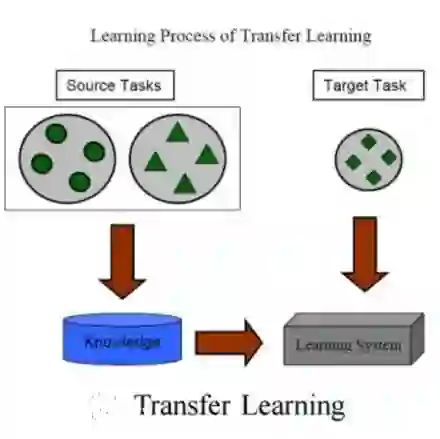
Transfer learning is fundamental for addressing problems in settings with little training data. While several transfer learning approaches have been proposed in 3D, unfortunately, these solutions typically operate on an entire 3D object or even scene-level and thus, as we show, fail to generalize to new classes, such as deformable organic shapes. In addition, there is currently a lack of understanding of what makes pre-trained features transferable across significantly different 3D shape categories. In this paper, we make a step toward addressing these challenges. First, we analyze the link between feature locality and transferability in tasks involving deformable 3D objects, while also comparing different backbones and losses for local feature pre-training. We observe that with proper training, learned features can be useful in such tasks, but, crucially, only with an appropriate choice of the receptive field size. We then propose a differentiable method for optimizing the receptive field within 3D transfer learning. Jointly, this leads to the first learnable features that can successfully generalize to unseen classes of 3D shapes such as humans and animals. Our extensive experiments show that this approach leads to state-of-the-art results on several downstream tasks such as segmentation, shape correspondence, and classification. Our code is available at \url{https://github.com/pvnieo/vader}.
翻译:迁移学习是解决小样本训练数据问题的核心方法。尽管在三维领域已提出多种迁移学习方案,但这些方法通常作用于整个三维物体甚至场景级别,因此,如我们所示,它们无法泛化到新类别,例如可变形有机形状。此外,当前尚缺乏对预训练特征在显著不同的三维形状类别间可迁移性的成因理解。本文朝着解决这些挑战迈出了一步。首先,我们分析了涉及可变形三维物体的任务中特征局部性与可迁移性之间的关联,同时比较了用于局部特征预训练的不同主干网络和损失函数。我们观察到,通过适当的训练,学习到的特征可在此类任务中发挥作用,但关键在于必须选择合适的感受野大小。随后,我们提出了一种可微方法,用于在三维迁移学习中优化感受野。综合而言,这诞生了首个能够成功泛化到未见三维形状类别(如人类和动物)的可学习特征。我们的广泛实验表明,该方法在分割、形状对应和分类等多个下游任务中取得了最先进的结果。我们的代码已开源至 \url{https://github.com/pvnieo/vader}。




相关内容


 微信扫码咨询专知VIP会员