

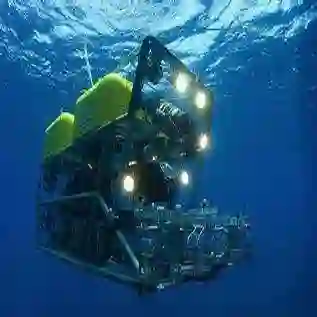
The current approach to exploring and monitoring complex underwater ecosystems, such as coral reefs, is to conduct surveys using diver-held or static cameras, or deploying sensor buoys. These approaches often fail to capture the full variation and complexity of interactions between different reef organisms and their habitat. The CUREE platform presented in this paper provides a unique set of capabilities in the form of robot behaviors and perception algorithms to enable scientists to explore different aspects of an ecosystem. Examples of these capabilities include low-altitude visual surveys, soundscape surveys, habitat characterization, and animal following. We demonstrate these capabilities by describing two field deployments on coral reefs in the US Virgin Islands. In the first deployment, we show that CUREE can identify the preferred habitat type of snapping shrimp in a reef through a combination of a visual survey, habitat characterization, and a soundscape survey. In the second deployment, we demonstrate CUREE's ability to follow arbitrary animals by separately following a barracuda and stingray for several minutes each in midwater and benthic environments, respectively.
翻译:当前探索与监测复杂水下生态系统(如珊瑚礁)的主流方法包括使用潜水员手持或静态摄像机进行调查,以及部署传感器浮标。这些方法往往难以捕捉不同珊瑚礁生物与其栖息地之间相互作用的全方位变化及其复杂性。本文提出的CUREE平台提供了一系列独特能力,通过机器人行为与感知算法,使科学家能够探索生态系统的不同维度。这些能力包括低空视觉调查、声景调查、栖息地特征描述以及动物跟踪。我们通过在美国维尔京群岛珊瑚礁上开展的两次实地部署来展示这些能力。第一次部署表明,CUREE能够通过结合视觉调查、栖息地特征描述和声景调查,识别礁区中鼓虾偏好的栖息地类型。第二次部署中,我们分别在中层水域和底栖环境下对梭鱼和黄貂鱼进行数分钟的跟踪实验,验证了CUREE对任意动物的跟踪能力。




相关内容



 微信扫码咨询专知VIP会员