

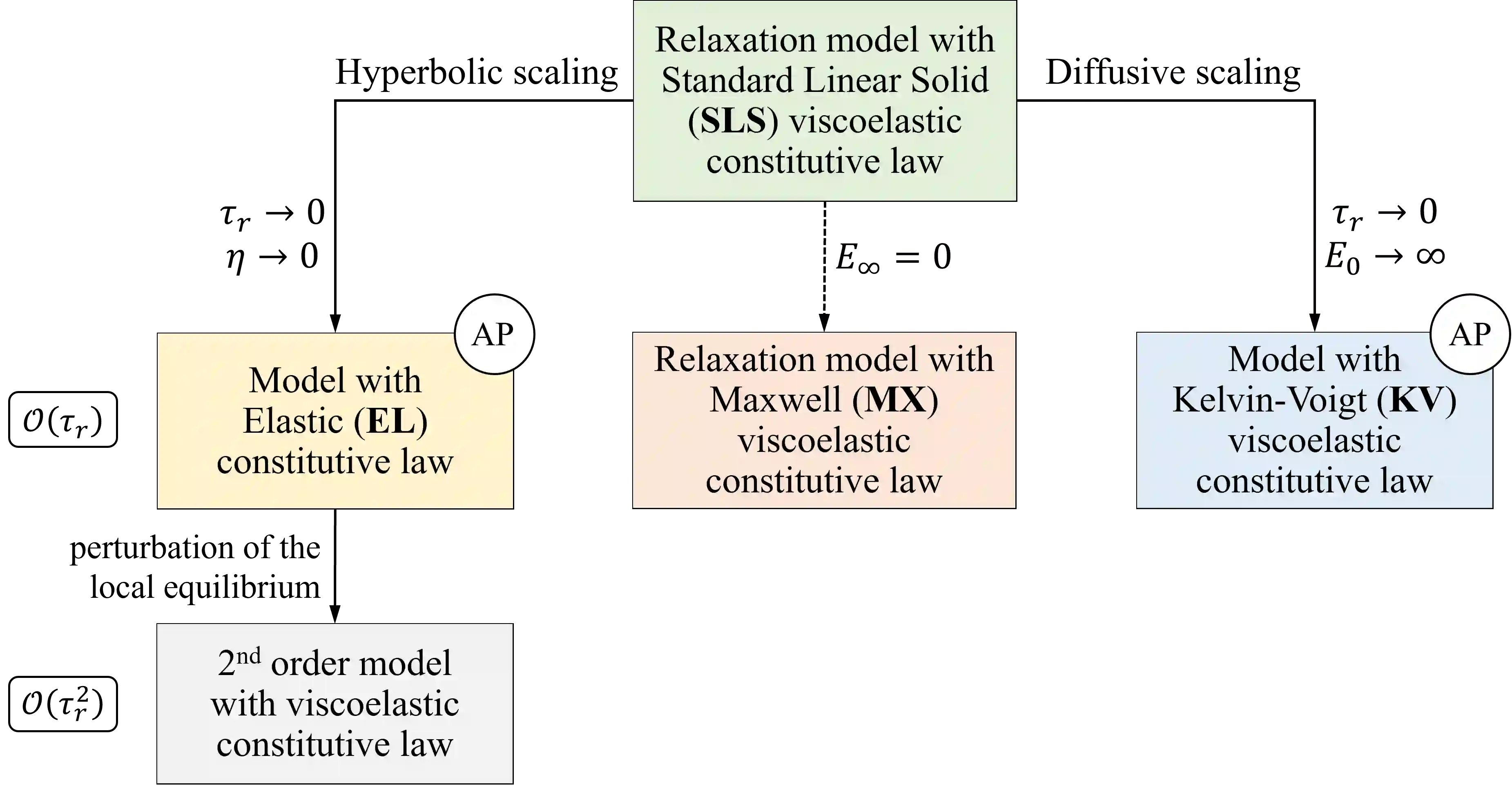
In this paper, a multiscale constitutive framework for one-dimensional blood flow modeling is presented and discussed. By analyzing the asymptotic limits of the proposed model, it is shown that different types of blood propagation phenomena in arteries and veins can be described through an appropriate choice of scaling parameters, which are related to distinct characterizations of the fluid-structure interaction mechanism (whether elastic or viscoelastic) that exist between vessel walls and blood flow. In these asymptotic limits, well-known blood flow models from the literature are recovered. Additionally, by analyzing the perturbation of the local elastic equilibrium of the system, a new viscoelastic blood flow model is derived. The proposed approach is highly flexible and suitable for studying the human cardiovascular system, which is composed of vessels with high morphological and mechanical variability. The resulting multiscale hyperbolic model of blood flow is solved using an asymptotic-preserving Implicit-Explicit Runge-Kutta Finite Volume method, which ensures the consistency of the numerical scheme with the different asymptotic limits of the mathematical model without affecting the choice of the time step by restrictions related to the smallness of the scaling parameters. Several numerical tests confirm the validity of the proposed methodology, including a case study investigating the hemodynamics of a thoracic aorta in the presence of a stent.
翻译:本文提出并讨论了一种用于一维血流建模的多尺度本构框架。通过分析所提模型的渐近极限,表明可通过适当选择与血管壁和血流之间流固耦合机制(弹性或粘弹性)的不同表征相关的尺度参数,来描述动脉和静脉中不同类型的血流传播现象。在这些渐近极限下,可重现文献中广为人知的血流模型。此外,通过分析系统局部弹性平衡的扰动,推导出一种新的粘弹性血流模型。所提方法具有高度灵活性,适用于研究由形态学和力学特性高度多样的血管组成的人体心血管系统。采用保持渐近性的隐式-显式龙格-库塔有限体积法求解所得到的多尺度双曲型血流模型,该方法能确保数值格式与数学模型的不同渐近极限保持一致性,且时间步长的选取不受尺度参数小量相关的限制。多项数值测试验证了所提方法的有效性,其中包括一项研究胸主动脉在支架存在下血液动力学特征的实例分析。






相关内容




 微信扫码咨询专知VIP会员