

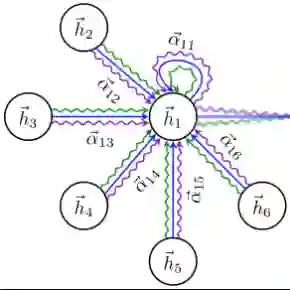
Gene regulatory relationships can be abstracted as a gene regulatory network (GRN), which plays a key role in characterizing complex cellular processes and pathways. Recently, graph neural networks (GNNs), as a class of deep learning models, have emerged as a useful tool to infer gene regulatory relationships from gene expression data. However, deep learning models have been found to be vulnerable to noise, which greatly hinders the adoption of deep learning in constructing GRNs, because high noise is often unavoidable in the process of gene expression measurement. Can we preferably prototype a robust GNN for constructing GRNs? In this paper, we give a positive answer by proposing a Quadratic Graph Attention Network (Q-GAT) with a dual attention mechanism. We study the changes in the predictive accuracy of Q-GAT and 9 state-of-the-art baselines by introducing different levels of adversarial perturbations. Experiments in the E. coli and S. cerevisiae datasets suggest that Q-GAT outperforms the state-of-the-art models in robustness. Lastly, we dissect why Q-GAT is robust through the signal-to-noise ratio (SNR) and interpretability analyses. The former informs that nonlinear aggregation of quadratic neurons can amplify useful signals and suppress unwanted noise, thereby facilitating robustness, while the latter reveals that Q-GAT can leverage more features in prediction thanks to the dual attention mechanism, which endows Q-GAT with the ability to confront adversarial perturbation. We have shared our code in https://github.com/Minorway/Q-GAT_for_Robust_Construction_of_GRN for readers' evaluation.
翻译:基因调控关系可抽象为基因调控网络(gene regulatory network, GRN),其在表征复杂细胞过程与通路中发挥关键作用。近年来,图神经网络(graph neural networks, GNNs)作为一类深度学习模型,已成为从基因表达数据推断基因调控关系的有力工具。然而,深度学习模型被发现易受噪声干扰,这极大阻碍了其在构建GRN中的应用,因为基因表达测量过程中高噪声往往难以避免。我们能否优先设计出鲁棒的GNN用于构建GRN?本文通过提出具有双重注意力机制的二次图注意力网络(Quadratic Graph Attention Network, Q-GAT)给出了肯定答案。我们通过引入不同水平的对抗扰动,研究了Q-GAT与9种最先进基线模型的预测精度变化。在大肠杆菌(E. coli)和酿酒酵母(S. cerevisiae)数据集上的实验表明,Q-GAT在鲁棒性上优于现有最先进模型。最后,我们通过信噪比(signal-to-noise ratio, SNR)和可解释性分析剖析了Q-GAT鲁棒的原因:前者表明二次神经元的非线性聚合可放大有效信号并抑制无关噪声,从而促进鲁棒性;后者揭示Q-GAT因双重注意力机制能在预测中利用更多特征,这赋予了Q-GAT对抗扰动的能力。相关代码已共享至https://github.com/Minorway/Q-GAT_for_Robust_Construction_of_GRN供读者评估。




相关内容


 微信扫码咨询专知VIP会员