

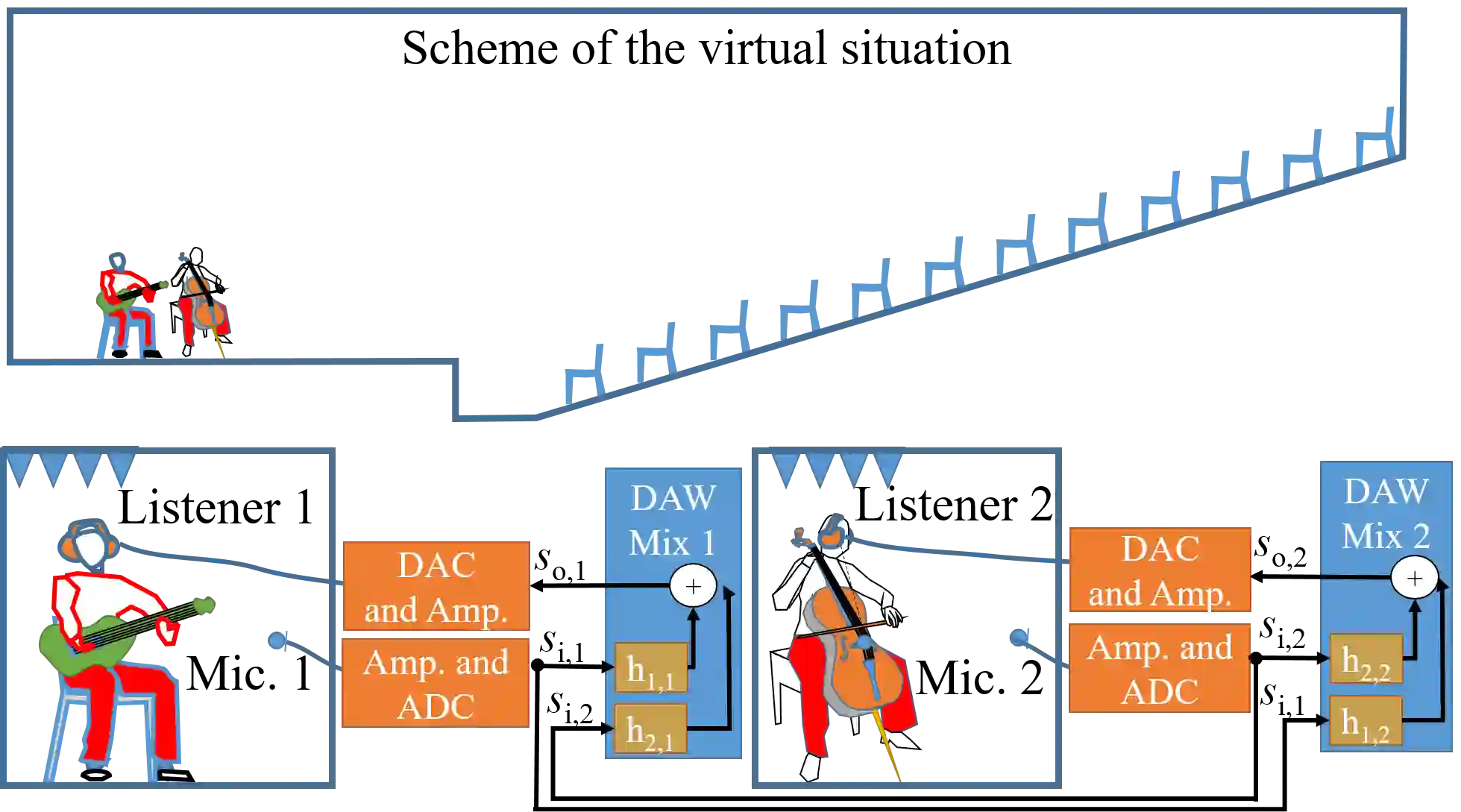
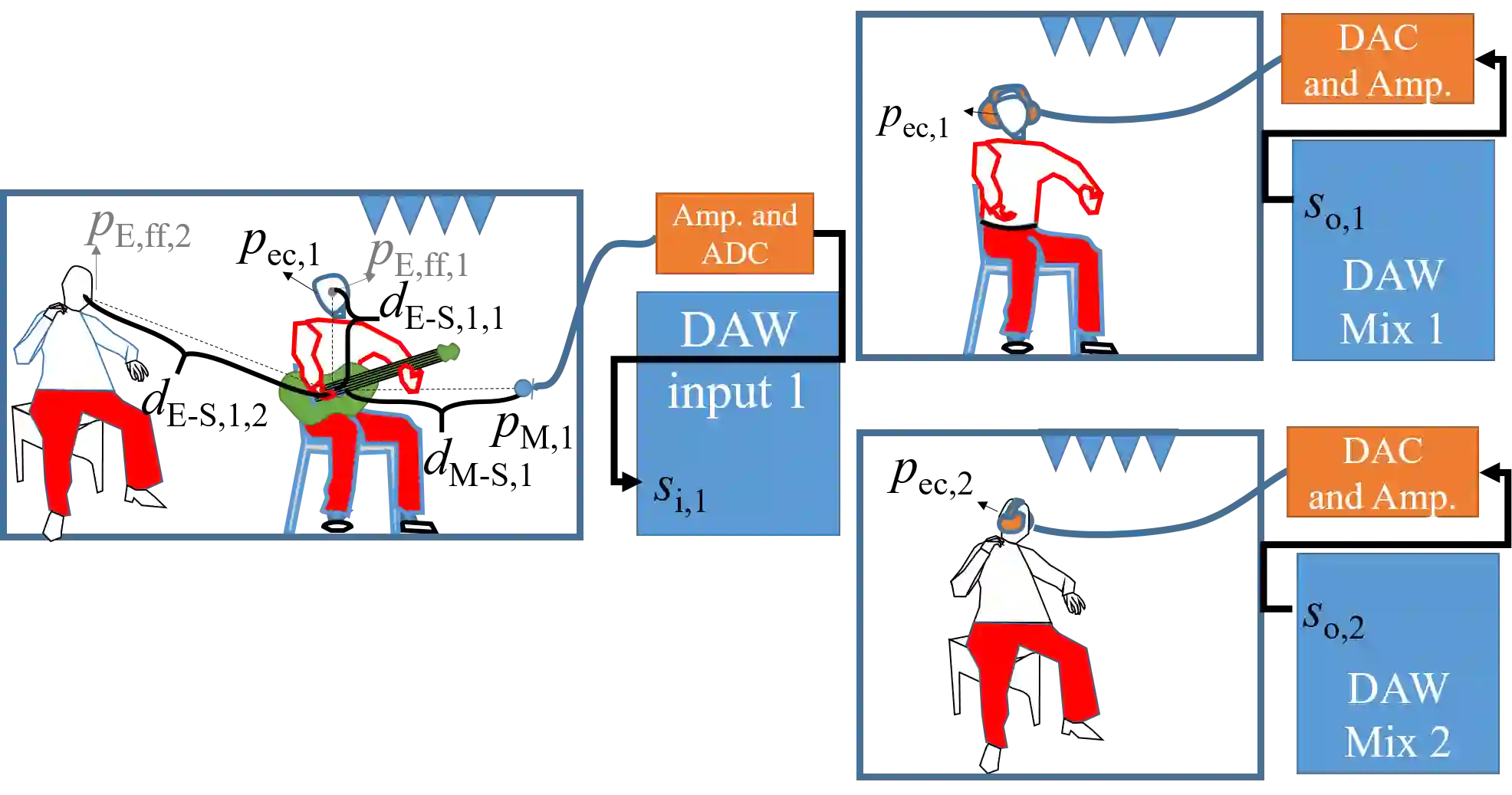
This article presents an interactive system for stage acoustics experimentation including considerations for hearing one's own and others' instruments. The quality of real-time auralization systems for psychophysical experiments on music performance depends on the system's calibration and latency, among other factors (e.g. visuals, simulation methods, haptics, etc). The presented system focuses on the acoustic considerations for laboratory implementations. The calibration is implemented as a set of filters accounting for the microphone-instrument distances and the directivity factors, as well as the transducers' frequency responses. Moreover, sources of errors are characterized using both state-of-the-art information and derivations from the mathematical definition of the calibration filter. In order to compensate for hardware latency without cropping parts of the simulated impulse responses, the virtual direct sound of musicians hearing themselves is skipped from the simulation and addressed by letting the actual direct sound reach the listener through open headphones. The required latency compensation of the interactive part (i.e. hearing others) meets the minimum distance requirement between musicians, which is 2 m for the implemented system. Finally, a proof of concept is provided that includes objective and subjective experiments, which give support to the feasibility of the proposed setup.
翻译:本文介绍了一个用于舞台声学实验的交互系统,其中特别考虑了演奏者自身及他人乐器声音的听觉感知。用于音乐表演心理物理实验的实时可听化系统质量取决于系统校准和延迟等多种因素(如视觉呈现、仿真方法、触觉反馈等)。本系统着重于实验室实现中的声学考量。校准环节采用一组滤波器实现,该滤波器考虑了麦克风-乐器间距、指向性因子以及换能器的频率响应。此外,误差源的分析结合了前沿文献信息与校准滤波器数学定义的推导结果。为避免截断仿真脉冲响应,系统在硬件延迟补偿中跳过了演奏者感知自身虚拟直达声的环节,转而通过开放式耳机让实际直达声直接传递给听者。交互部分(即感知他人演奏)所需的延迟补偿需满足演奏者间的最小距离要求,本实现系统的间距阈值设为2米。最后,通过客观与主观实验验证概念可行性,证明了所提方案的可靠性。






相关内容




 微信扫码咨询专知VIP会员