

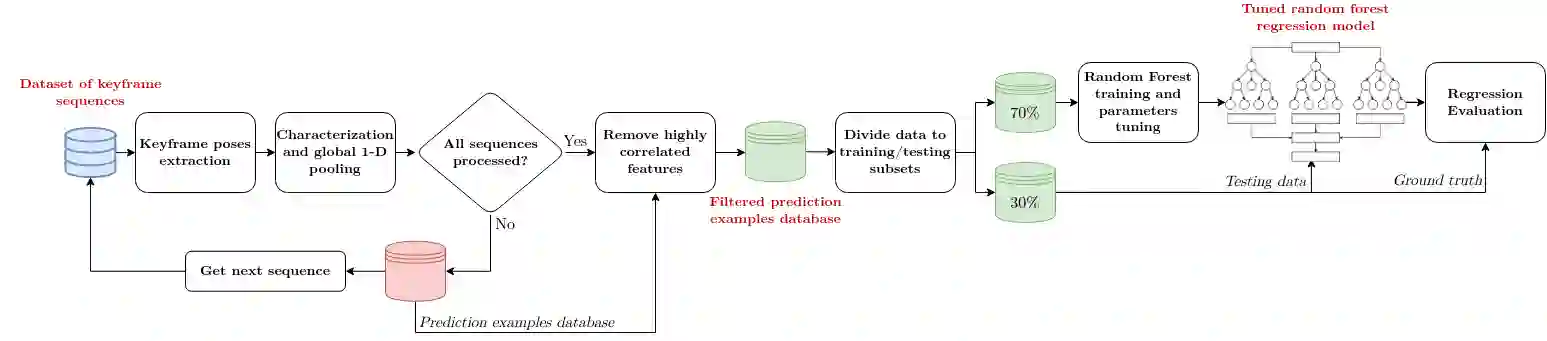
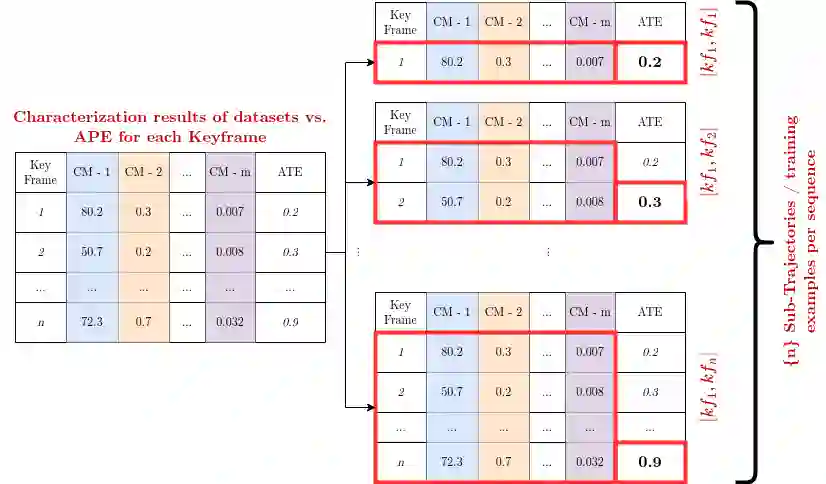
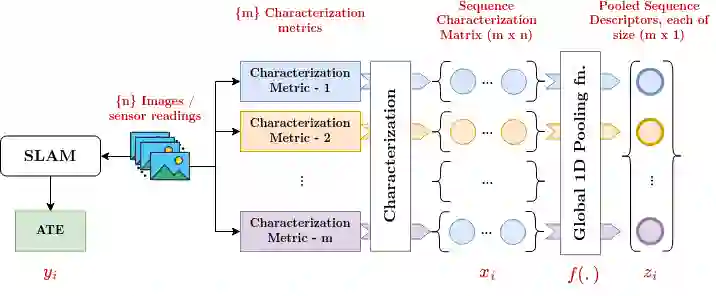
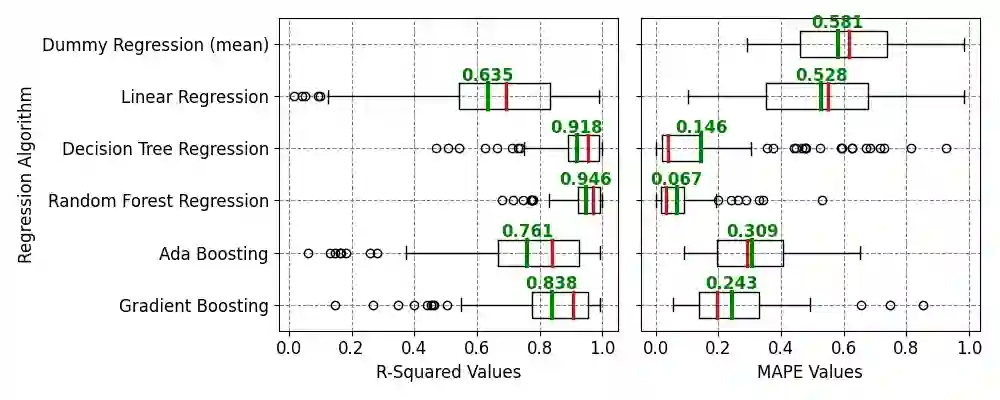
Robustness and resilience of simultaneous localization and mapping (SLAM) are critical requirements for modern autonomous robotic systems. One of the essential steps to achieve robustness and resilience is the ability of SLAM to have an integrity measure for its localization estimates, and thus, have internal fault tolerance mechanisms to deal with performance degradation. In this work, we introduce a novel method for predicting SLAM localization error based on the characterization of raw sensor inputs. The proposed method relies on using a random forest regression model trained on 1-D global pooled features that are generated from characterized raw sensor data. The model is validated by using it to predict the performance of ORB-SLAM3 on three different datasets running on four different operating modes, resulting in an average prediction accuracy of up to 94.7\%. The paper also studies the impact of 12 different 1-D global pooling functions on regression quality, and the superiority of 1-D global averaging is quantitatively proven. Finally, the paper studies the quality of prediction with limited training data, and proves that we are able to maintain proper prediction quality when only 20 \% of the training examples are used for training, which highlights how the proposed model can optimize the evaluation footprint of SLAM systems.
翻译:同时定位与地图构建(SLAM)的鲁棒性与弹性是现代自主机器人系统的关键需求。实现鲁棒性与弹性的核心要素之一,是SLAM具备对其定位估计的完整性度量能力,从而通过内部容错机制应对性能退化问题。本文提出一种基于原始传感器输入特征预测SLAM定位误差的新方法。该方法利用随机森林回归模型,该模型基于从特征化原始传感器数据生成的一维全局池化特征进行训练。通过使用该模型预测ORB-SLAM3在三种不同数据集、四种不同运行模式下的性能进行验证,平均预测精度高达94.7%。本文还研究了12种不同一维全局池化函数对回归质量的影响,并定量证明了一维全局平均池化的优越性。最后,本文探讨了有限训练数据下的预测质量,证明仅使用20%训练样本时仍能保持合理的预测精度,突显了所提模型在优化SLAM系统评估开销方面的潜力。




相关内容



 微信扫码咨询专知VIP会员