

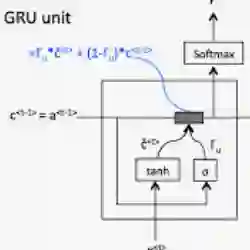
In this study, it is demonstrated that Recurrent Neural Networks (RNNs), specifically those utilizing Gated Recurrent Unit (GRU) architecture, possess the capability to learn the complex dynamics of rate-and-state friction laws from synthetic data. The data employed for training the network is generated through the application of traditional rate-and-state friction equations coupled with the aging law for state evolution. A novel aspect of our approach is the formulation of a loss function that explicitly accounts for the direct effect by means of automatic differentiation. It is found that the RNN, with its GRU architecture, effectively learns to predict changes in the friction coefficient resulting from velocity jumps (with and without noise in the target data), thereby showcasing the potential of machine learning models in understanding and simulating the physics of frictional processes.
翻译:本研究证明,循环神经网络(RNNs),特别是采用门控循环单元(GRU)架构的模型,能够从合成数据中学习速率-状态摩擦定律的复杂动力学。用于训练网络的数据通过应用传统的速率-状态摩擦方程并结合状态演化的老化定律生成。我们方法的一个新颖之处在于,通过自动微分显式考虑直接效应的损失函数构建。研究发现,采用GRU架构的RNN能够有效学习预测由速度跳跃(目标数据含噪声与不含噪声情况下)引起的摩擦系数变化,从而展示了机器学习模型在理解和模拟摩擦过程物理机制方面的潜力。




相关内容




 微信扫码咨询专知VIP会员