

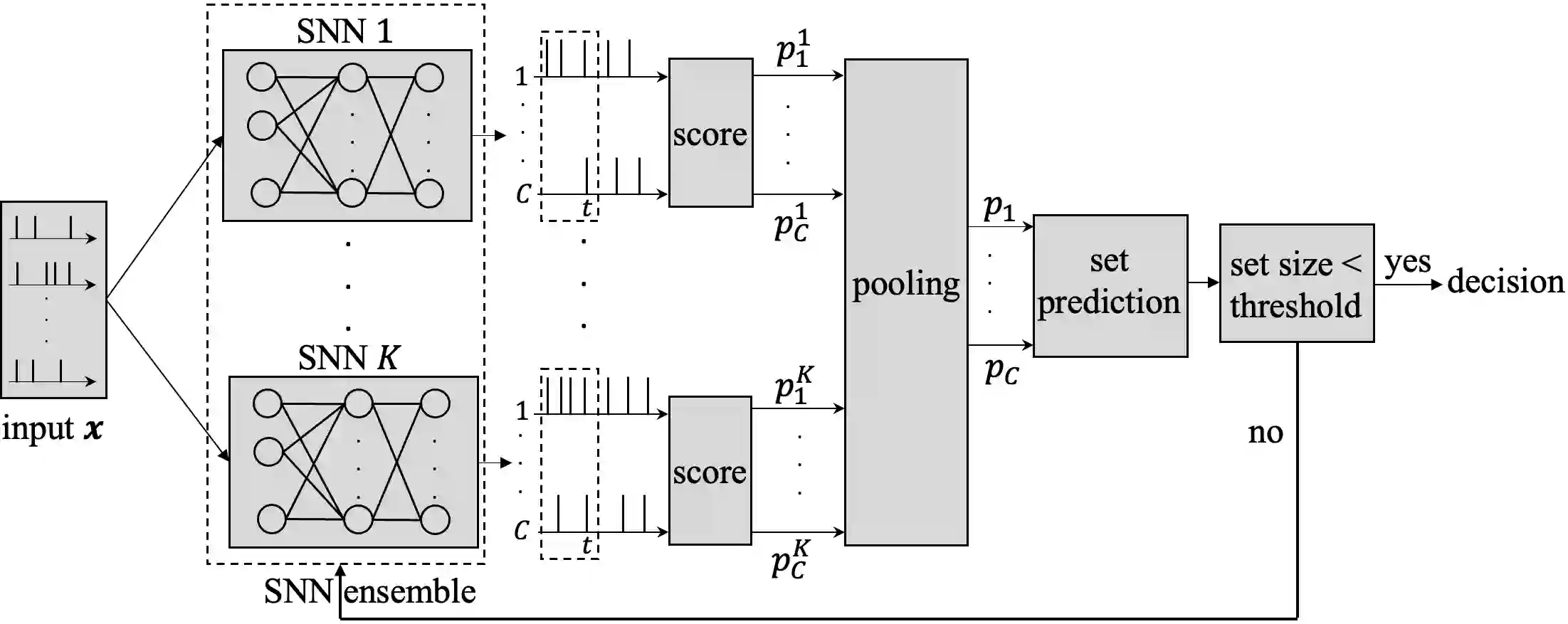
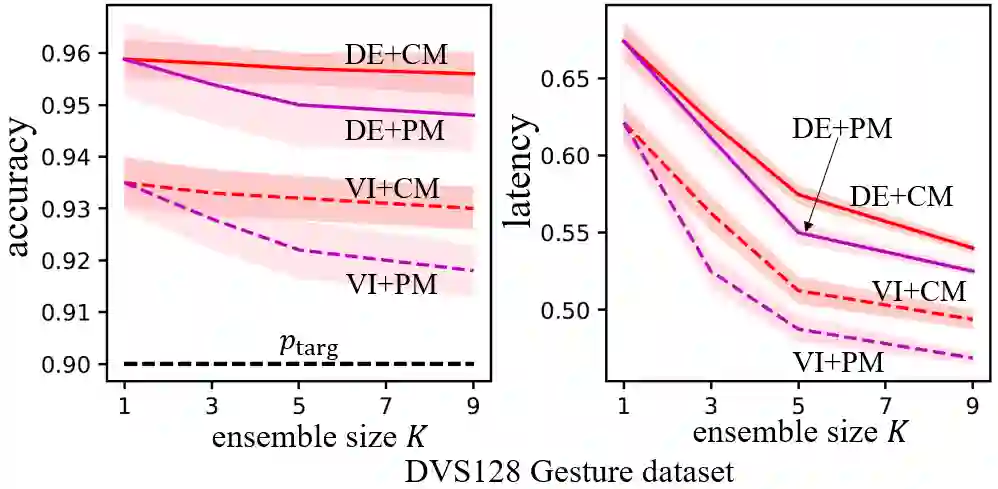
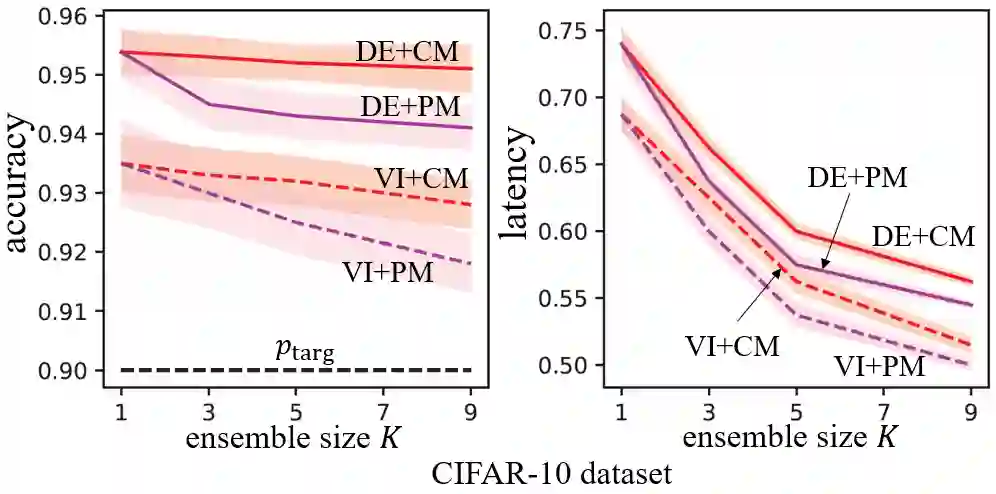
Spiking neural networks (SNNs) are recurrent models that can leverage sparsity in input time series to efficiently carry out tasks such as classification. Additional efficiency gains can be obtained if decisions are taken as early as possible as a function of the complexity of the input time series. The decision on when to stop inference and produce a decision must rely on an estimate of the current accuracy of the decision. Prior work demonstrated the use of conformal prediction (CP) as a principled way to quantify uncertainty and support adaptive-latency decisions in SNNs. In this paper, we propose to enhance the uncertainty quantification capabilities of SNNs by implementing ensemble models for the purpose of improving the reliability of stopping decisions. Intuitively, an ensemble of multiple models can decide when to stop more reliably by selecting times at which most models agree that the current accuracy level is sufficient. The proposed method relies on different forms of information pooling from ensemble models, and offers theoretical reliability guarantees. We specifically show that variational inference-based ensembles with p-variable pooling significantly reduce the average latency of state-of-the-art methods, while maintaining reliability guarantees.
翻译:脉冲神经网络(SNNs)是一类循环模型,能够利用输入时间序列的稀疏性高效执行分类等任务。若根据输入时间序列的复杂度尽早做出决策,可进一步提升效率。何时停止推理并产生决策的判断必须依赖于当前决策准确性的估计。已有研究证明了共形预测(CP)作为量化不确定性并支持SNN自适应延迟决策的理论严谨方法。本文提出通过实现集成模型增强SNN的不确定性量化能力,旨在提升停止决策的可靠性。直观而言,多模型集成可通过选择大多数模型认为当前精度水平足够的时刻,更可靠地决定停止时机。该方法依赖于集成模型中不同形式的信息池化策略,并提供理论可靠性保证。我们特别证明,采用p变量池化的变分推断集成方法在保持可靠性保证的同时,显著降低了现有方法的平均延迟。




相关内容





 微信扫码咨询专知VIP会员