

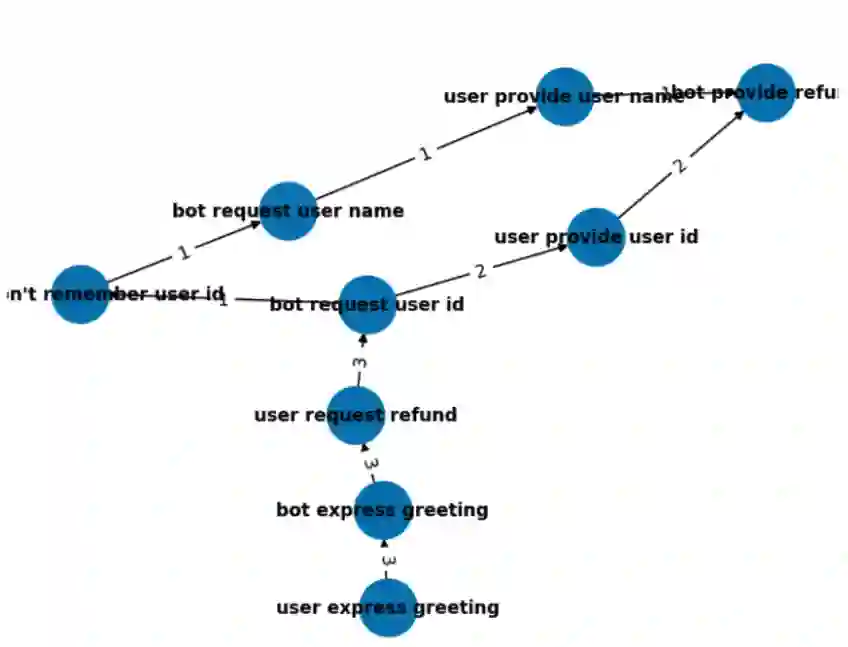
Dialogue policies play a crucial role in developing task-oriented dialogue systems, yet their development and maintenance are challenging and typically require substantial effort from experts in dialogue modeling. While in many situations, large amounts of conversational data are available for the task at hand, people lack an effective solution able to extract dialogue policies from this data. In this paper, we address this gap by first illustrating how Large Language Models (LLMs) can be instrumental in extracting dialogue policies from datasets, through the conversion of conversations into a unified intermediate representation consisting of canonical forms. We then propose a novel method for generating dialogue policies utilizing a controllable and interpretable graph-based methodology. By combining canonical forms across conversations into a flow network, we find that running graph traversal algorithms helps in extracting dialogue flows. These flows are a better representation of the underlying interactions than flows extracted by prompting LLMs. Our technique focuses on giving conversation designers greater control, offering a productivity tool to improve the process of developing dialogue policies.
翻译:对话策略在开发任务导向型对话系统中起着至关重要的作用,然而其开发与维护极具挑战性,通常需要对话建模专家投入大量精力。尽管在许多情况下,手头任务拥有大量可用的对话数据,但人们缺乏一种能够从这些数据中有效提取对话策略的解决方案。在本文中,我们首先阐述了大型语言模型如何通过将对话转换为由规范形式构成的统一中间表示,从而在从数据集中提取对话策略方面发挥关键作用,以此弥合这一差距。随后,我们提出了一种新颖的方法,利用一种可控且可解释的基于图的方法来生成对话策略。通过将不同对话中的规范形式组合成一个流网络,我们发现运行图遍历算法有助于提取对话流。与通过提示大型语言模型提取的流相比,这些流能更好地表示底层的交互。我们的技术侧重于赋予对话设计者更大的控制权,提供一种生产力工具以改进对话策略的开发流程。





相关内容




 微信扫码咨询专知VIP会员