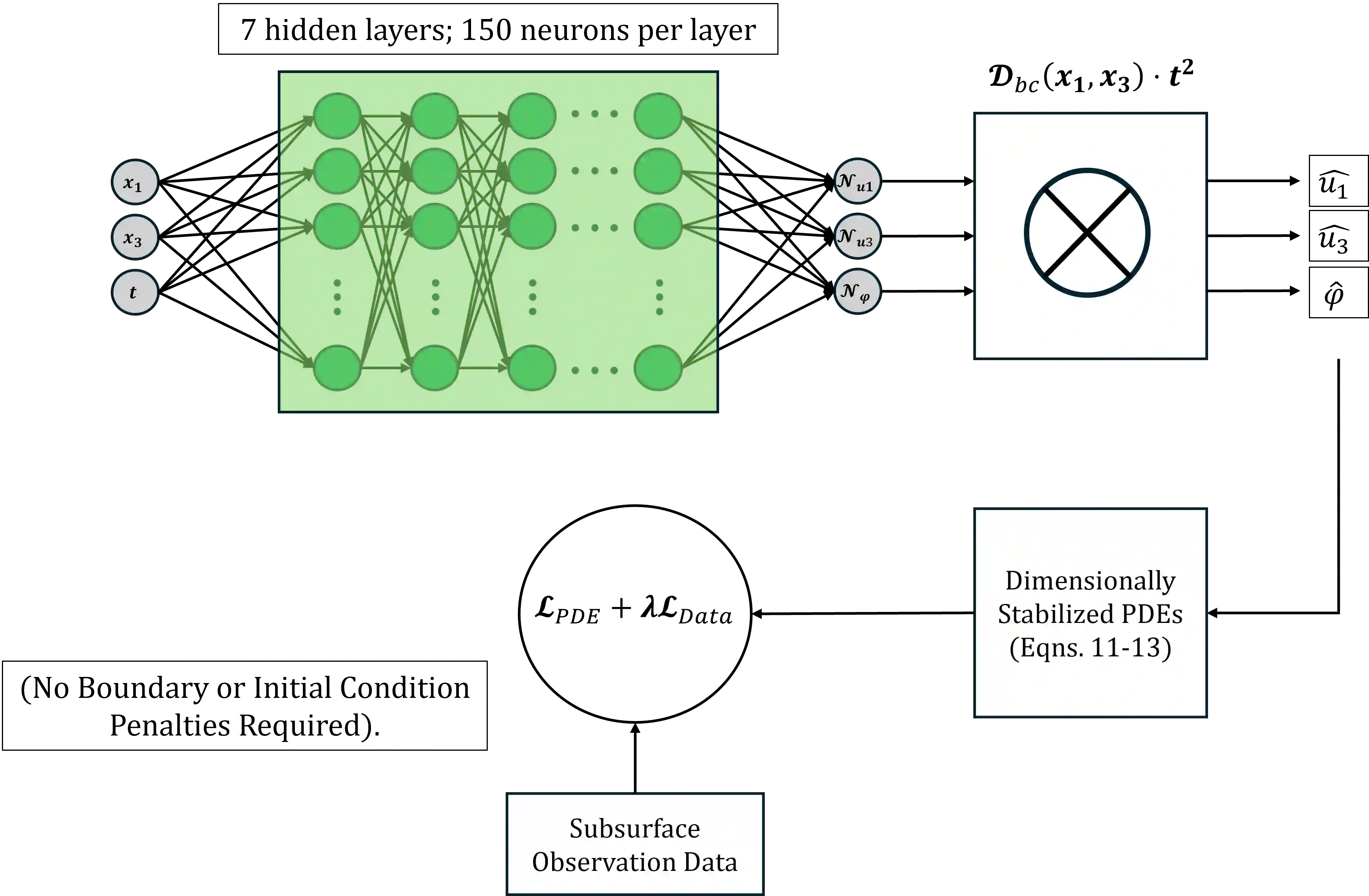
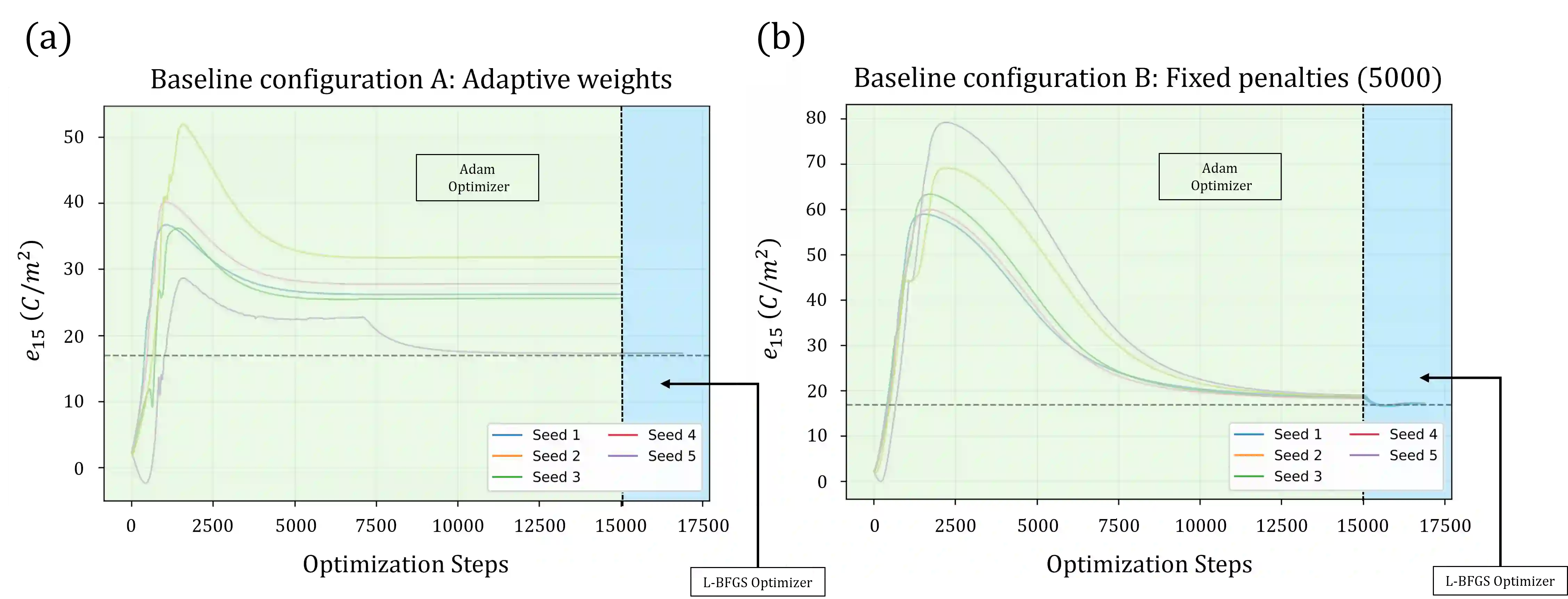
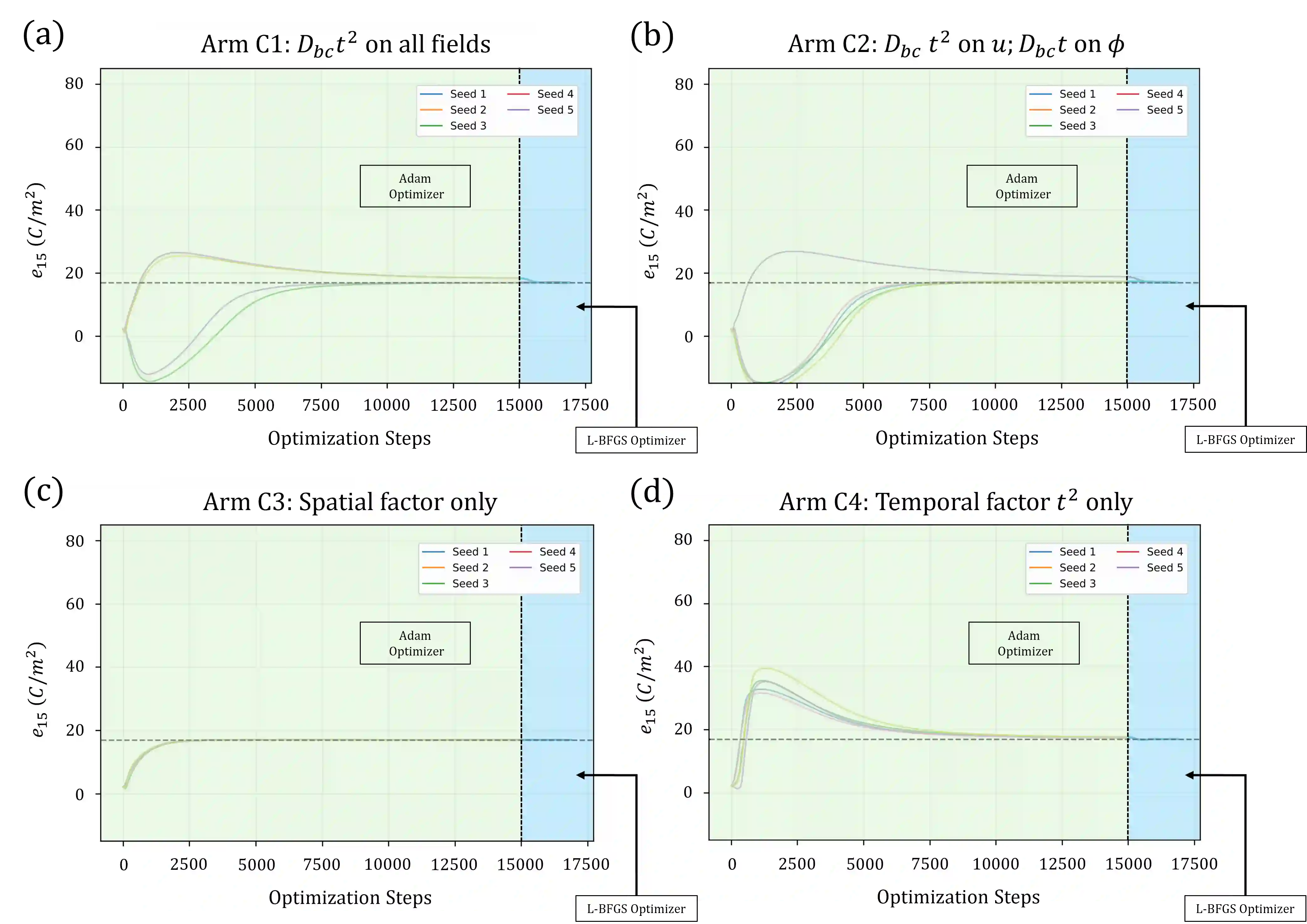
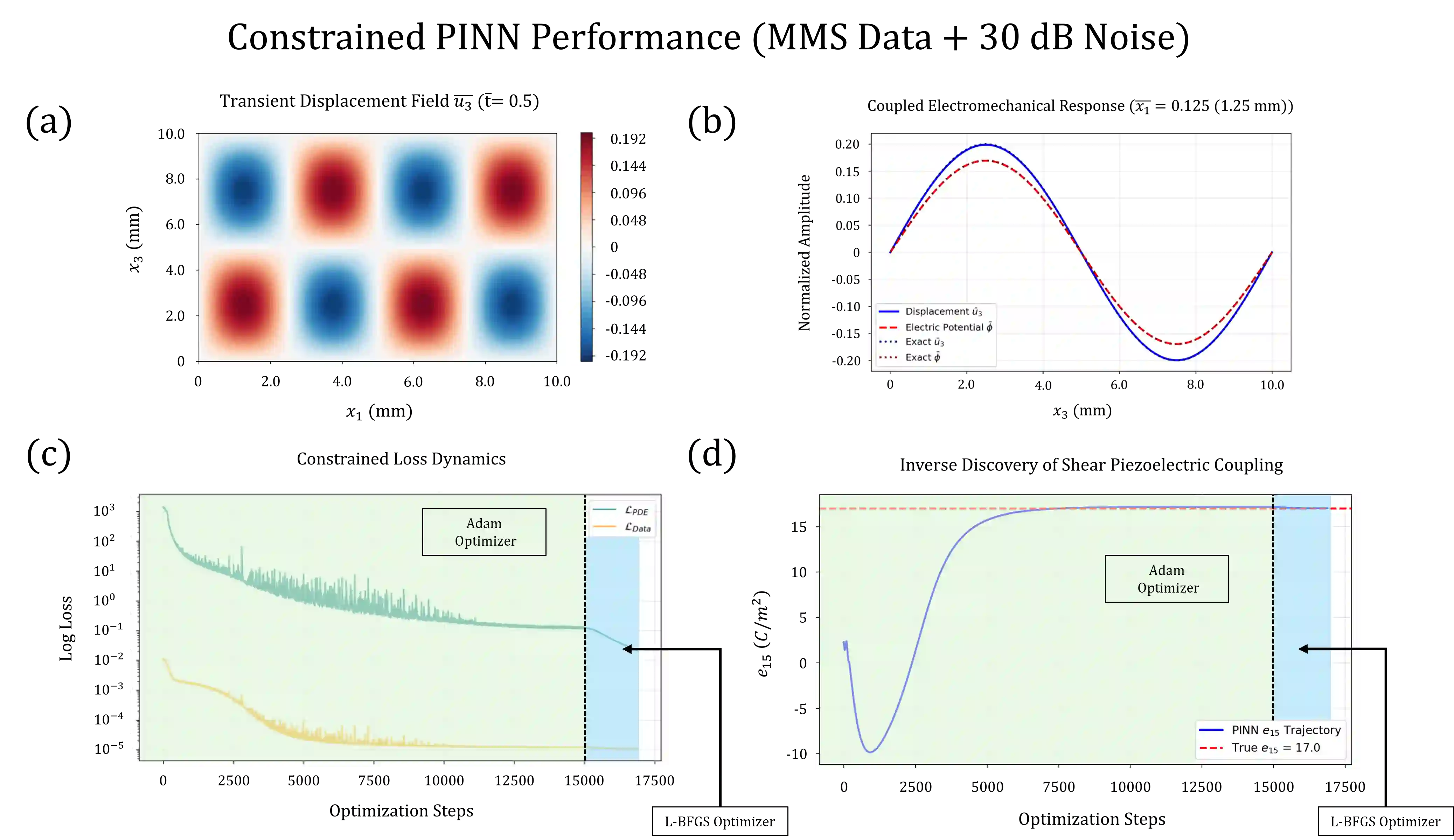
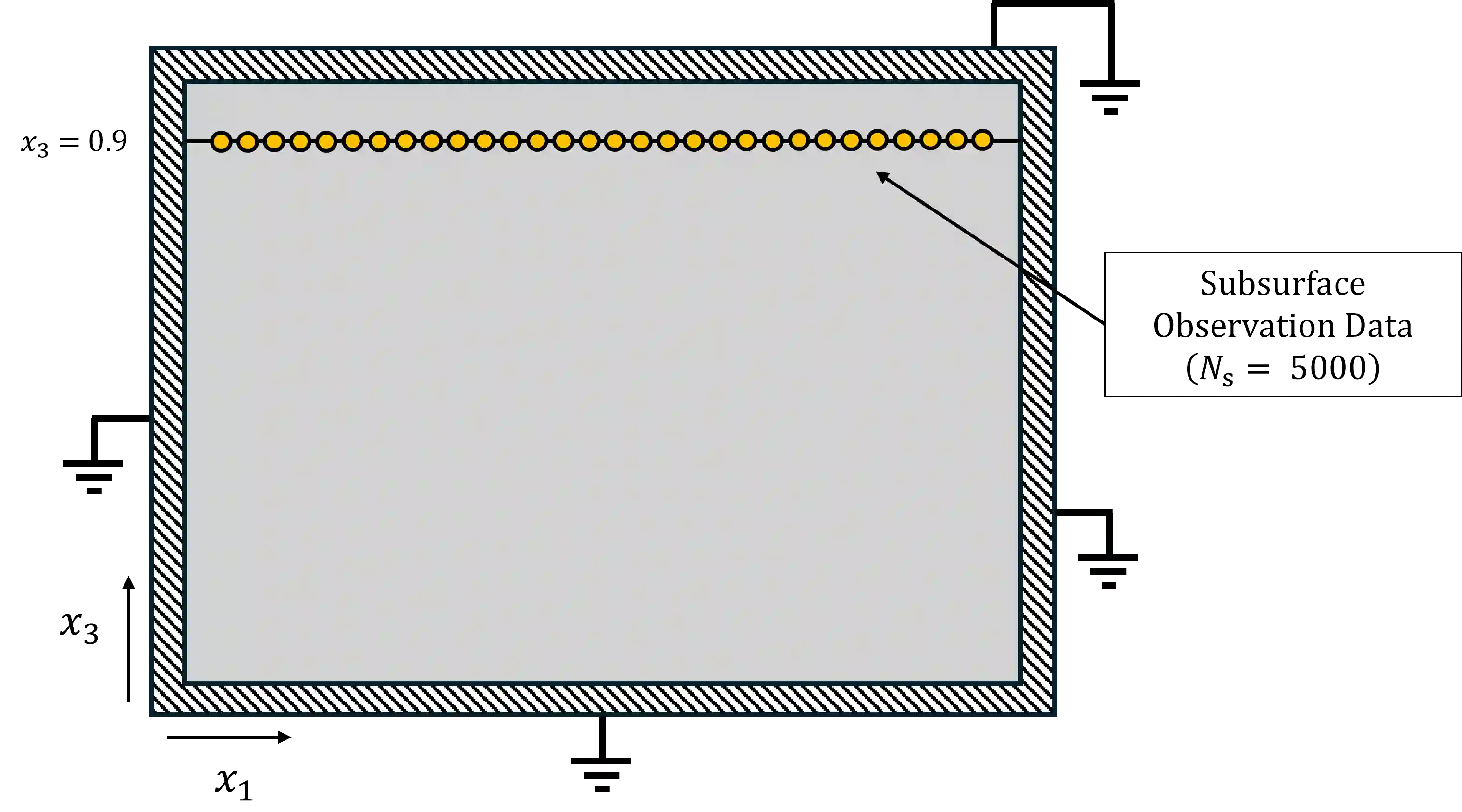
The shear piezoelectric coefficient $e_{15}$ governs the shear-mode electromechanical coupling in piezoelectric micromachined ultrasonic transducers (PMUTs) and surface acoustic wave (SAW) devices, but measuring it typically requires destructive resonance testing on dedicated specimens. On simulated data, $e_{15}$ can instead be recovered non-destructively from sparse, noisy subsurface wavefield observations using a constrained physics-informed neural network (PINN). By building exact spatial distance functions and temporal multipliers directly into the network output, the clamped, grounded boundaries and resting initial state hold automatically, leaving the loss with only the interior equations of coupled electro-elastodynamics and the data misfit. Non-dimensional scaling brings all governing coefficients within one decade of O(1), and the setup removes the boundary and initial-condition penalty weights that soft-constraint methods must tune. In a six-way comparison (plane-strain PZT-5H, manufactured wavefield, 30 dB noise), a soft-penalty baseline with adaptive weights converges to an erroneous $e_{15}$ in four of the five runs (51.7% mean error), and fixed penalties reach an error of 0.85% only after a second-order optimization stage. The constrained formulations reach mean $e_{15}$ errors between 0.15% and 0.51% with held-out displacement errors below 1%. Within these variants, the spatial multiplier gives rapid first-order convergence, and the quadratic temporal multiplier lowers the early-time electrostatic residual by a factor of 6.8 versus a linear one. On finite-element data along one subsurface line, the full formulation recovers $e_{15}$ with 1.19% mean error at 30 dB and keeps it between 0.65% and 2.71% across a 40 to 0 dB noise sweep. Finally, training on displacements alone still recovers $e_{15}$ with mean errors of 0.45% on finite-element and 1.64% on manufactured data.


翻译:暂无翻译
0
下载
关闭预览

相关内容

Networking:IFIP International Conferences on Networking。 Explanation:国际网络会议。 Publisher:IFIP。 SIT: http://dblp.uni-trier.de/db/conf/networking/index.html
Hierarchically Structured Meta-learning
CreateAMind
27+阅读 · 2019年5月22日
A Technical Overview of AI & ML in 2018 & Trends for 2019
待字闺中
18+阅读 · 2018年12月24日
Fully-Convolutional Siamese Networks for Object Tracking论文笔记
统计学习与视觉计算组
10+阅读 · 2018年10月12日
disentangled-representation-papers
CreateAMind
26+阅读 · 2018年9月12日
《pyramid Attention Network for Semantic Segmentation》
统计学习与视觉计算组
44+阅读 · 2018年8月30日
Hierarchical Imitation - Reinforcement Learning
CreateAMind
19+阅读 · 2018年5月25日
【AAAI专题】论文分享:以生物可塑性为核心的类脑脉冲神经网络
中国科学院自动化研究所
15+阅读 · 2018年1月23日
【推荐】ResNet, AlexNet, VGG, Inception:各种卷积网络架构的理解
机器学习研究会
20+阅读 · 2017年12月17日
国家自然科学基金
0+阅读 · 2017年12月31日
国家自然科学基金
0+阅读 · 2015年12月31日
国家自然科学基金
0+阅读 · 2015年12月31日
国家自然科学基金
0+阅读 · 2015年12月31日
国家自然科学基金
0+阅读 · 2014年12月31日
国家自然科学基金
0+阅读 · 2014年12月31日
VIP会员
最新内容
《美空军2026条令文件:对海压制作战》
专知会员服务
18+阅读 · 11月9日
人工智能与战争的未来
专知会员服务
7+阅读 · 11月8日
《Agent Mosaic:识别智能体LLM系统中的机密泄露》
人工智能在军事教育中的应用:若干视角与经验
专知会员服务
10+阅读 · 11月6日
“星链”减速与不断适应的乌克兰
专知会员服务
8+阅读 · 11月6日
美国中期选举之后:帕兰提尔面临不确定性?
专知会员服务
5+阅读 · 11月6日
相关VIP内容
相关资讯
Hierarchically Structured Meta-learning
CreateAMind
27+阅读 · 2019年5月22日
A Technical Overview of AI & ML in 2018 & Trends for 2019
待字闺中
18+阅读 · 2018年12月24日
Fully-Convolutional Siamese Networks for Object Tracking论文笔记
统计学习与视觉计算组
10+阅读 · 2018年10月12日
disentangled-representation-papers
CreateAMind
26+阅读 · 2018年9月12日
《pyramid Attention Network for Semantic Segmentation》
统计学习与视觉计算组
44+阅读 · 2018年8月30日
Hierarchical Imitation - Reinforcement Learning
CreateAMind
19+阅读 · 2018年5月25日
【AAAI专题】论文分享:以生物可塑性为核心的类脑脉冲神经网络
中国科学院自动化研究所
15+阅读 · 2018年1月23日
【推荐】ResNet, AlexNet, VGG, Inception:各种卷积网络架构的理解
机器学习研究会
20+阅读 · 2017年12月17日
相关基金
国家自然科学基金
0+阅读 · 2017年12月31日
国家自然科学基金
0+阅读 · 2015年12月31日
国家自然科学基金
0+阅读 · 2015年12月31日
国家自然科学基金
0+阅读 · 2015年12月31日
国家自然科学基金
0+阅读 · 2014年12月31日
国家自然科学基金
0+阅读 · 2014年12月31日
Top
微信扫码咨询专知VIP会员