

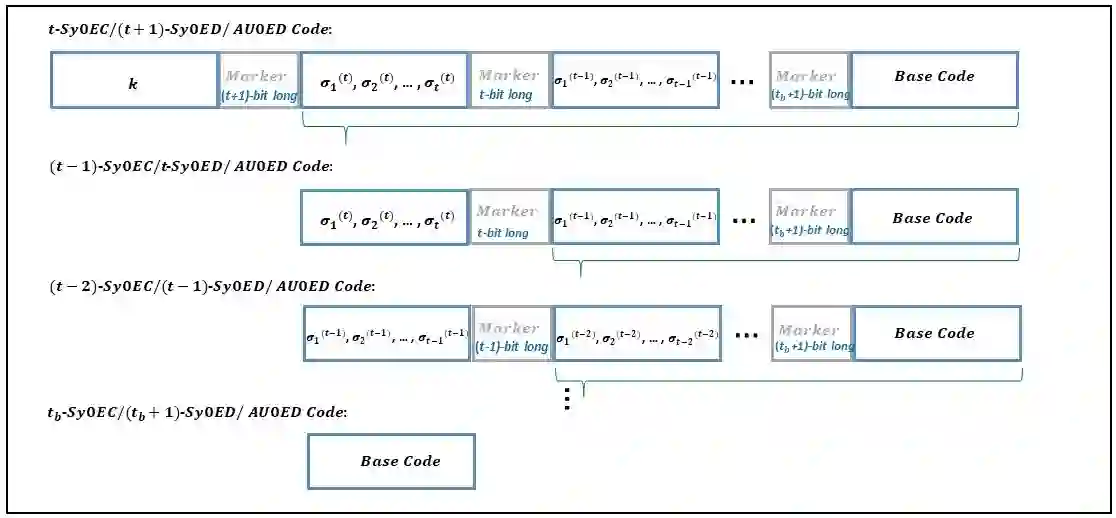
This paper gives some theory and efficient design of binary block systematic codes capable of controlling the deletions of the symbol ``$0$'' (referred to as $0$-deletions) and/or the insertions of the symbol ``$0$'' (referred to as $0$-insertions). The problem of controlling $0$-deletions and/or $0$-insertions (referred to as $0$-errors) is known to be equivalent to the efficient design of $L_{1}$ metric asymmetric error control codes over the natural alphabet, $\mathbb{N}$. So, $t$ $0$-insertion correcting codes can actually correct $t$ $0$-errors, detect $(t+1)$ $0$-errors and, simultaneously, detect all occurrences of only $0$-deletions or only $0$-insertions in every received word (briefly, they are $t$-Symmetric $0$-Error Correcting/$(t+1)$-Symmetric $0$-Error Detecting/All Unidirectional $0$-Error Detecting ($t$-Sy$0$EC/$(t+1)$-Sy$0$ED/AU$0$ED) codes). From the relations with the $L_{1}$ distance, optimal systematic code designs are given. In general, for all $t,k\in\mathbb{N}$, a recursive method is presented to encode $k$ information bits into efficient systematic $t$-Sy$0$EC/$(t+1)$-Sy$0$ED/AU$0$ED codes of length $$ n\leq k+t\log_{2}k+o(t\log n) $$ as $n\in\mathbb{N}$ increases. Decoding can be efficiently performed by algebraic means using the Extended Euclidean Algorithm (EEA).
翻译:本文给出了能够控制符号“$0$”删除(简称$0$-删除)和/或符号“$0$”插入(简称$0$-插入)的二元分组系统化码的理论与高效设计。控制$0$-删除和/或$0$-插入(简称$0$-错误)的问题,等价于在自然字母表$\mathbb{N}$上高效设计$L_{1}$度量非对称错误控制码。因此,能够纠正$t$个$0$-插入的码实际上可以纠正$t$个$0$-错误、检测$(t+1)$个$0$-错误,并同时检测每个接收字中仅由$0$-删除或仅由$0$-插入引起的全部错误(简称为$t$-对称$0$-错误纠正/$(t+1)$-对称$0$-错误检测/全单向$0$-错误检测($t$-Sy$0$EC/$(t+1)$-Sy$0$ED/AU$0$ED)码)。基于与$L_{1}$距离的关系,给出了最优系统化码的设计。一般地,对于所有$t,k\in\mathbb{N}$,提出了一种递归方法,将$k$个信息比特编码为高效系统化$t$-Sy$0$EC/$(t+1)$-Sy$0$ED/AU$0$ED码,其长度满足 $$ n\leq k+t\log_{2}k+o(t\log n) $$ 随$n\in\mathbb{N}$增大而变化。解码可通过扩展欧几里得算法(EEA)以代数方式高效完成。




相关内容




 微信扫码咨询专知VIP会员