

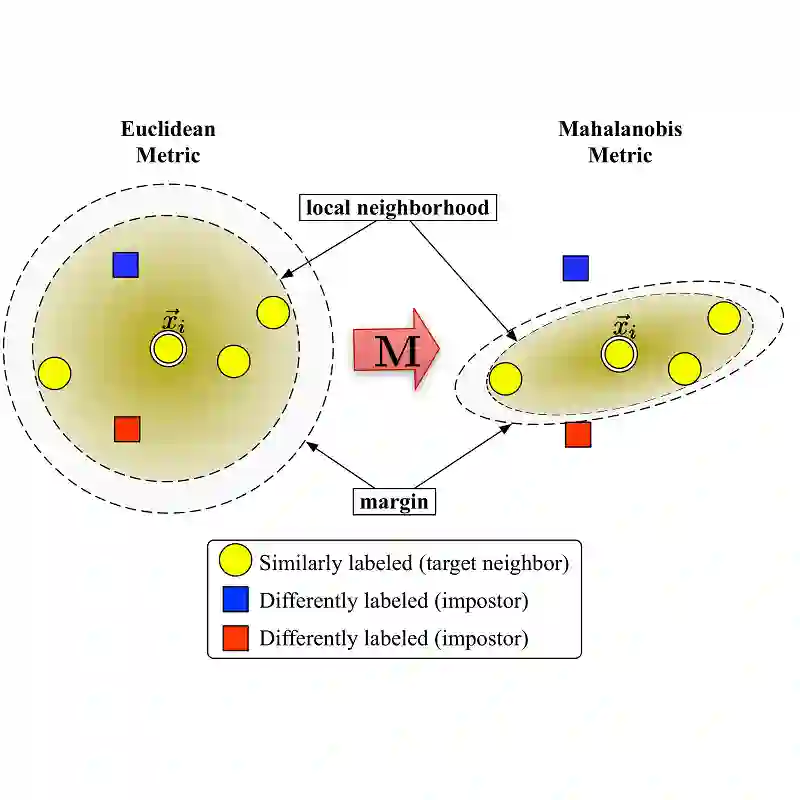
Accurate modeling of aircraft environmental impact is pivotal to the design of operational procedures and policies to mitigate negative aviation environmental impact. Aircraft environmental impact segmentation is a process which clusters aircraft types that have similar environmental impact characteristics based on a set of aircraft features. This practice helps model a large population of aircraft types with insufficient aircraft noise and performance models and contributes to better understanding of aviation environmental impact. Through measuring the similarity between aircraft types, distance metric is the kernel of aircraft segmentation. Traditional ways of aircraft segmentation use plain distance metrics and assign equal weight to all features in an unsupervised clustering process. In this work, we utilize weakly-supervised metric learning and partial information on aircraft fuel burn, emissions, and noise to learn weighted distance metrics for aircraft environmental impact segmentation. We show in a comprehensive case study that the tailored distance metrics can indeed make aircraft segmentation better reflect the actual environmental impact of aircraft. The metric learning approach can help refine a number of similar data-driven analytical studies in aviation.
翻译:飞机环境影响的精确建模对于设计减少航空负面环境影响的运行程序和政策至关重要。飞机环境影响分割是一个根据一组飞机特征将具有相似环境影响特性的机型聚类在一起的过程。这一实践有助于对缺乏足够噪声和性能模型的众多机型进行建模,并促进对航空环境影响的深入理解。通过衡量机型间的相似性,距离度量是飞机分割的核心。传统的飞机分割方法使用普通距离度量,在无监督聚类过程中对所有特征赋予相同权重。本研究利用弱监督度量学习以及飞机燃油消耗、排放和噪声的部分信息,学习用于飞机环境影响分割的加权距离度量。我们通过一项全面的案例研究表明,定制化的距离度量确实能使飞机分割更好地反映飞机的实际环境影响。该度量学习方法有助于完善航空领域中一系列类似的数据驱动分析研究。




相关内容



 微信扫码咨询专知VIP会员