

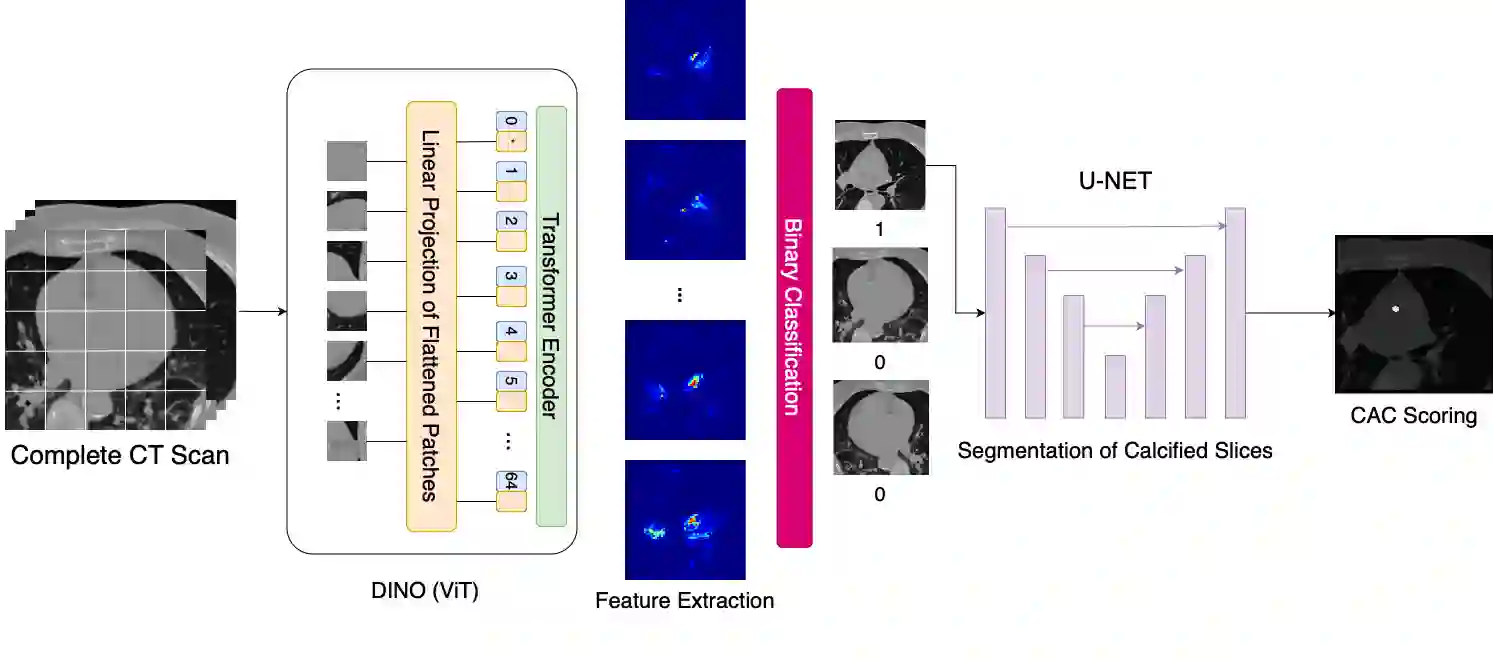
Coronary artery disease (CAD), one of the leading causes of mortality worldwide, necessitates effective risk assessment strategies, with coronary artery calcium (CAC) scoring via computed tomography (CT) being a key method for prevention. Traditional methods, primarily based on UNET architectures implemented on pre-built models, face challenges like the scarcity of annotated CT scans containing CAC and imbalanced datasets, leading to reduced performance in segmentation and scoring tasks. In this study, we address these limitations by incorporating the self-supervised learning (SSL) technique of DINO (self-distillation with no labels), which trains without requiring CAC-specific annotations, enhancing its robustness in generating distinct features. The DINO-LG model, which leverages label guidance to focus on calcified areas, achieves significant improvements, with a sensitivity of 89% and specificity of 90% for detecting CAC-containing CT slices, compared to the standard DINO model's sensitivity of 79% and specificity of 77%. Additionally, false-negative and false-positive rates are reduced by 49% and 59%, respectively, instilling greater confidence in clinicians when ruling out calcification in low-risk patients and minimizing unnecessary imaging reviews by radiologists. Further, CAC scoring and segmentation tasks are conducted using a basic UNET architecture, applied specifically to CT slices identified by the DINO-LG model as containing calcified areas. This targeted approach enhances CAC scoring accuracy by feeding the UNET model with relevant slices, significantly improving diagnostic precision, reducing both false positives and false negatives, and ultimately lowering overall healthcare costs by minimizing unnecessary tests and treatments, presenting a valuable advancement in CAD risk assessment.
翻译:冠状动脉疾病(CAD)是全球主要死亡原因之一,需要有效的风险评估策略,其中通过计算机断层扫描(CT)进行冠状动脉钙化(CAC)评分是关键的预防手段。传统方法主要基于在预建模型上实现的UNET架构,面临着包含CAC的标注CT扫描稀缺以及数据集不平衡等挑战,导致在分割和评分任务中性能下降。在本研究中,我们通过引入DINO(无标签自蒸馏)的自监督学习(SSL)技术来解决这些限制,该技术无需CAC特定标注即可训练,增强了其生成显著特征的鲁棒性。DINO-LG模型利用标签引导聚焦于钙化区域,取得了显著改进:在检测包含CAC的CT切片时,其灵敏度达到89%,特异性达到90%,而标准DINO模型的灵敏度为79%,特异性为77%。此外,假阴性和假阳性率分别降低了49%和59%,这使临床医生在排除低风险患者钙化时更有信心,并最大限度地减少了放射科医生不必要的影像复查。进一步地,CAC评分和分割任务使用基础的UNET架构执行,并专门应用于被DINO-LG模型识别为包含钙化区域的CT切片。这种针对性方法通过向UNET模型提供相关切片,提高了CAC评分的准确性,显著提升了诊断精度,减少了假阳性和假阴性,最终通过减少不必要的检测和治疗降低了整体医疗成本,为CAD风险评估提供了有价值的进展。





相关内容




 微信扫码咨询专知VIP会员