

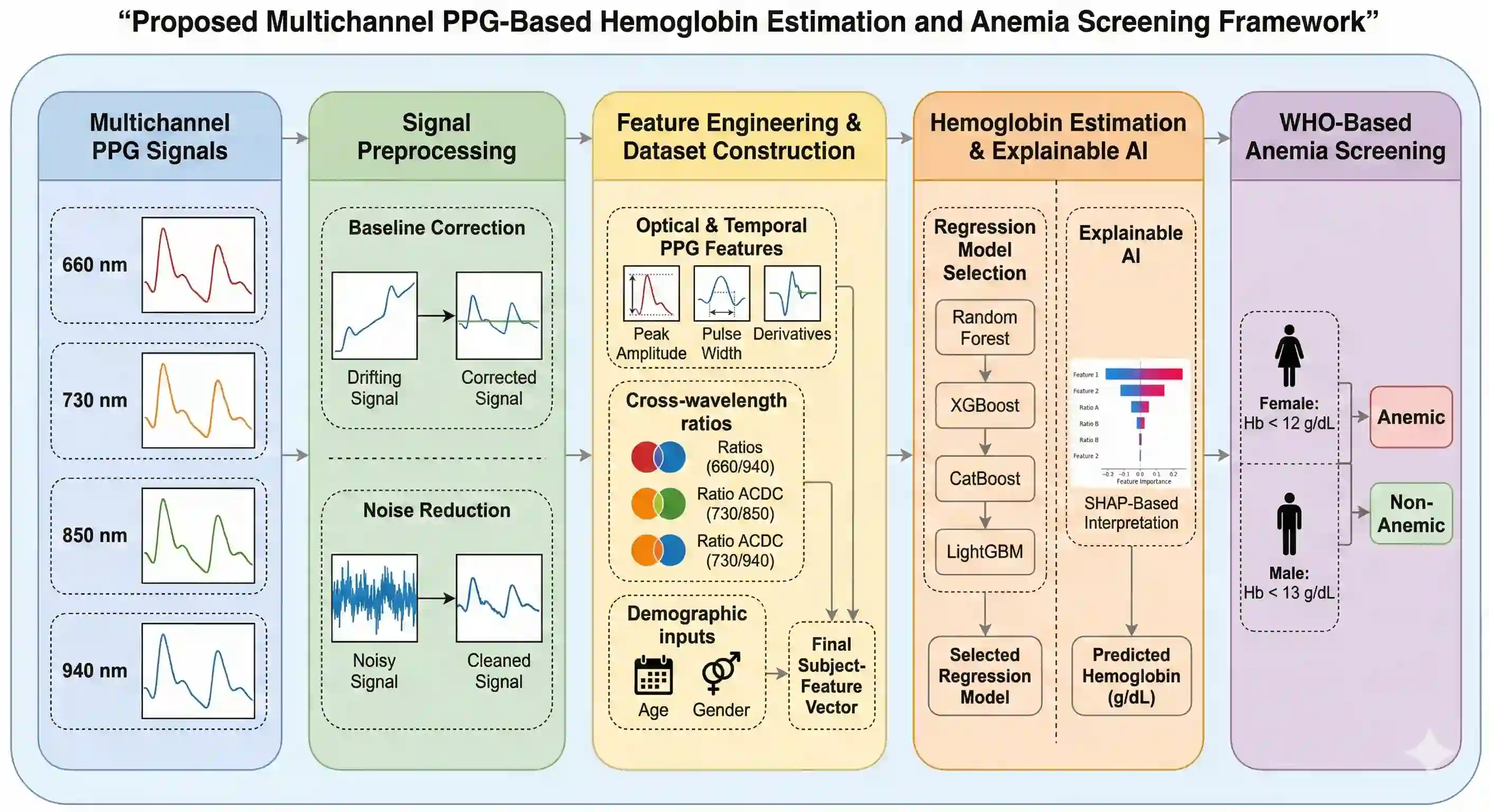
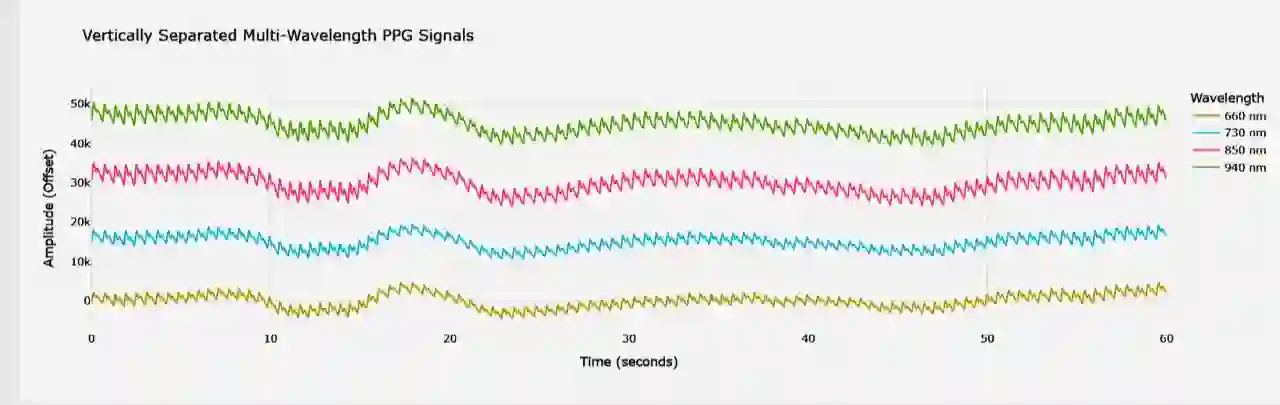
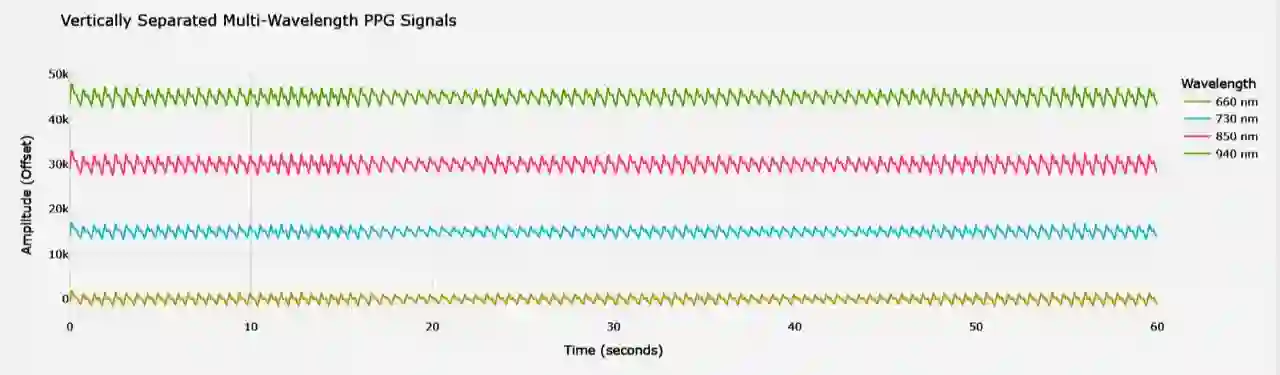
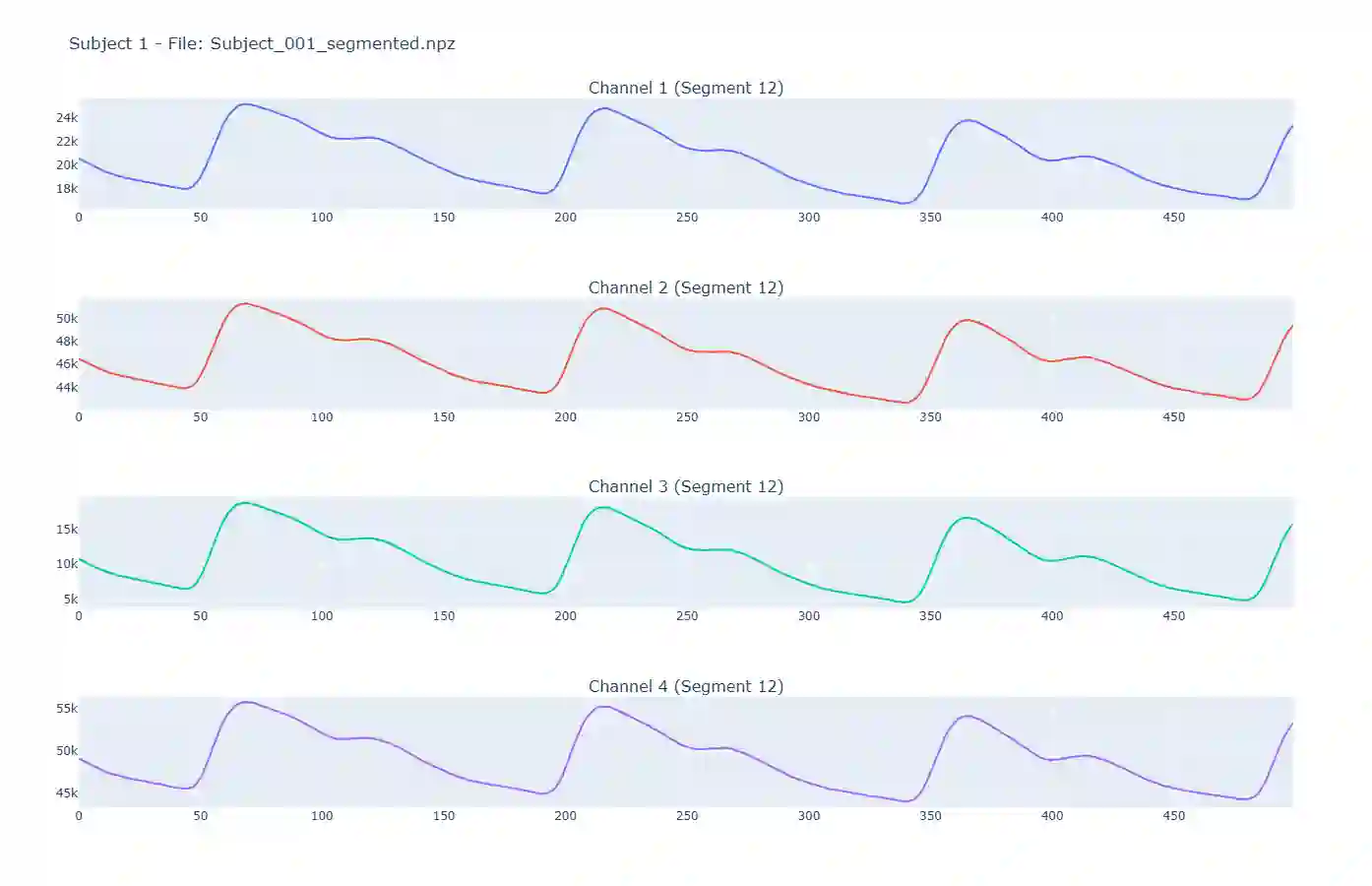
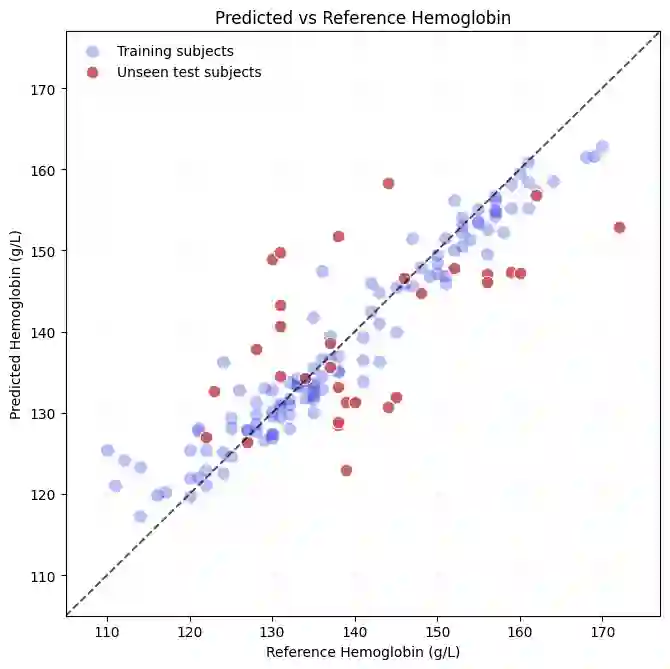
Anemia is a prevalent hematological disorder that requires frequent hemoglobin monitoring for early diagnosis and effective management. Conventional hemoglobin assessment relies on invasive blood sampling, limiting its suitability for large-scale or continuous screening. This paper presents a non-invasive framework for hemoglobin estimation and anemia screening using multichannel photoplethysmography (PPG) signals and explainable artificial intelligence. Four-wavelength PPG signals (660, 730, 850, and 940~nm) are processed to extract optical and cross-wavelength features, which are aggregated at the subject level to avoid data leakage. A gradient boosting regression model is employed to estimate hemoglobin concentration, followed by post-regression anemia screening using World Health Organization (WHO) thresholds. Model interpretability is achieved using SHapley Additive explanations (SHAP), enabling both global and subject-specific analysis of feature contributions. Experimental evaluation on a publicly available dataset demonstrates a mean absolute error of 8.50 plus minus 1.27 and a root mean squared error of 8.21~g/L on unseen test subjects, indicating the potential of the proposed approach for interpretable, non-invasive hemoglobin monitoring and preliminary anemia screening.
翻译:贫血是一种常见的血液疾病,其早期诊断和有效管理需要频繁的血红蛋白监测。传统的血红蛋白评估依赖于侵入性血液采样,限制了其在大规模或连续筛查中的适用性。本文提出了一种利用多通道光电容积脉搏波(PPG)信号和可解释人工智能进行血红蛋白估计和贫血筛查的非侵入性框架。通过处理四波长PPG信号(660、730、850和940 nm)提取光学和跨波长特征,并在受试者层面进行特征聚合以避免数据泄露。采用梯度提升回归模型估计血红蛋白浓度,随后根据世界卫生组织(WHO)阈值进行回归后贫血筛查。模型可解释性通过SHapley可加性解释(SHAP)实现,支持对特征贡献进行全局和个体特异性分析。在公开数据集上的实验评估显示,在未见测试受试者上取得了8.50±1.27 g/L的平均绝对误差和8.21 g/L的均方根误差,表明所提方法在可解释、非侵入性血红蛋白监测和初步贫血筛查方面具有潜力。




相关内容



 微信扫码咨询专知VIP会员