

马赛克战常被视为一个遥远的未来概念,与新兴颠覆性技术的进一步突破相关联。本文认为,乌克兰战争挑战了这一观点。尽管乌克兰并未明确使用该术语,但其战场适应过程反映了马赛克战的核心原则,包括分布式低成本无人系统、自适应杀伤网、分散化决策以及快速的“传感器-射手”集成。文章表明,马赛克战不仅仅是一种推测性的未来愿景,而且是理解当代战争中军事成功与效能的日益有用的视角。与此同时,乌克兰的案例表明战争性质正在发生变化,其中作战优势越来越依赖于适应性、分布式兵力运用以及传感器、决策者与射手的快速集成,同时也暴露出目前在互操作性、通信韧性、维持保障和组织规模化方面存在的局限。
问题陈述:乌克兰战争如何通过展示马赛克战的核心原则已在当代战争中得到应用,从而挑战了将其普遍误解为遥远或过于未来主义概念的看法?
意义所在:军队、防务规划者和采购组织应停止将马赛克战视为一个遥远未来的概念,并立即开始从乌克兰汲取实际经验教训。即使乌克兰军队并未直接使用这个术语,他们的战场成功与马赛克战的核心原则密切相关,特别是分布式无人系统的集成、软件赋能的杀伤网、委托的主动性以及快速的适应性。因此,关键的概念转变在于从以平台为中心的部队设计转向模块化、可消耗、可互操作且能快速重组的能力。这需要在条令、采购、训练、数字化集成和维持保障方面进行相应的变革。
引言
2022年2月俄罗斯对乌克兰的全面行动,引发了自第二次世界大战以来欧洲规模最广、程度最深的国家间战争,并为观察当代战争的演变提供了一个前所未有的经验环境。其中最引人注目的发展是分布式无人系统、数字化集成平台和分散化决策实践在战场上的迅速扩散。虽然这些发展常被作为“无人机战争”、网络化作战或战场创新的要素而单独分析,但本文认为,通过“马赛克战”这一概念视角,可以更连贯地理解它们。尽管乌克兰并未明确使用该术语,但其许多战场实践反映了马赛克战的核心原则:分布式低成本系统、自适应杀伤网、分散化执行以及快速的“传感器-射手”集成。因此,乌克兰的案例挑战了普遍认为马赛克战主要是一个与新兴颠覆性技术相关的遥远未来概念的假设。
马赛克战:概念基础
美国国防高级研究计划局的战略技术办公室(DARPA STO)提出了马赛克战概念,以应对那些将多种任务集中于少量精密的、高价值资产的平台中心化部队设计在作战价值上的下降,以及美国相对于对手技术优势的削弱。[1] 这些系统的特点是开发周期长、适应性有限、指挥与控制结构僵化,使其难以适应由反介入/区域拒止战略、电子战和精确打击能力扩散所塑造的快速演变作战条件。[2] 诸如旨在打击关键节点和网络以破坏军事行动的“系统摧毁战”等对手战术,凸显了集中式系统和线性杀伤链的脆弱性。[3]
DARPA的战略技术办公室提出马赛克战概念,以应对精密平台中心化部队设计日益下降的作战价值。
“瓦片”系统
马赛克战架构优先考虑松耦合、模块化和快速可组合性,使部队编组能够随着任务和威胁条件的变化而重新配置和重组。[4] 与将多种功能集中整合在少数高度集成的多任务平台上不同,马赛克战设计将能力分解为许多更小、更专业化、可互操作的节点,这些节点可以组合成针对特定任务的定制化编组或部队包。[5] 实际上,这通常意味着从“庞大且包罗万象”的所谓单体平台,转向更小、更分布式的“瓦片”平台,包括无人系统,昂贵的多任务系统被分解为大量可以更广泛部署的低成本单元。
这种设计逻辑支持可负担的大规模运用,并通过冗余性提高韧性。如果执行某项功能的节点被毁,可以派遣具有相同功能的另一平台来恢复编组,而不会导致整体任务效能崩溃。然而,同样的分解将复杂性上移至集成与编配层面。基于瓦片的部队必须同步数量更多的异构节点,这增加了对通信、数据融合和指挥与控制的要求。[6]
杀伤网
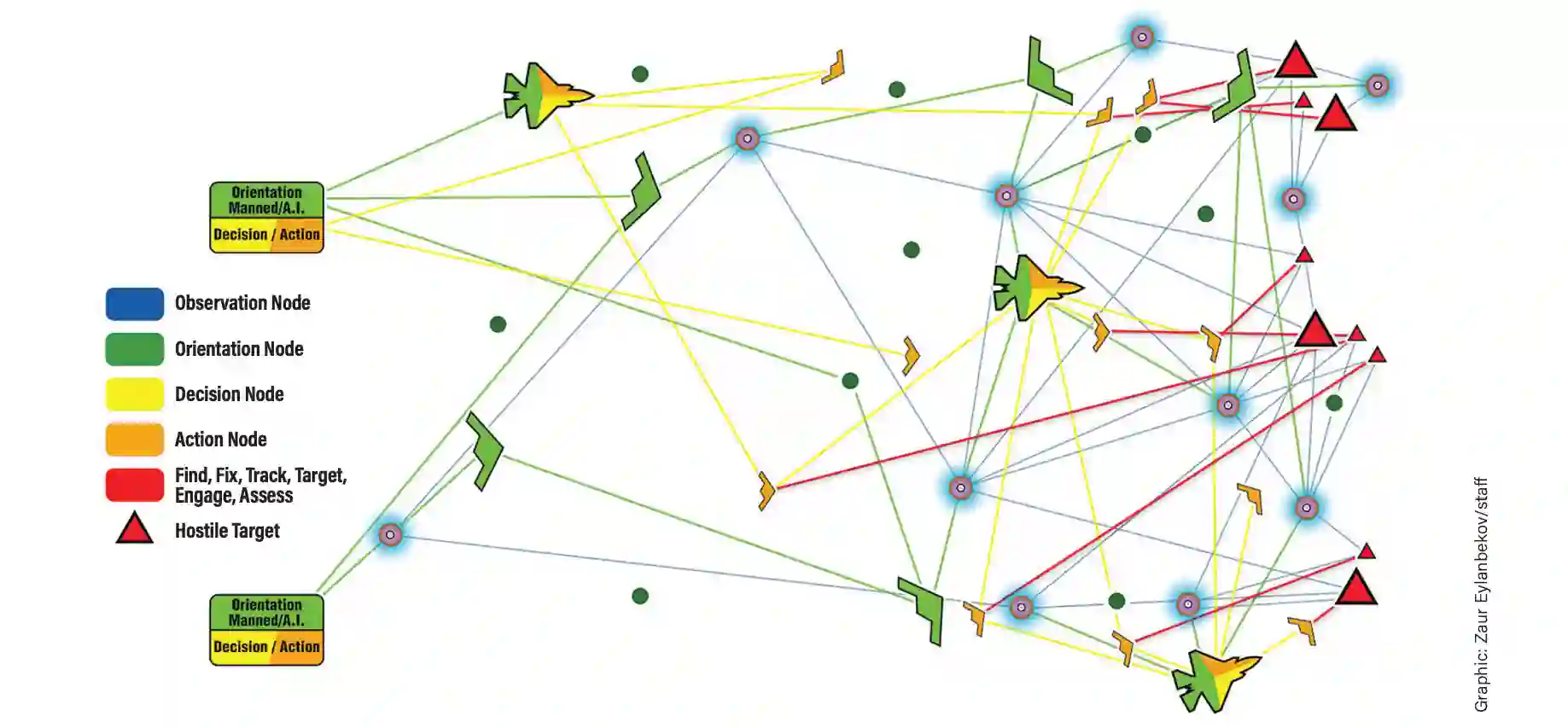
传统的杀伤链通常是线性且顺序的:传感器探测,信息流经指挥环节,授权批准,射手交战——这造成了脆弱的依赖关系,单个节点的中断即可使整个链条瘫痪。相比之下,马赛克战更倾向于“杀伤网”:这是一种网络化架构,提供从传感到决策到施效的多条并行路径,使部队能够重组可用节点、绕过损失进行路由传递,并在遭受损耗时保持作战节奏。[7] 从概念上讲,这通过功能分解得以实现:不是将观察—判断—决策—行动循环视为固定的线性链条,而是将其各功能分解为可互操作的元素,然后为特定任务重组成多个并发的“路径”。稍后将通过乌克兰实施的一个具体杀伤网实例加以说明。借鉴茨维贝尔森的类比,传统的杀伤链可以类比为一棵树,一种具有可识别的树干-树枝依赖关系的层级化、线性结构,会产生脆弱的关键节点。[8] 相比之下,杀伤网则类似于根茎,一种多对多连接的分散化网状结构,可以通过选择最短路径(避开层级)来路由传递效果以提高速度,或重新路由以绕过被中断或被摧毁的节点。此外,根茎结构能够自我重组或修复。
传统的杀伤链可以类比为一棵树,一种具有可识别的树干-树枝依赖关系的层级化、线性结构,会产生脆弱的关键节点。
重要的是,杀伤网并不依赖于“无处不在”的连接;相反,网络化被视为任务适应性的,需要在带宽、覆盖范围和延迟之间进行平衡,以在被拒止或高强度的环境中维持信息流。一个成熟的杀伤网方法不仅仅是“连接更多”;它应具有弹性、敏捷性和智能性,能够在干扰或故障下持续运作,快速组建适合任务的编组,并利用人工智能(AI)支持来执行诸如编组规划、恢复和自适应学习等任务。[9] 这些优势伴随着权衡:杀伤网增加了协调要求,并对指挥与控制、通信和集成施加了更大压力,以防止分布式灵活性演变成分布式混乱。
决策、自主性与时间压缩
有效的马赛克战依赖于集中意图但分散执行。任务式指挥向下级明确目的和边界,同时赋予其行动自由。以决策为中心的作战则增加了在对抗条件下比对手做出和执行更快、更好决策的目标。[10] 两者结合,使得下级梯队无需等待上级批准即可抓住稍纵即逝的机会。总体而言,马赛克战概念寻求通过加速观察—判断—决策—行动循环和减少杀伤流程延迟来压缩时间。[11]
在以决策为中心的视角下,马赛克战力量不仅通过加速自身的观察—判断—决策—行动循环寻求优势,还通过使对手“观察”和解读己方部队结构与意图的能力复杂化来寻求优势,从而即使在战场透明度很高的条件下,也能延长对手的决策周期。[12] 通过运用诱饵、虚假发射和误导性运动模式,马赛克战力量制造关于其真实部队结构和意图的混乱,然后在行动瞬间才揭示实际攻击路径,从而突然打乱对手的决策周期。
在以决策为中心的视角下,马赛克战力量不仅通过加速自身的观察—判断—决策—行动循环寻求优势。
自主性以两种互补的形式至关重要:人的自主性(战术边缘的委托决策权)和机器赋能的自主动/自动化,后者可加速执行并减轻认知负荷。自动化还能通过支持在带宽限制或网络中断下的协同信息处理和传输,并协助指挥官通过数据驱动的态势理解实现“先探测—先理解—先行动”的效果,来支持分布式指挥与控制。[13] 通过将决策权和执行能力前推,部队即使在与上级总部的联系中断时,也能维持局部主动性和效果生成。这种韧性在对抗性电磁频谱环境中尤为宝贵,因为对手的电子战会因射频发射和其他特征信号而威胁到集中式指挥与控制网络或探测。[14]
并非所有形式的战场适应或技术创新都自动构成马赛克战。该概念特指一种分布式架构,其中模块化的“瓦片”可以动态重组成针对特定任务的部队包,从而跨异构系统集成传感、决策和效果生成。虽然乌克兰的战时适应过程包含许多与此种方法相符的要素,包括分布式无人机运用、数字化战场集成和分散化执行,但冲突的其他方面仍由更常规的动态因素塑造,例如以炮兵为中心的消耗战和阵地战。因此,区分一般性适应和真正的马赛克式架构,对于避免过度扩展该概念,并阐明乌克兰战场实践中哪些具体特征与马赛克战原则相符,具有重要意义。
2022–2025年乌克兰战场创新
分布式大规模低成本无人系统的运用
俄罗斯的全面行动始于2022年2月,投入的是一支前沿部署且处于战备状态的部队,但就其政治目标而言,这支部队的规模最终是有限的,其作战构想旨在通过对乌克兰的重心基辅实施快速机械化突进,产生震慑效果。该作战构想结合了空中突击(最引人注目的是夺取霍斯托梅尔/安东诺夫机场的企图)和旨在夺取关键节点、破坏乌克兰指挥与控制并对政治重心施压的纵深装甲突击。[15] 可以说,在此初始阶段,俄军部队质量处于最高水平。然而,相对于任务规模,可用兵力有限,且其计划假设显然预期乌克兰会迅速崩溃而非持续抵抗。在实践中,俄军部队在协同、指挥控制和后勤方面遇到困难,其快速营级战术群的机动遭遇了乌克兰的顽强防御。[16] 此阶段的特点是快速的机械化运动,部队受命以行军纵队沿道路推进,这使其易遭伏击,并导致乌克兰广泛使用便携式反坦克制导武器(特别是“标枪”和NLAW)。[17] 重要的是,“快速推进”并未随着俄军对基辅的攻势陷入停滞而结束。2022年9月,乌克兰在哈尔科夫攻势中展示了大规模的快速机动,利用俄军兵力薄弱的防区实现快速突破,并在数日内收复大片地区。[18]
俄军部队在协同、指挥控制和后勤方面遇到困难,其快速营级战术群的机动遭遇了乌克兰的顽强防御。
从2022年底到2023年,战争更明确地转向以炮兵为中心的消耗战和阵地战,由防御工事、雷区和激烈的侦察-打击对抗塑造的战线日益稳定。[19] 无人机赋能观察改善了目标瞄准,压缩了杀伤链,使得炮兵和弹药供应成为伤亡和作战节奏的核心驱动因素。这种动态支撑了残酷的消耗战,最显著的是围绕巴赫穆特的战斗,并框定了乌克兰2023年的反攻,面对层层防御地带,进展必然是缓慢且有章法的。[20] 俄军试图通过“绞肉机”式攻击和反复装甲突击重获主动权,在堑壕和雷区环境中往往造成高损失而收益有限。[21] 总体而言,这一时期凸显了乌克兰对更多火炮系统、弹药和情报、监视、侦察(ISR)赋能器的需求不断增长,因为战争从快速机动转向持续的炮火、消耗和耐力比拼。[22]
在乌克兰,以无人机为中心的战争最好地理解不仅是技术变革,更是与马赛克战原则相契合的组织和作战转型与发展。[23] 大量低成本无人机促成了分布式传感和打击架构,其中许多可消耗平台同时作为传感器、中继器和射手运行。乌克兰军队并非将能力集中在少数高价值平台上,而是通过将众多集成到自适应侦察-打击网络中的小型系统灵活重组来产生效果。[24] 这种架构支持快速的“传感器-射手”集成,通过冗余性提高韧性,并允许战术单位将针对特定任务的“瓦片”动态组装成作战杀伤网。[25] 从这个意义上说,战场日益明显的无人机中心化反映了一种更广泛的、向分布式和模块化兵力运用的转变,而不仅仅是无人平台的扩散。[26],[27],[28],[29],[30]
到2025年,无人地面车辆(UGV)在“最后一英里”后勤和伤员后送方面变得重要,其明确目标是减少人员在接触线附近暴露于炮火和普遍存在的无人机威胁。[31] 然而,作为配备重机枪的武器化平台,它们对作战的重要性也日益增加。诸如一名操作员监管多辆无人地面车辆、监控多个摄像画面、仅在目标出现时手动接管等概念,契合了更广泛的趋势:接触线上更少的人,杀伤区内更多的传感器和可消耗系统。[32] 乌克兰对低成本、装载炸药的水面无人艇的部署,从根本上消解了俄罗斯黑海舰队的区域主导地位,迫使其主要战舰从塞瓦斯托波尔撤退到更远的港口,这一切乌克兰是在没有海军的情况下实现的。[33] 与这一海上成功并行的,是乌克兰拦截无人机的迅速成熟,为近程防空增加了一个日益具有决定性且低成本的层次。到2026年2月,据称“野黄蜂”公司的高速“毒刺”等系统在基辅及其周边地区摧毁了超过70%的来袭“沙赫德-136”/“天竺葵-2”型单向攻击无人机,从而减少了对稀缺的西方防空导弹的依赖,并将它们保留用于应对更高端的威胁。[34] 总体趋势是明确的:战争持续越久,其形态就越明显地类似于以小型无人系统为中心的战争,不断扩大的对抗性监视与打击空间持续推高了机动、再补给和兵力集中的成本。
到2025年,无人地面车辆在“最后一英里”后勤和伤员后送方面变得重要,其明确目标是减少人员在接触线附近暴露于炮火和普遍存在的无人机威胁。
乌克兰在小型、低成本无人系统方面快速的战场创新,是由一个去中心化的生态系统驱动的。在这个生态系统中,士兵、志愿者、初创公司和旅级部队将广泛可用的民用技术大规模地转化为军事能力。[35] 至关重要的是,决定性的转变较少依赖于技术突破,而更多依赖于现有技术的新颖应用和大规模扩散,报告强调“真正的改变并非主要在于技术创新本身,而在于现有技术的新颖应用”。[36] 这个生态系统将“开发-实战测试-修改-实战测试”的紧密循环制度化,伴随着“大规模的战术实验,随后是武装部队广泛的技术采用”,而这得益于前线用户与开发者之间的直接反馈循环,将传统的研发周期从数年压缩到数月。[37] 这些模式与马赛克战对分布式、分解的能力架构和模块化的强调高度契合,后者最初由美国国防高级研究计划局阐述,即将多种多样的“瓦片”(配备不同传感器和武器)组装成针对特定任务的部队包,以在不集中兵力的前提下实现效果集中。美国国防高级研究计划局进一步强调可消耗性是一个核心驱动力,即部署大量可消耗平台,使其能在承受损失的同时维持作战产出。
自适应杀伤网的出现
乌克兰的战时发展轨迹指向一种自适应杀伤网,而非线性杀伤链的出现。因为其以“三角洲”为核心并与GIS Arta、Kropyva等系统链接的作战软件生态系统,充当了一个联合集成层,跨梯队连接传感器、决策者和射手,而非依赖于单一固定的“传感器-射手”序列。[38] “三角洲”作为一个军事态势感知和战场集成平台,汇总来自无人机、卫星、固定摄像头、传感器、侦察单位和其他报告流的数据,形成共享作战图,而“元素”支持安全协同,“三角洲管道”分发实时视频,“任务控制”协助飞行规划,从而在战场压力下维持快速的任务重分配。[39] 在此更广泛的架构内,GIS Arta 这一指挥与控制和火力任务分配系统,执行的功能最常被类比为所谓的“炮兵界的优步”,因为它汇集来自无人机、前沿观察员、雷达、智能手机、GPS设备和其他来源的目标数据,然后将火力任务分配给可用的、处于最佳位置并能以速度、精度和效益交付所需效果的火炮、迫击炮、导弹或无人机单位。[40] Kropyva 这一前线战术火力控制和导航工具,通过支持任务规划、射击解算、位置交换以及在连接降级下的离线操作,补充了这一架构,从而在通信受限或部分中断时保持作战功能。[41] 总而言之,这些系统使得乌克兰军队能够压缩目标瞄准周期、动态分配火力,并在特定节点被干扰、降级或摧毁时重新规划效果传递路径,这就是为什么乌克兰的战场管理越来越像是一个杀伤网而非链条。
乌克兰的战时发展轨迹指向一种自适应杀伤网,而非线性杀伤链的出现。
乌克兰的“边缘”指挥控制,以及通过人机自主实现的时间压缩
乌克兰的人员自主性和主动性(授权和分散的战术执行)被广泛归因于2014年后的改革和伙伴训练,这些改革和训练旨在分散指挥、使士官队伍专业化,并将领导文化转向任务式指挥原则。[42]
一份关于西方训练工作的详细学术报告指出,任务式指挥被有意识地作为“可输出的专业知识”进行教授和示范,以在指挥官意图范围内实现更快的下级行动,同时也指出了实施中的摩擦:乌克兰方面没有“任务式指挥”的对应术语,且该概念与苏联遗留的等级制度以及对(下级的)有限信任相冲突。[43] 在作战实践中,战争初期的证据也表明,即使在高层指导不完整或中断的情况下,乌克兰部队在迅速展开的交战中仍保持了战术主动权,并有效行动。[44] 这种文化上的“行动许可”有效地将数量上的短缺转化为速度优势,允许分散的小型部队通过更快的局部决策和利用稍纵即逝的机会来弥补,这与马赛克战的分散执行和快速重组原则紧密契合。与此同时,多项评估也警告说,自主性和分散化并非普遍:随着战争规模扩大,某些职能(特别是侦察/无人机“屏护”)在营旅级变得更加集中,外部观察者将乌克兰武装部队的整体指挥方式描述为北约式任务式指挥愿景与更集中控制倾向的混合体。[45] 然而,不同部队和梯队的做法存在差异,有些指挥官采纳任务式指挥原则,而另一些则保持更严格的控制,这既反映了条令上的不确定性,也反映了个人领导风格的差异。[46] 乌克兰马赛克战的另一个决定性特征是通过分布式的情报、监视、侦察-打击集成,压缩了“传感器-射手”时间线。传统的目标瞄准周期:探测、识别、决策、交战,通常需要数小时或数天,因为信息需经指挥层级传递,并且要获得交战授权。乌克兰军队通过将传感器与射手配置在同一地点、将交战授权下放至战术梯队、以及采用自动化或半自动化的战斗管理系统,将这些周期压缩至数分钟甚至数秒。[47] 此外,乌克兰通过将传感和打击决策下放到战术无人机操作员层面,并用人工智能(AI)赋能的目标识别、跟踪、自主导航和末段目标锁定来增强其能力,从而压缩了杀伤周期,从而在对抗性电磁条件下改善了对稍纵即逝目标的交战能力,同时并未取消人对开火决策的控制。[48]
不同部队和梯队的做法存在差异,有些指挥官采纳任务式指挥原则,而另一些则保持更严格的控制,这既反映了条令上的不确定性,也反映了个人领导风格的差异。
技术与组织适应
平台异构性与传感器集成
乌克兰的杀伤网由商用、临时改装和专用军用平台的异构混合体构建而成。虽然这种多样性在常规部队规划中通常被视为不利因素,因为它使互操作性复杂化并增加了训练、维护和后勤的负担,但乌克兰已将其转化为作战优势。使用多种平台类型和采购渠道增加了冗余性,实现了快速替换和迭代,并使俄军更难通过针对特定平台的反制措施来压制乌克兰的能力。[49] 平台组合包括用于近程情报、监视、侦察(ISR)的小型商用四旋翼无人机(大疆“御”系列、道通智能及类似产品);改装用于自杀式攻击的FPV竞速无人机;专用巡飞弹(“弹簧刀”、“凤凰幽灵”及乌克兰自研系统);中航时战术无人机系统(RQ-11“大乌鸦”、“美洲狮”及同等产品);以及用于纵深侦察的更大规模战役级系统。[50] 每个平台类别服务于不同的角色,显著的重叠性支持了替换和冗余。传感器集成超越了战术无人机系统,涵盖了国家卫星侦察、西方情报、监视、侦察资产(包括天基和机载系统)、地面传感器和人力情报网络。[51] 乌克兰的战场管理系统融合了这些多源输入,创建了一个具有冗余覆盖和多重提示路径的分层情报、监视、侦察架构。考虑到数据格式、安全分类和组织边界的多样性,这种集成在技术上具有挑战性,它是通过专用软件、商业工具以及由志愿者程序员和军事技术人员开发的临时接口相结合实现的。[52]
通信架构与态势感知
乌克兰的分布式杀伤网需要能够在对抗性电磁频谱条件下,将传感器数据从分散的平台传输到射手和战场管理节点的通信架构。乌克兰军队混合使用了视距无线电链路、商用蜂窝网络、卫星通信(星链)和临时中继技术来维持连通性。[53] 这种异构通信架构通过多样性提供了韧性:当俄军电子战干扰一种链路类型时,可以使用替代方案,但标准化接口和数据格式的缺乏使自动化融合和跨平台协同复杂化。[54] 乌克兰军队严重依赖人工操作员手动整合来自不同来源的数据,增加了操作员的认知负担,并限制了“传感器-射手”协同大规模自动化的程度。[55] 通信链路对俄军电子战的脆弱性成为一个关键的摩擦点。俄军对全球定位系统、商用蜂窝网络和无人机控制链路采用了复杂的干扰和欺骗手段,迫使乌克兰操作员采取包括跳频、定向天线、自主导航和减少对实时链路依赖在内的反制措施。[56] 持续的电子战-反电子战循环推动了乌克兰通信架构的不断适应,双方都在压缩的时间框架内迭代战术和技术。[57] 在这种异构通信架构中,乌克兰的“德尔塔”作战软件作为一个基于云端的战场管理和数据融合系统发挥作用,它从一个态势感知地图(由“空中侦察”构想)演变为一个平台,将雷达、视频、文本、人力情报、信号情报和伙伴情报整合成一个从旅级到总参谋部级别均可访问的统一作战图。[58] 从技术上讲,“德尔塔”的“类谷歌地图”界面支持分层过滤、历史活动模式分析,并通过高亮显示受电子战影响的区域来协助无人机打击任务规划,帮助将分散的传感器数据流转化为可执行的任务。[59] “德尔塔”也处于一个更广泛的作战软件生态系统(例如,大多数炮兵使用的“克洛皮瓦”)之中,报告称该系统将目标瞄准时间从20多分钟缩短至约1分钟,从而压缩了“传感器-射手”工作流程。[60]
乌克兰的分布式杀伤网需要能够在对抗性电磁频谱条件下,将传感器数据从分散的平台传输到射手和战场管理节点的通信架构。
关键能力差距与摩擦点
技术差距与挑战
尽管取得了作战上的成功,对乌克兰战时“杀伤网”/马赛克战式方法的分析强调,在通信碎片化、装备异构和激烈电子战的条件下,技术和集成摩擦仍可能限制其可扩展性和韧性。[61] 一个反复被指出的差距是,难以在一个由传感器、通信链路和战场管理工具组成的多样化生态系统中实现标准化互操作性,这个生态系统是在战场压力下涌现并扩展的,而非通过单一、预先规划的企业架构。[62] 在实践中,互操作性参差不齐,当系统无法顺畅集成时,广泛依赖人工变通方法(例如,在应用程序之间传输屏幕截图)。[63] 这些变通方法使人员仍需介入基本的数据传输和关联,增加了操作员工作量,并限制了“传感器-射手”协同大规模自动化的程度。缺乏即插即用的标准化可与美国的模块化开放系统方法(MOSA)相比较,美国法律将其定义为一种模块化设计和接口策略,旨在支持广泛采用的标准,并实现组件更便捷的集成和替换。[64] 相比之下,乌克兰的软件和平台生态系统通常不得不通过务实的集成和变通方法“共同成长”,尽管像“德尔塔”这样的系统是明确作为集成平台开发的,并针对北约互操作性标准进行测试,以便与盟军系统交换作战图。[65] 因此,实现更强的马赛克战可扩展性被广泛视为一个架构挑战:转向开放、模块化的数据交换方法和通用集成路径,以减少工具间定制化拼接的需求。[66] 另一个技术差距涉及人工智能赋能的自主性和指挥控制:降低对干扰的敏感性、限制操作员工作量和人员暴露、以及实现更大规模无人系统群的同步运用,越来越需要不依赖于持续射频链路或光纤电缆长度的机载导航、感知和协同功能。[67] 合乎逻辑的下一步是发展网络化、日益智能的蜂群,或者更广泛地说,由人类操作员监督的、多个低成本平台的协同编组,操作员分配目标和约束条件,而系统则在编组内自主分配任务。这样的蜂群将通过使分布式资产能够协同、重新分配功能并以更少的人工微观管理产生效果,从而有助于更无缝、更复杂地实施马赛克战。这有望实现更好的同步、冲突消解,并同时跨多个平台产生分布式集群效果。与此同时,它也提高了对可互操作数据交换、安全网状网络和可靠边缘融合的要求。随着自主性从辅助功能转向目标交战,并且人类将日益复杂的任务委托给人工智能赋能系统,直接人工控制的程度可能会削弱。这反过来又加剧了围绕马赛克战背景下致命性自主武器系统的法律和伦理关切。
一个反复被指出的差距是,难以在一个由传感器、通信链路和战场管理工具组成的多样化生态系统中实现标准化互操作性,这个生态系统是在战场压力下涌现并扩展的,而非通过单一、预先规划的企业架构。
乌克兰武装部队实施马赛克战的社会与组织差距
乌克兰扩展马赛克战式实践的能力受到组织摩擦的限制,特别是在庞大的战时部队中捕获、验证和传播快速变化的经验教训的困难。[68] 尽管自下而上的创新产生了有效的局部解决方案,但各旅的采用情况仍不均衡,整合民用技术的限制阻碍了更广泛的实施。[69] 这些差距因一支多代际部队内部的文化差异而加剧,这支部队结合了苏联式的等级制度和横向的非正式网络,使得主动性和经验扩散在早期采用者之外并不一致。[70] 评估指出,乌克兰正在摆脱集中式指挥,但持久的适应需要更强的训练、学习、领导和条令,以便在整个部队中制度化新的实践。[71]
乌克兰扩展马赛克战式实践的能力受到组织摩擦的限制,特别是在庞大的战时部队中捕获、验证和传播快速变化的经验教训的困难。
分布式后勤、生产能力与快速过时
维持能力限制了乌克兰可消耗无人系统模型的可扩展性,因为大规模使用低成本、高损耗的平台对替换品、电池、备件、弹药和维修能力产生了巨大需求。[72] 乌克兰通过商业采购、志愿者网络和外国支持维持了这一模式,但这种很大程度上临时性的系统面临明显的限制,因为分散的部队也需要在对抗条件下进行本地维修、前沿储备和韧性分发。[73] 这些压力使得集中式后勤枢纽日益脆弱,并推动乌克兰转向更多分布式、冗余的、具有多条供应路径的维持网络。[74] 随着无人机使用从数千套扩展到数万套,制度化的后勤、受保护的生产能力和更强的维护基础设施对于维持战斗力变得至关重要。[75] 与此同时,快速的“措施-反制措施”循环意味着许多前线适应措施在能够全军推广之前就已过时,这使跨混合代次装备的标准化、训练、维护和互操作性复杂化。[76]
结论
乌克兰战争表明,马赛克战未必是与量子计算、高超音速导弹或其他高度先进的突破性系统等新兴颠覆性技术紧密相连的遥远未来概念。相反,乌克兰的案例证明,通过创造性整合现有技术、分布式架构和适应性作战实践,其许多核心原则已在当代战争中显现。尽管乌克兰并未明确使用“马赛克战”这一术语本身,但其战场适应仍然反映了该概念的许多核心特征。最重要的是,乌克兰展示了分布式低成本无人系统、适应性杀伤网、分散式决策、快速“传感器-射手”集成以及持续由战场驱动的创新的军事价值。这些实践使乌克兰军队能够通过灵活组合许多更小且通常可消耗的要素来产生效果,而非主要依赖数量有限的高度集成且昂贵的平台。从这个意义上说,乌克兰案例表明,马赛克战的实践相关性与其说在于未来主义技术本身,不如说在于比对手更快地连接、重组和适应异构能力的能力。与此同时,战争也强调,马赛克战并非单纯的技术问题。乌克兰的成功不仅依赖于无人系统和数字工具,还依赖于组织和文化因素,特别是授权的主动性、快速学习、前线用户与开发者之间的紧密反馈循环,以及在战场压力下进行实验的意愿。因此,这种方法的有效性取决于技术、指挥文化和机构适应性之间的相互作用。在实践中,马赛克战既是关于硬件或软件,也同样关乎组织设计和作战方法。然而,乌克兰的经验也暴露了当前实施这一概念成熟度的局限性。异构平台、碎片化通信、不均衡的互操作性、沉重的电子战压力、人工变通方法以及持续的维持负担,都使分布式作战系统的规模化和制度化复杂化。因此,乌克兰既验证了马赛克战的作战相关性,同时也展示了在消耗和持续适应的条件下,实现标准化、集成和维持是多么困难。
尽管乌克兰并未明确使用“马赛克战”这一术语本身,但其战场适应仍然反映了该概念的许多核心特征。
对军队而言,核心启示是明确的。乌克兰不应被视为一个孤立的特例,而应被视为一个极其重要的迹象,表明马赛克战的逻辑已经在塑造成功的当代战争,即使并未用这些术语来描述。因此,关键挑战不在于此类概念是否重要,而在于条令、采购、指挥控制和维持必须如何改变,以使武装力量在未来冲突中更加分布式、可互操作、可消耗和适应性强。
[1] Stew Magnuson, “DARPA Tiles Together a Vision of Mosaic Warfare,” DARPA, 2018, https://www.darpa.mil/news/features/mosaic-warfare; Timothy P. Grayson and Samuele Lilliu, “Mosaic Warfare and Human–Machine Symbiosis,” Scientific Video Protocols 1, no. 1 (January 24, 2021): 1–12, https://doi.org/10.32386/scivpro.000024; Peter Simon Sapaty, “Mosaic Warfare: From Philosophy to Model to Solutions,” International Robotics & Automation Journal 5, no. 5 (September 2019): 157–66, https://doi.org/10.15406/iratj.2019.05.00190.
[2] Bryan Clark, Daniel Patt, and Harrison Schramm, Mosaic Warfare: Exploiting Artificial Intelligence and Autonomous Systems to Implement Decision-Centric Operations (Washington, DC: Center for Strategic and Budgetary Assessments, 2020), https://csbaonline.org/research/publications/mosaic-warfare-exploiting-artificial-intelligence-and-autonomous-systems-to-implement-decision-centric-operations; Jessie Riposo, Megan McKernan, and Chelsea Kaihoi, Prolonged Cycle Times and Schedule Growth in Defense Acquisition: A Literature Review (Santa Monica, CA: RAND Corporation, 2014), https://www.rand.org/pubs/research_reports/RR455.html; Jeff Hagen, Forrest E. Morgan, Jacob L. Heim, and Matthew Carroll, The Foundations of Operational Resilience—Assessing the Ability to Operate in an Anti-Access/Area Denial (A2/AD) Environment: The Analytical Framework, Lexicon, and Characteristics of the Operational Resilience Analysis Model (ORAM) (Santa Monica, CA: RAND Corporation, 2016), https://www.rand.org/pubs/research_reports/RR1265.html.
[3] Heather R. Penney, Scale, Scope, Speed & Survivability: Winning the Kill Chain Competition, Mitchell Institute Policy Paper 40 (Arlington, VA: Mitchell Institute for Aerospace Studies, May 2023), https://www.mitchellaerospacepower.org/scale-scope-speed-survivability-winning-the-kill-chain-competition/; Jeffrey Engstrom, Systems Confrontation and System Destruction Warfare: How the Chinese People’s Liberation Army Seeks to Wage Modern Warfare (Santa Monica, CA: RAND Corporation, 2018), https://www.rand.org/pubs/research_reports/RR1708.html.
[4] DARPA, “Strategic Technology Office Outlines Vision for ‘Mosaic Warfare,’” August 4, 2017, https://www.darpa.mil/news/2017/sto-mosaic-warfare; Stew Magnuson, “DARPA Tiles Together a Vision of Mosaic Warfare,” DARPA, 2018, https://www.darpa.mil/news/features/mosaic-warfare; Timothy P. Grayson and Samuele Lilliu, “Mosaic Warfare and Human–Machine Symbiosis,” Scientific Video Protocols 1, no. 1 (January 24, 2021): 1–12, https://doi.org/10.32386/scivpro.000024.
[5] Timothy P. Grayson and Samuele Lilliu, “Mosaic Warfare and Human–Machine Symbiosis,” Scientific Video Protocols 1, no. 1 (January 24, 2021): 1–12, https://doi.org/10.32386/scivpro.000024; Bryan Clark, Daniel Patt, and Harrison Schramm, Mosaic Warfare: Exploiting Artificial Intelligence and Autonomous Systems to Implement Decision-Centric Operations (Washington, DC: Center for Strategic and Budgetary Assessments, 2020), https://csbaonline.org/research/publications/mosaic-warfare-exploiting-artificial-intelligence-and-autonomous-systems-to-implement-decision-centric-operations; DARPA, “Strategic Technology Office Outlines Vision for ‘Mosaic Warfare.’”
[6] Timothy R. Gulden, Jonathan Lamb, Jeff Hagen, and Nicholas A. O’Donoughue, Modeling Rapidly Composable, Heterogeneous, and Fractionated Forces: Findings on Mosaic Warfare from an Agent-Based Model (Santa Monica, CA: RAND Corporation, 2021), https://www.rand.org/pubs/research_reports/RR4396.html; Bryan Clark, Dan Patt, and Harrison Schramm, Mosaic Warfare: Exploiting Artificial Intelligence and Autonomous Systems to Implement Decision-Centric Operations (Washington, DC: Center for Strategic and Budgetary Assessments, 2020), https://csbaonline.org/research/publications/mosaic-warfare-exploiting-artificial-intelligence-and-autonomous-systems-to-implement-decision-centric-operations; Heather R. Penney, Scale, Scope, Speed & Survivability: Winning the Kill Chain Competition, Mitchell Institute Policy Paper 40 (Arlington, VA: Mitchell Institute for Aerospace Studies, May 2023), https://www.mitchellaerospacepower.org/scale-scope-speed-survivability-winning-the-kill-chain-competition/.
[7] Timothy P. Grayson and Samuele Lilliu, “Mosaic Warfare and Human–Machine Symbiosis,” Scientific Video Protocols 1, no. 1 (January 24, 2021): 1–12, https://doi.org/10.32386/scivpro.000024; Bryan Clark, Daniel Patt, and Harrison Schramm, Mosaic Warfare: Exploiting Artificial Intelligence and Autonomous Systems to Implement Decision-Centric Operations (Washington, DC: Center for Strategic and Budgetary Assessments, 2020), https://csbaonline.org/research/publications/mosaic-warfare-exploiting-artificial-intelligence-and-autonomous-systems-to-implement-decision-centric-operations; Heather R. Penney, Scale, Scope, Speed & Survivability: Winning the Kill Chain Competition, Mitchell Institute Policy Paper 40 (Arlington, VA: Mitchell Institute for Aerospace Studies, May 2023), https://www.mitchellaerospacepower.org/scale-scope-speed-survivability-winning-the-kill-chain-competition/; Sun Zhangjun, Tang Qiang, and Li Hao, “Cooperative Control and Management for UAS in Distributed Dynamic Kill Web,” in Proceedings of 2023 Chinese Intelligent Systems Conference, ed. Yingmin Jia, Weicun Zhang, Yongling Fu, and Jiqiang Wang (Singapore: Springer, 2023), 729–30, https://doi.org/10.1007/978-981-99-6882-4_60; Ashley Ruiz, “The Future of War: Kill-Chain Supremacy and Ukraine’s Lessons,” Journal of Strategic Security 18, no. 4 (2025): 53–63, https://doi.org/10.5038/1944-0472.18.4.2592; Nicholas A. O’Donoughue, Samantha McBirney, and Brian Persons, Distributed Kill Chains: Drawing Insights for Mosaic Warfare from the Immune System and from the Navy (Santa Monica, CA: RAND Corporation, 2021), https://www.rand.org/pubs/research_reports/RRA573-1.html.
[8] Ben Zweibelson, Beyond the Pale: Designing Military Decision-Making Anew (Maxwell AFB, AL: Air University Press, 2023), https://www.airuniversity.af.edu/Portals/10/AUPress/Books/B_181_Zweibelson_Beyond_the_Pale_.pdf.
[9] Bo Yu, Huachun Tan, Yanan Zhao, Bin Xu, and Yifan Dong, “Preliminary Analysis of the Structure of Land Unmanned Combat Systems Based on Mosaic Warfare,” in Proceedings of 2025 13th China Conference on Command and Control, vol. 1517 of Lecture Notes in Electrical Engineering (Singapore: Springer, 2026), 397–410, https://doi.org/10.1007/978-981-95-5021-0_33.
[10] Bryan Clark, Daniel Patt, and Harrison Schramm, Mosaic Warfare: Exploiting Artificial Intelligence and Autonomous Systems to Implement Decision-Centric Operations (Washington, DC: Center for Strategic and Budgetary Assessments, 2020), https://csbaonline.org/research/publications/mosaic-warfare-exploiting-artificial-intelligence-and-autonomous-systems-to-implement-decision-centric-operations; Bryan Clark, “The Emergence of Decision-Centric Warfare,” in Technological Innovation and Security: The Impact on the Strategic Environment in East Asia, NIDS International Symposium on Security Affairs 2021 (Tokyo: National Institute for Defense Studies, September 2022), 17–32, https://www.nids.mod.go.jp/event/proceedings/symposium/pdf/2021/e_01.pdf; Bryan Clark, Dan Patt, and Timothy A. Walton, Implementing Decision-Centric Warfare: Elevating Command and Control to Gain an Optionality Advantage (Washington, DC: Hudson Institute, 2021), https://www.hudson.org/national-security-defense/implementing-decision-centric-warfare-elevating-command-and-control-to-gain-an-optionality-advantage.
[11] Stew Magnuson, “DARPA Tiles Together a Vision of Mosaic Warfare,” DARPA, 2018, https://www.darpa.mil/news/features/mosaic-warfare; Timothy P. Grayson and Samuele Lilliu, “Mosaic Warfare and Human–Machine Symbiosis,” Scientific Video Protocols 1, no. 1 (January 24, 2021): 1–12, https://doi.org/10.32386/scivpro.000024; Bryan Clark, Daniel Patt, and Harrison Schramm, Mosaic Warfare: Exploiting Artificial Intelligence and Autonomous Systems to Implement Decision-Centric Operations (Washington, DC: Center for Strategic and Budgetary Assessments, 2020), https://csbaonline.org/research/publications/mosaic-warfare-exploiting-artificial-intelligence-and-autonomous-systems-to-implement-decision-centric-operations; Bryan Clark, “The Emergence of Decision-Centric Warfare,” in Technological Innovation and Security: The Impact on the Strategic Environment in East Asia, NIDS International Symposium on Security Affairs 2021 (Tokyo: National Institute for Defense Studies, September 2022), 17–32, https://www.nids.mod.go.jp/event/proceedings/symposium/pdf/2021/e_01.pdf; Bryan Clark, Dan Patt, and Timothy A. Walton, Implementing Decision-Centric Warfare: Elevating Command and Control to Gain an Optionality Advantage (Washington, DC: Hudson Institute, March 2021), https://www.hudson.org/national-security-defense/implementing-decision-centric-warfare-elevating-command-and-control-to-gain-an-optionality-advantage.
[12] Bo Yu, Huachun Tan, Yanan Zhao, Bin Xu, and Yifan Dong, “Preliminary Analysis of the Structure of Land Unmanned Combat Systems Based on Mosaic Warfare,” in Proceedings of 2025 13th China Conference on Command and Control, vol. 1517 of Lecture Notes in Electrical Engineering (Singapore: Springer, 2026), 397–410, https://doi.org/10.1007/978-981-95-5021-0_33.
[13] Timothy P. Grayson and Samuele Lilliu, “Mosaic Warfare and Human–Machine Symbiosis,” Scientific Video Protocols 1, no. 1 (January 24, 2021): 1–12, https://doi.org/10.32386/scivpro.000024; Bo Yu, Huachun Tan, Yanan Zhao, Bin Xu, and Yifan Dong, “Preliminary Analysis of the Structure of Land Unmanned Combat Systems Based on Mosaic Warfare,” in Proceedings of 2025 13th China Conference on Command and Control, vol. 1517 of Lecture Notes in Electrical Engineering (Singapore: Springer, 2026), 397–410, https://doi.org/10.1007/978-981-95-5021-0_33; Jack Watling, The Arms of the Future: Technology and Close Combat in the Twenty-First Century (London: Bloomsbury Academic, 2023); Jack Watling, Supporting Command and Control for Land Forces on a Data-Rich Battlefield, RUSI Occasional Paper (London: Royal United Services Institute for Defence and Security Studies, July 2023), https://static.rusi.org/Supporting-command-and-control-for-land-forces-on-a-data-rich-battlefield.pdf; Michael Mayer, “Trusting Machine Intelligence: Artificial Intelligence and Human-Autonomy Teaming in Military Operations,” Defense and Security Analysis 39, no. 4 (2023): 521–38, https://doi.org/10.1080/14751798.2023.2264070; Sidharth Kaushal, Justin Lynch, Juliana Suess, Jung-Ju Lee, Luke Vannurden, and Ylber Bajraktari, Leveraging Human–Machine Teaming, RUSI Special Resources (London: Royal United Services Institute for Defence and Security Studies, January 2024), https://static.rusi.org/human-machine-teaming-sr-jan-2024.pdf.
[14] Jack Watling, The Arms of the Future: Technology and Close Combat in the Twenty-First Century (London: Bloomsbury Academic, 2023); Jack Watling, Supporting Command and Control for Land Forces on a Data-Rich Battlefield, RUSI Occasional Paper (London: Royal United Services Institute for Defence and Security Studies, July 27, 2023), https://www.rusi.org/explore-our-research/publications/occasional-papers/supporting-command-and-control-land-forces-data-rich-battlefield.
[15] Seth G. Jones, “Russia’s Ill-Fated Invasion of Ukraine: Lessons in Modern Warfare” (Washington, DC: Center for Strategic and International Studies, June 1, 2022), https://www.csis.org/analysis/russias-ill-fated-invasion-ukraine-lessons-modern-warfare; Mykhaylo Zabrodskyi, Jack Watling, Oleksandr V. Danylyuk, and Nick Reynolds, Preliminary Lessons in Conventional Warfighting from Russia’s Invasion of Ukraine: February–July 2022, RUSI Special Report (London: Royal United Services Institute for Defence and Security Studies, November 30, 2022), https://www.rusi.org/explore-our-research/publications/special-resources/preliminary-lessons-conventional-warfighting-russias-invasion-ukraine-february-july-2022.
[16] Seth G. Jones, “Russia’s Ill-Fated Invasion of Ukraine: Lessons in Modern Warfare” (Washington, DC: Center for Strategic and International Studies, June 1, 2022), https://www.csis.org/analysis/russias-ill-fated-invasion-ukraine-lessons-modern-warfare; Mykhaylo Zabrodskyi, Jack Watling, Oleksandr V. Danylyuk, and Nick Reynolds, Preliminary Lessons in Conventional Warfighting from Russia’s Invasion of Ukraine: February–July 2022, RUSI Special Report (London: Royal United Services Institute for Defence and Security Studies, November 30, 2022), https://www.rusi.org/explore-our-research/publications/special-resources/preliminary-lessons-conventional-warfighting-russias-invasion-ukraine-february-july-2022.
[17] Mykhaylo Zabrodskyi, Jack Watling, Oleksandr V. Danylyuk, and Nick Reynolds, Preliminary Lessons in Conventional Warfighting from Russia’s Invasion of Ukraine: February–July 2022, RUSI Special Report (London: Royal United Services Institute for Defence and Security Studies, November 30, 2022), https://www.rusi.org/explore-our-research/publications/special-resources/preliminary-lessons-conventional-warfighting-russias-invasion-ukraine-february-july-2022.
[18] Kateryna Stepanenko, Karolina Hird, Grace Mappes, and Frederick W. Kagan, “Russian Offensive Campaign Assessment, September 11, 2022,” Institute for the Study of War, September 11, 2022, https://understandingwar.org/research/russia-ukraine/russian-offensive-campaign-assessment_88.
[19] Jack Watling and Nick Reynolds, Meatgrinder: Russian Tactics in the Second Year of Its Invasion of Ukraine, RUSI Special Report (London: Royal United Services Institute for Defence and Security Studies, May 19, 2023), https://www.rusi.org/explore-our-research/publications/special-resources/meatgrinder-russian-tactics-second-year-its-invasion-ukraine; Mark Hvizda, Bryan Frederick, Alisa Laufer, Alexandra T. Evans, Kristen Gunness, and David A. Ochmanek, Dispersed, Disguised, and Degradable: The Implications of the Fighting in Ukraine for Future U.S.-Involved Conflicts (Santa Monica, CA: RAND Corporation, 2025), https://www.rand.org/pubs/research_reports/RRA3141-2.html; Jack Watling and Nick Reynolds, Stormbreak: Fighting Through Russian Defences in Ukraine’s 2023 Offensive, RUSI Special Report (London: Royal United Services Institute for Defence and Security Studies, September 4, 2023), https://www.rusi.org/explore-our-research/publications/special-resources/stormbreak-fighting-through-russian-defences-ukraines-2023-offensive.
[20] Jack Watling and Nick Reynolds, Meatgrinder: Russian Tactics in the Second Year of Its Invasion of Ukraine, RUSI Special Report (London: Royal United Services Institute for Defence and Security Studies, May 19, 2023), https://www.rusi.org/explore-our-research/publications/special-resources/meatgrinder-russian-tactics-second-year-its-invasion-ukraine; Mark Hvizda, Bryan Frederick, Alisa Laufer, Alexandra T. Evans, Kristen Gunness, and David A. Ochmanek, Dispersed, Disguised, and Degradable: The Implications of the Fighting in Ukraine for Future U.S.-Involved Conflicts (Santa Monica, CA: RAND Corporation, 2025), https://www.rand.org/pubs/research_reports/RRA3141-2.html; Jack Watling and Nick Reynolds, Stormbreak: Fighting Through Russian Defences in Ukraine’s 2023 Offensive, RUSI Special Report (London: Royal United Services Institute for Defence and Security Studies, September 4, 2023), https://www.rusi.org/explore-our-research/publications/special-resources/stormbreak-fighting-through-russian-defences-ukraines-2023-offensive.
[21] Jack Watling and Nick Reynolds, Meatgrinder: Russian Tactics in the Second Year of Its Invasion of Ukraine, RUSI Special Report (London: Royal United Services Institute for Defence and Security Studies, May 19, 2023), https://www.rusi.org/explore-our-research/publications/special-resources/meatgrinder-russian-tactics-second-year-its-invasion-ukraine.
[22] See Jack Watling, The Arms of the Future: Technology and Close Combat in the Twenty-First Century (London: Bloomsbury Academic, 2023); Jack Watling, Supporting Command and Control for Land Forces on a Data-Rich Battlefield, RUSI Occasional Paper (London: Royal United Services Institute for Defence and Security Studies, July 27, 2023), https://www.rusi.org/explore-our-research/publications/occasional-papers/supporting-command-and-control-land-forces-data-rich-battlefield.
[23] Bohdan Kostiuk, Daryna-Maryna Patiuk, Anastasiya Shapochkina, and Élie Tenenbaum, Mapping the MilTech War: Eight Lessons from Ukraine’s Battlefield, Focus Stratégique no. 132 (Paris: Ifri, February 2026), https://www.ifri.org/sites/default/files/2026-02/ifri_tenenbaum_et_al_miltech_war_ukraine_2026_0.pdf; Stacie Pettyjohn, Evolution Not Revolution: Drone Warfare in Russia’s 2022 Invasion of Ukraine (Washington, DC: Center for a New American Security, February 8, 2024), https://www.cnas.org/publications/reports/evolution-not-revolution; Frederick W. Kagan, Kimberly Kagan, Mason Clark, Karolina Hird, Nataliya Bugayova, Kateryna Stepanenko, Riley Bailey, and George Barros, Ukraine and the Problem of Restoring Maneuver in Contemporary War (Washington, DC: Institute for the Study of War, August 12, 2024), https://understandingwar.org/wp-content/uploads/2025/05/Ukraine20and20the20Problem20of20Restoring20Maneuver20in20Contemporary20War_final.pdf.
[24] See Jack Watling, The Arms of the Future: Technology and Close Combat in the Twenty-First Century (London: Bloomsbury Academic, 2023); Jack Watling, Supporting Command and Control for Land Forces on a Data-Rich Battlefield, RUSI Occasional Paper (London: Royal United Services Institute for Defence and Security Studies, July 27, 2023), https://www.rusi.org/explore-our-research/publications/occasional-papers/supporting-command-and-control-land-forces-data-rich-battlefield.
[25] Jack Watling and Nick Reynolds, Meatgrinder: Russian Tactics in the Second Year of Its Invasion of Ukraine, RUSI Special Report (London: Royal United Services Institute for Defence and Security Studies, May 19, 2023), https://www.rusi.org/explore-our-research/publications/special-resources/meatgrinder-russian-tactics-second-year-its-invasion-ukraine; Oleksandra Molloy, Drones in Modern Warfare: Lessons Learnt from the War in Ukraine, Australian Army Occasional Paper 29 (Australian Army Research Centre, 2024), https://doi.org/10.61451/267513.
[26] Stacie Pettyjohn, Evolution Not Revolution: Drone Warfare in Russia’s 2022 Invasion of Ukraine (Washington, DC: Center for a New American Security, February 8, 2024), https://www.cnas.org/publications/reports/evolution-not-revolution; Frederick W. Kagan and Kimberly Kagan, with Mason Clark, Karolina Hird, Nataliya Bugayova, Kateryna Stepanenko, Riley Bailey, and George Barros, Ukraine and the Problem of Restoring Maneuver in Contemporary War (Washington, DC: Institute for the Study of War, August 2024), https://understandingwar.org/research/future-of-war/ukraine-and-the-problem-of-restoring-maneuver-in-contemporary-war/; Jack Watling, “Emergent Approaches to Combined Arms Manoeuvre in Ukraine,” RUSI Insights Paper (London: Royal United Services Institute for Defence and Security Studies, October 23, 2025), https://www.rusi.org/explore-our-research/publications/insights-papers/emergent-approaches-combined-arms-manoeuvre-ukraine; Tsiporah Fried, The Impact of Drones on the Battlefield: Lessons of the Russia-Ukraine War from a French Perspective (Washington, DC: Hudson Institute, November 13, 2025), https://www.hudson.org/missile-defense/impact-drones-battlefield-lessons-russian-ukraine-war-french-perspective-tsiporah-fried.
[27] Mark Hvizda, Bryan Frederick, Alisa Laufer, Alexandra T. Evans, Kristen Gunness, and David A. Ochmanek, Dispersed, Disguised, and Degradable: The Implications of the Fighting in Ukraine for Future U.S.-Involved Conflicts (Santa Monica, CA: RAND Corporation, 2025), https://www.rand.org/pubs/research_reports/RRA3141-2.html; Stacie Pettyjohn, Evolution Not Revolution: Drone Warfare in Russia’s 2022 Invasion of Ukraine (Washington, DC: Center for a New American Security, February 8, 2024), https://www.cnas.org/publications/reports/evolution-not-revolution.
[28] Frederick W. Kagan and Kimberly Kagan, with Mason Clark, Karolina Hird, Nataliya Bugayova, Kateryna Stepanenko, Riley Bailey, and George Barros, Ukraine and the Problem of Restoring Maneuver in Contemporary War (Washington, DC: Institute for the Study of War, August 12, 2024), https://understandingwar.org/research/future-of-war/ukraine-and-the-problem-of-restoring-maneuver-in-contemporary-war/; Tsiporah Fried, The Impact of Drones on the Battlefield: Lessons of the Russia-Ukraine War from a French Perspective (Washington, DC: Hudson Institute, November 13, 2025), https://www.hudson.org/missile-defense/impact-drones-battlefield-lessons-russian-ukraine-war-french-perspective-tsiporah-fried; Jack Watling and Nick Reynolds, “Tactical Developments During the Third Year of the Russo-Ukrainian War,” RUSI Special Resources (London: Royal United Services Institute for Defence and Security Studies, February 14, 2025), https://www.rusi.org/explore-our-research/publications/special-resources/tactical-developments-during-third-year-russo-ukrainian-war; Perun, “Four Years of War in Ukraine—The Battlefield Balance, Losses & Counterattacks,” YouTube video, accessed March 6, 2026, https://www.youtube.com/watch?v=RXmQIkV3SzU.
[29] NATO, Russian War Against Ukraine Lessons Curriculum Guide (NATO Headquarters, 2023), https://nllp.jallc.nato.int/iks/sharing%20public/231208-ruswar-ukraine-lessons-curriculum.pdf; Jack Watling, “Emergent Approaches to Combined Arms Manoeuvre in Ukraine,” RUSI Insights Paper (London: Royal United Services Institute for Defence and Security Studies, October 23, 2025), https://www.rusi.org/explore-our-research/publications/insights-papers/emergent-approaches-combined-arms-manoeuvre-ukraine; Perun, “Four Years of War in Ukraine—The Battlefield Balance, Losses & Counterattacks,” YouTube video, accessed March 6, 2026, https://www.youtube.com/watch?v=RXmQIkV3SzU&t=1754s.
[30] Olena Bilousova, Kateryna Olkhovyk, and Lucas Risinger, From the Battlefield to the Future of Warfare: Harnessing Ukraine’s Drone Innovations to Advance U.S. Military Capabilities (Kyiv: KSE Institute, November 2025), https://kse.ua/about-the-school/news/from-the-battlefield-to-the-future-of-warfare-harnessing-ukraine-s-drone-innovations-to-advance-u-s-military-capabilities-kse-institute-report/.
[31] Jack Watling, “Emergent Approaches to Combined Arms Manoeuvre in Ukraine,” RUSI Insights Paper (London: Royal United Services Institute for Defence and Security Studies, October 23, 2025), https://www.rusi.org/explore-our-research/publications/insights-papers/emergent-approaches-combined-arms-manoeuvre-ukraine; Jack Watling and Nick Reynolds, “Tactical Developments During the Third Year of the Russo–Ukrainian War,” RUSI Special Resources (London: Royal United Services Institute for Defence and Security Studies, February 14, 2025), https://www.rusi.org/explore-our-research/publications/special-resources/tactical-developments-during-third-year-russo-ukrainian-war; Perun, “Four Years of War in Ukraine—The Battlefield Balance, Losses & Counterattacks,” YouTube video, accessed March 6, 2026, https://www.youtube.com/watch?v=RXmQIkV3SzU.
[32] Perun, “Four Years of War in Ukraine—The Battlefield Balance, Losses & Counterattacks,” YouTube video, accessed March 12, 2026, https://www.youtube.com/watch?v=RXmQIkV3SzU.
[33] Thane C. Clare, A Navy of Necessity: Ukraine’s Unmanned Surface Vessels at War (Washington, DC: Center for Strategic and Budgetary Assessments, November 25, 2025), https://csbaonline.org/research/publications/a-navy-of-necessity-ukraines-unmanned-surface-vessels-at-war.
[34] Katie Livingstone, “Novel Interceptor Drones Bend Air-Defense Economics in Ukraine’s Favor,” Defense News, March 5, 2026, https://www.defensenews.com/global/europe/2026/03/05/novel-interceptor-drones-bend-air-defense-economics-in-ukraines-favor/.
[35] Tim Sweijs, Élie Tenenbaum, and Jan Feldhusen, Lessons from the Jungle for the Zoo: Support Ukraine, Help Ourselves | Key Findings Ukraine Visit (The Hague: The Hague Centre for Strategic Studies, February 5, 2026), https://hcss.nl/report/lessons-from-the-jungle-for-the-zoo/; Krzysztof Nieczypor and Sławomir Matuszak, “Game of Drones: The Production and Use of Ukrainian Battlefield Unmanned Aerial Vehicles,” OSW Commentary (Warsaw: Centre for Eastern Studies, October 14, 2025), https://www.osw.waw.pl/en/publikacje/osw-commentary/2025-10-14/game-drones-production-and-use-ukrainian-battlefield-unmanned.
[36] Tim Sweijs, Élie Tenenbaum, and Jan Feldhusen, Lessons from the Jungle for the Zoo: Support Ukraine, Help Ourselves | Key Findings Ukraine Visit (The Hague: The Hague Centre for Strategic Studies, February 5, 2026), https://hcss.nl/report/lessons-from-the-jungle-for-the-zoo/.
[37] Tim Sweijs, Élie Tenenbaum, and Jan Feldhusen, Lessons from the Jungle for the Zoo: Support Ukraine, Help Ourselves | Key Findings Ukraine Visit (The Hague: The Hague Centre for Strategic Studies, February 2026), https://hcss.nl/report/lessons-from-the-jungle-for-the-zoo/; Olena Bilousova, Kateryna Olkhovyk, and Lucas Risinger, From the Battlefield to the Future of Warfare: Harnessing Ukraine’s Drone Innovations to Advance U.S. Military Capabilities (Kyiv: KSE Institute, November 2025), https://kse.ua/about-the-school/news/from-the-battlefield-to-the-future-of-warfare-harnessing-ukraine-s-drone-innovations-to-advance-u-s-military-capabilities-kse-institute-report/.
[38] Tim Sweijs, Élie Tenenbaum, and Jan Feldhusen, Lessons from the Jungle for the Zoo: Support Ukraine, Help Ourselves | Key Findings Ukraine Visit (The Hague: The Hague Centre for Strategic Studies, February 5, 2026), https://hcss.nl/report/lessons-from-the-jungle-for-the-zoo/; Dominika Kunertova, Learning from the Ukrainian Battlefield: Tomorrow’s Drone Warfare, Today’s Innovation Challenge (Zurich: Center for Security Studies, ETH Zürich, August 2024), https://doi.org/10.3929/ethz-b-000690448; Dominika Kunertova, “The War in Ukraine Shows the Game-Changing Effect of Drones Depends on the Game,” Bulletin of the Atomic Scientists 79, no. 2 (2023): 95–102, https://doi.org/10.1080/00963402.2023.2178180.
[39] Kateryna Bondar, Understanding the Military AI Ecosystem of Ukraine (Washington, DC: Center for Strategic and International Studies, November 12, 2024), https://www.csis.org/analysis/understanding-military-ai-ecosystem-ukraine; Stefan Soesanto, The Ukrainian Way of Digital Warfighting: Volunteers, Applications, and Intelligence Sharing Platforms (Zurich: Center for Security Studies, ETH Zürich, July 2024), https://doi.org/10.3929/ethz-b-000685245.
[40] David Zikusoka, “How Ukraine’s ‘Uber for Artillery’ Is Leading the Software War Against Russia,” New America, May 25, 2023, https://www.newamerica.org/insights/how-ukraines-uber-for-artillery-is-leading-the-software-war-against-russia/; Emily Beaudoin, Muhammad Najjar, Liberty Potter, Jack Shanley, Shawn Singh, and David Sweeterman, Commercialized Combat: Analyzing Wartime Applications of Non-Military Technologies in the War in Ukraine (New York: Columbia University School of International and Public Affairs, April 2023), https://www.sipa.columbia.edu/sites/default/files/2023-05/For_Publication_NSIN_Bonfili.pdf.
[41] Stefan Soesanto, The Ukrainian Way of Digital Warfighting: Volunteers, Applications, and Intelligence Sharing Platforms (Zurich: Center for Security Studies, ETH Zürich, July 2024), https://doi.org/10.3929/ethz-b-000685245.
[42] Nick Ducich, Nathan Minami, Ryan Riggin, and Jacob Austin, “Transformative Staff Training in Ukraine,” Military Review 96, no. 6 (November–December 2016): 44–51; Lea Ellmanns, Oleksiy Melnyk, and Wolf-Christian Paes, Transformation Under Fire: An Analysis of Ukraine’s Security Sector Since 1991 (London: International Institute for Strategic Studies, January 17, 2025), https://www.iiss.org/research-paper/2025/transformation-under-fire-an-analysis-of-ukraines–security-sector-since-1991/; Deborah Sanders, “Ukraine’s Third Wave of Military Reform 2016–2022—Building a Military Able to Defend Ukraine against the Russian Invasion,” Defense and Security Analysis 39, no. 3 (2023): 312–28, https://doi.org/10.1080/14751798.2023.2201017.
[43] Nick Ducich, Nathan Minami, Ryan Riggin, and Jacob Austin, “Transformative Staff Training in Ukraine,” Military Review 96, no. 6 (November–December 2016): 44–51, https://www.armyupress.army.mil/Journals/Military-Review/English-Edition-Archives/November-December-2016/; Thomas-Durell Young, “Legacy Concepts: A Sociology of Command in Central and Eastern Europe,” Parameters 47, no. 1 (2017), https://doi.org/10.55540/0031-1723.2834.
[44] Lea Ellmanns, Oleksiy Melnyk, and Wolf-Christian Paes, Transformation Under Fire: An Analysis of Ukraine’s Security Sector Since 1991 (London: International Institute for Strategic Studies, January 17, 2025), https://www.iiss.org/research-paper/2025/transformation-under-fire-an-analysis-of-ukraines–security-sector-since-1991/; Mykhaylo Zabrodskyi, Jack Watling, Oleksandr V. Danylyuk, and Nick Reynolds, Preliminary Lessons in Conventional Warfighting from Russia’s Invasion of Ukraine: February–July 2022, RUSI Special Report (London: Royal United Services Institute for Defence and Security Studies, November 30, 2022), https://www.rusi.org/explore-our-research/publications/special-resources/preliminary-lessons-conventional-warfighting-russias-invasion-ukraine-february-july-2022; Deborah Sanders, “Ukraine’s Third Wave of Military Reform 2016–2022—Building a Military Able to Defend Ukraine against the Russian Invasion,” Defense and Security Analysis 39, no. 3 (2023): 312–28, https://doi.org/10.1080/14751798.2023.2201017.
[45] Jack Watling and Nick Reynolds, “Tactical Developments During the Third Year of the Russo–Ukrainian War,” RUSI Special Resources (London: Royal United Services Institute for Defence and Security Studies, February 14, 2025), https://www.rusi.org/explore-our-research/publications/special-resources/tactical-developments-during-third-year-russo-ukrainian-war; Lea Ellmanns, Oleksiy Melnyk, and Wolf-Christian Paes, Transformation Under Fire: An Analysis of Ukraine’s Security Sector Since 1991 (London: International Institute for Strategic Studies, January 17, 2025), https://www.iiss.org/research-paper/2025/transformation-under-fire-an-analysis-of-ukraines–security-sector-since-1991/; Dominika Kunertova, Learning from the Ukrainian Battlefield: Tomorrow’s Drone Warfare, Today’s Innovation Challenge (Zurich: Center for Security Studies, ETH Zürich, August 2024), https://doi.org/10.3929/ethz-b-000690448.
[46] Jack Watling and Nick Reynolds, “Tactical Developments During the Third Year of the Russo–Ukrainian War,” RUSI Special Resources (London: Royal United Services Institute for Defence and Security Studies, February 14, 2025), https://www.rusi.org/explore-our-research/publications/special-resources/tactical-developments-during-third-year-russo-ukrainian-war; Lea Ellmanns, Oleksiy Melnyk, and Wolf-Christian Paes, Transformation Under Fire: An Analysis of Ukraine’s Security Sector Since 1991 (London: International Institute for Strategic Studies, January 17, 2025), https://www.iiss.org/research-paper/2025/transformation-under-fire-an-analysis-of-ukraines–security-sector-since-1991/; Dominika Kunertova, Learning from the Ukrainian Battlefield: Tomorrow’s Drone Warfare, Today’s Innovation Challenge (Zurich: Center for Security Studies, ETH Zürich, August 2024), https://doi.org/10.3929/ethz-b-000690448.
[47] Viktor Putrenko and Nataliia Pashynska, “Military Situation Awareness: Ukrainian Experience,” Applied Cybersecurity and Internet Governance 3, no. 1 (2024): 122–46, https://doi.org/10.60097/ACIG/190341; Lt. Col. Garrett M. Searle, “Tactical Reconnaissance Strike in Ukraine: A Mandate for the U.S. Army,” Infantry, Spring 2025, 38–45, https://www.lineofdeparture.army.mil/Portals/144/PDF/Journals/Infantry/Infantry-Spring-2025/tactical%20recon.pdf.
[48] Jack Watling and Nick Reynolds, “Tactical Developments During the Third Year of the Russo–Ukrainian War,” RUSI Special Resources (London: Royal United Services Institute for Defence and Security Studies, February 14, 2025), https://www.rusi.org/explore-our-research/publications/special-resources/tactical-developments-during-third-year-russo-ukrainian-war; Kateryna Bondar, Understanding the Military AI Ecosystem of Ukraine (Washington, DC: Center for Strategic and International Studies, November 12, 2024), https://www.csis.org/analysis/understanding-military-ai-ecosystem-ukraine.
[49] Tim Sweijs, Elie Tenenbaum, and Jan Feldhusen, Lessons from the Jungle for the Zoo: Support Ukraine, Help Ourselves | Key Findings Ukraine Visit (The Hague: The Hague Centre for Strategic Studies, February 5, 2026), https://hcss.nl/report/lessons-from-the-jungle-for-the-zoo/; Federico Borsari and Gordon B. “Skip” Davis Jr., An Urgent Matter of Drones (Washington, DC: Center for European Policy Analysis, September 27, 2023), https://cepa.org/comprehensive-reports/an-urgent-matter-of-drones/; Kateryna Bondar, Unleashing U.S. Military Drone Dominance: What the United States Can Learn from Ukraine (Washington, DC: Center for Strategic and International Studies, July 18, 2025), https://www.csis.org/analysis/unleashing-us-military-drone-dominance-what-united-states-can-learn-ukraine.
[50] Kateryna Bondar, Ukraine’s Future Vision and Current Capabilities for Waging AI-Enabled Autonomous Warfare (Washington, DC: Center for Strategic and International Studies, March 6, 2025), https://www.csis.org/analysis/ukraines-future-vision-and-current-capabilities-waging-ai-enabled-autonomous-warfare; Federico Borsari and Gordon B. “Skip” Davis Jr., An Urgent Matter of Drones (Washington, DC: Center for European Policy Analysis, September 27, 2023), https://cepa.org/comprehensive-reports/an-urgent-matter-of-drones/; Robert Tollast, Drones: Decoupling Supply Chains from China, RUSI Research Paper (London: Royal United Services Institute for Defence and Security Studies, November 18, 2025), https://static.rusi.org/rp-drone-supply-chains-china-nov-2025_0.pdf.
[51] Tim Sweijs, Élie Tenenbaum, and Jan Feldhusen, Lessons from the Jungle for the Zoo: Support Ukraine, Help Ourselves | Key Findings Ukraine Visit (The Hague: The Hague Centre for Strategic Studies, February 5, 2026), https://hcss.nl/report/lessons-from-the-jungle-for-the-zoo/; Andrew Radin, Khrystyna Holynska, Cheyenne Tretter, and Thomas Van Bibber, Lessons from the War in Ukraine for Space: Challenges and Opportunities for Future Conflicts (Santa Monica, CA: RAND Corporation, 2025), https://www.rand.org/pubs/research_reports/RRA2950-1.html; NATO Allied Command Transformation, “Battlefield Innovation: Ukraine’s DELTA System Paves the Way for Allied Interoperability at CWIX24,” July 12, 2024, https://www.act.nato.int/article/delta-system-cwix/.
[52] Stefan Soesanto, The Ukrainian Way of Digital Warfighting: Volunteers, Applications, and Intelligence Sharing Platforms (Zurich: Center for Security Studies, ETH Zürich, July 2024), https://doi.org/10.3929/ethz-b-000685245; Tim Sweijs, Élie Tenenbaum, and Jan Feldhusen, Lessons from the Jungle for the Zoo: Support Ukraine, Help Ourselves | Key Findings Ukraine Visit (The Hague: The Hague Centre for Strategic Studies, February 5, 2026), https://hcss.nl/report/lessons-from-the-jungle-for-the-zoo/; Bohdan Kostiuk, Daryna-Maryna Patiuk, Anastasiya Shapochkina, and Élie Tenenbaum, Mapping the MilTech War: Eight Lessons from Ukraine’s Battlefield, Focus Stratégique no. 132 (Paris: Ifri, February 12, 2026), https://www.ifri.org/en/studies/mapping-miltech-war-eight-lessons-ukraines-battlefield; Viktor Putrenko and Nataliia Pashynska, “Military Situation Awareness: Ukrainian Experience,” Applied Cybersecurity and Internet Governance 3, no. 1 (2024): 122–46, https://doi.org/10.60097/ACIG/190341.
[53] Bohdan Kostiuk, Daryna-Maryna Patiuk, Anastasiya Shapochkina, and Élie Tenenbaum, Mapping the MilTech War: Eight Lessons from Ukraine’s Battlefield, Focus Stratégique no. 132 (Paris: Ifri, February 12, 2026), https://www.ifri.org/en/studies/mapping-miltech-war-eight-lessons-ukraines-battlefield; Tim Sweijs, Élie Tenenbaum, and Jan Feldhusen, Lessons from the Jungle for the Zoo: Support Ukraine, Help Ourselves | Key Findings Ukraine Visit (The Hague: The Hague Centre for Strategic Studies, February 5, 2026), https://hcss.nl/report/lessons-from-the-jungle-for-the-zoo/; Andrew Radin, Khrystyna Holynska, Cheyenne Tretter, and Thomas Van Bibber, Lessons from the War in Ukraine for Space: Challenges and Opportunities for Future Conflicts (Santa Monica, CA: RAND Corporation, 2025), https://www.rand.org/pubs/research_reports/RRA2950-1.html.
[54] Bohdan Kostiuk, Daryna-Maryna Patiuk, Anastasiya Shapochkina, and Élie Tenenbaum, Mapping the MilTech War: Eight Lessons from Ukraine’s Battlefield, Focus Stratégique no. 132 (Paris: Ifri, February 12, 2026), https://www.ifri.org/en/studies/mapping-miltech-war-eight-lessons-ukraines-battlefield; Tim Sweijs, Élie Tenenbaum, and Jan Feldhusen, Lessons from the Jungle for the Zoo: Support Ukraine, Help Ourselves | Key Findings Ukraine Visit (The Hague: The Hague Centre for Strategic Studies, February 5, 2026), https://hcss.nl/report/lessons-from-the-jungle-for-the-zoo/; Andrew Radin, Khrystyna Holynska, Cheyenne Tretter, and Thomas Van Bibber, Lessons from the War in Ukraine for Space: Challenges and Opportunities for Future Conflicts (Santa Monica, CA: RAND Corporation, 2025), https://www.rand.org/pubs/research_reports/RRA2950-1.html.
[55] Bohdan Kostiuk, Daryna-Maryna Patiuk, Anastasiya Shapochkina, and Élie Tenenbaum, Mapping the MilTech War: Eight Lessons from Ukraine’s Battlefield, Focus Stratégique no. 132 (Paris: Ifri, February 12, 2026), https://www.ifri.org/en/studies/mapping-miltech-war-eight-lessons-ukraines-battlefield.
[56] Bohdan Kostiuk, Daryna-Maryna Patiuk, Anastasiya Shapochkina, and Élie Tenenbaum, Mapping the MilTech War: Eight Lessons from Ukraine’s Battlefield, Focus Stratégique no. 132 (Paris: Ifri, February 12, 2026), https://www.ifri.org/en/studies/mapping-miltech-war-eight-lessons-ukraines-battlefield; Tim Sweijs, Élie Tenenbaum, and Jan Feldhusen, Lessons from the Jungle for the Zoo: Support Ukraine, Help Ourselves | Key Findings Ukraine Visit (The Hague: The Hague Centre for Strategic Studies, February 5, 2026), https://hcss.nl/report/lessons-from-the-jungle-for-the-zoo/; Andrew Radin, Khrystyna Holynska, Cheyenne Tretter, and Thomas Van Bibber, Lessons from the War in Ukraine for Space: Challenges and Opportunities for Future Conflicts (Santa Monica, CA: RAND Corporation, 2025), https://www.rand.org/pubs/research_reports/RRA2950-1.html; Thomas Withington, “Jamming JDAM: The Threat to US Munitions from Russian Electronic Warfare,” RUSI Commentary, June 6, 2023, https://www.rusi.org/explore-our-research/publications/commentary/jamming-jdam-threat-us-munitions-russian-electronic-warfare.
[57] Bohdan Kostiuk, Daryna-Maryna Patiuk, Anastasiya Shapochkina, and Élie Tenenbaum, Mapping the MilTech War: Eight Lessons from Ukraine’s Battlefield, Focus Stratégique no. 132 (Paris: Ifri, February 12, 2026), https://www.ifri.org/en/studies/mapping-miltech-war-eight-lessons-ukraines-battlefield; Tim Sweijs, Élie Tenenbaum, and Jan Feldhusen, Lessons from the Jungle for the Zoo: Support Ukraine, Help Ourselves | Key Findings Ukraine Visit (The Hague: The Hague Centre for Strategic Studies, February 5, 2026), https://hcss.nl/report/lessons-from-the-jungle-for-the-zoo/; Andrew Radin, Khrystyna Holynska, Cheyenne Tretter, and Thomas Van Bibber, Lessons from the War in Ukraine for Space: Challenges and Opportunities for Future Conflicts (Santa Monica, CA: RAND Corporation, 2025), https://www.rand.org/pubs/research_reports/RRA2950-1.html; Thomas Withington, “Jamming JDAM: The Threat to US Munitions from Russian Electronic Warfare,” RUSI Commentary, June 6, 2023, https://www.rusi.org/explore-our-research/publications/commentary/jamming-jdam-threat-us-munitions-russian-electronic-warfare.
[58] Tim Sweijs, Élie Tenenbaum, and Jan Feldhusen, Lessons from the Jungle for the Zoo: Support Ukraine, Help Ourselves | Key Findings Ukraine Visit (The Hague: The Hague Centre for Strategic Studies, February 5, 2026), https://hcss.nl/report/lessons-from-the-jungle-for-the-zoo/; NATO Allied Command Transformation, “Battlefield Innovation: Ukraine’s DELTA System Paves the Way for Allied Interoperability at CWIX24,” July 12, 2024, https://www.act.nato.int/article/delta-system-cwix/; Stefan Soesanto, The Ukrainian Way of Digital Warfighting: Volunteers, Applications, and Intelligence Sharing Platforms (Zurich: Center for Security Studies, ETH Zürich, July 2024), https://doi.org/10.3929/ethz-b-000685245.
[59] Tim Sweijs, Élie Tenenbaum, and Jan Feldhusen, Lessons from the Jungle for the Zoo: Support Ukraine, Help Ourselves | Key Findings Ukraine Visit (The Hague: The Hague Centre for Strategic Studies, February 5, 2026), https://hcss.nl/report/lessons-from-the-jungle-for-the-zoo/.
[60] Tim Sweijs, Élie Tenenbaum, and Jan Feldhusen, Lessons from the Jungle for the Zoo: Support Ukraine, Help Ourselves | Key Findings Ukraine Visit (The Hague: The Hague Centre for Strategic Studies, February 5, 2026), https://hcss.nl/report/lessons-from-the-jungle-for-the-zoo/.
[61] Bohdan Kostiuk, Daryna-Maryna Patiuk, Anastasiya Shapochkina, and Élie Tenenbaum, Mapping the MilTech War: Eight Lessons from Ukraine’s Battlefield, Focus Stratégique no. 132 (Paris: Ifri, February 12, 2026), https://www.ifri.org/en/studies/mapping-miltech-war-eight-lessons-ukraines-battlefield.
[62] Bohdan Kostiuk, Daryna-Maryna Patiuk, Anastasiya Shapochkina, and Élie Tenenbaum, Mapping the MilTech War: Eight Lessons from Ukraine’s Battlefield, Focus Stratégique no. 132 (Paris: Ifri, February 12, 2026), https://www.ifri.org/en/studies/mapping-miltech-war-eight-lessons-ukraines-battlefield.
[63] Bohdan Kostiuk, Daryna-Maryna Patiuk, Anastasiya Shapochkina, and Élie Tenenbaum, Mapping the MilTech War: Eight Lessons from Ukraine’s Battlefield, Focus Stratégique no. 132 (Paris: Ifri, February 12, 2026), https://www.ifri.org/en/studies/mapping-miltech-war-eight-lessons-ukraines-battlefield.
[64] Department of Defense, Office of Systems Engineering and Architecture, Office of the Under Secretary of Defense for Research and Engineering, Implementing a Modular Open Systems Approach in Department of Defense Programs (Washington, DC: Department of Defense, February 2025), https://www.cto.mil/wp-content/uploads/2025/03/MOSA-Implementation-Guidebook-27Feb2025-Cleared.pdf.
[65] Bohdan Kostiuk, Daryna-Maryna Patiuk, Anastasiya Shapochkina, and Élie Tenenbaum, Mapping the MilTech War: Eight Lessons from Ukraine’s Battlefield, Focus Stratégique no. 132 (Paris: Ifri, February 12, 2026), https://www.ifri.org/en/studies/mapping-miltech-war-eight-lessons-ukraines-battlefield; NATO Allied Command Transformation, “Battlefield Innovation: Ukraine’s DELTA System Paves the Way for Allied Interoperability at CWIX24,” July 12, 2024, https://www.act.nato.int/article/delta-system-cwix/.
[66] Timothy P. Grayson and Samuele Lilliu, “Mosaic Warfare and Human–Machine Symbiosis,” Scientific Video Protocols 1, no. 1 (January 24, 2021): 1–12, https://doi.org/10.32386/scivpro.000024.
[67] Bohdan Kostiuk, Daryna-Maryna Patiuk, Anastasiya Shapochkina, and Élie Tenenbaum, Mapping the MilTech War: Eight Lessons from Ukraine’s Battlefield, Focus Stratégique no. 132 (Paris: Ifri, February 12, 2026), https://www.ifri.org/en/studies/mapping-miltech-war-eight-lessons-ukraines-battlefield.
[68] Stuart Dee, Katja Fedina, Kiran Suman-Chauhan, Evie Graham, Daniel Hill, Andrew Gibson, John Kendall, and John Foreman, Lessons Learned: Understanding the Role of Military Organisational and Adaptation Culture for the Future of Ukraine’s Defence (Santa Monica, CA: RAND Corporation, 2025), https://www.rand.org/pubs/research_reports/RRA3833-5.html.
[69] Sebastian Nannt and Hendrik Remmel, Innovation and Adaptability as Key Factors for Military Success: Strategic Insights from the Russia-Ukraine War, GIDSresearch no. 6 (Hamburg: German Institute for Defence and Strategic Studies, 2024), https://gids-hamburg.de/wp-content/uploads/2025/10/GIDSresearch2024_06_RemmelNannt_engl_250306.pdf.
[70] Stuart Dee, Katja Fedina, Kiran Suman-Chauhan, Evie Graham, Daniel Hill, Andrew Gibson, John Kendall, and John Foreman, Lessons Learned: Understanding the Role of Military Organisational and Adaptation Culture for the Future of Ukraine’s Defence (Santa Monica, CA: RAND Corporation, 2025), https://www.rand.org/pubs/research_reports/RRA3833-5.html.
[71] Jack Watling, “Emergent Approaches to Combined Arms Manoeuvre in Ukraine,” RUSI Insights Paper (London: Royal United Services Institute for Defence and Security Studies, October 23, 2025), https://www.rusi.org/explore-our-research/publications/insights-papers/emergent-approaches-combined-arms-manoeuvre-ukraine; NATO, Russian War Against Ukraine Lessons Curriculum Guide (NATO Headquarters, 2023), https://nllp.jallc.nato.int/iks/sharing%20public/231208-ruswar-ukraine-lessons-curriculum.pdf; Stuart Dee, Katja Fedina, Kiran Suman-Chauhan, Evie Graham, Daniel Hill, Andrew Gibson, John Kendall, and John Foreman, Lessons Learned: Understanding the Role of Military Organisational and Adaptation Culture for the Future of Ukraine’s Defence (Santa Monica, CA: RAND Corporation, 2025), https://www.rand.org/pubs/research_reports/RRA3833-5.html; Sebastian Nannt and Hendrik Remmel, Innovation and Adaptability as Key Factors for Military Success: Strategic Insights from the Russia-Ukraine War, GIDSresearch no. 6 (Hamburg: German Institute for Defence and Strategic Studies, 2024), https://gids-hamburg.de/wp-content/uploads/2025/10/GIDSresearch2024_06_RemmelNannt_engl_250306.pdf.
[72] Tim Sweijs, Élie Tenenbaum, and Jan Feldhusen, Lessons from the Jungle for the Zoo: Support Ukraine, Help Ourselves | Key Findings Ukraine Visit (The Hague: The Hague Centre for Strategic Studies, February 5, 2026), https://hcss.nl/report/lessons-from-the-jungle-for-the-zoo/; Robert Tollast, Drones: Decoupling Supply Chains from China, RUSI Research Paper (London: Royal United Services Institute for Defence and Security Studies, November 18, 2025), https://static.rusi.org/rp-drone-supply-chains-china-nov-2025_0.pdf; Jack Watling and Si Horne, Assuring the Tactical Sustainment of Land Forces on the Modern Battlefield, RUSI Occasional Paper (London: Royal United Services Institute for Defence and Security Studies, April 16, 2024), https://static.rusi.org/sustaining-land-forces-final-proof.pdf.
[73] Bohdan Kostiuk, Daryna-Maryna Patiuk, Anastasiya Shapochkina, and Élie Tenenbaum, Mapping the MilTech War: Eight Lessons from Ukraine’s Battlefield, Focus Stratégique no. 132 (Paris: Ifri, February 12, 2026), https://www.ifri.org/en/studies/mapping-miltech-war-eight-lessons-ukraines-battlefield; Tim Sweijs, Élie Tenenbaum, and Jan Feldhusen, Lessons from the Jungle for the Zoo: Support Ukraine, Help Ourselves | Key Findings Ukraine Visit (The Hague: The Hague Centre for Strategic Studies, February 5, 2026), https://hcss.nl/report/lessons-from-the-jungle-for-the-zoo/; Federico Borsari and Gordon B. “Skip” Davis Jr., An Urgent Matter of Drones (Washington, DC: Center for European Policy Analysis, September 27, 2023), https://cepa.org/comprehensive-reports/an-urgent-matter-of-drones/; Jack Watling and Si Horne, Assuring the Tactical Sustainment of Land Forces on the Modern Battlefield, RUSI Occasional Paper (London: Royal United Services Institute for Defence and Security Studies, April 16, 2024), https://static.rusi.org/sustaining-land-forces-final-proof.pdf; Stuart Dee, Katja Fedina, Kiran Suman-Chauhan, Evie Graham, Daniel Hill, and Andrew Gibson, Looking Ahead: Enablers of Innovation and Scale for the Future of Ukraine’s Defence-Industrial Base (Santa Monica, CA: RAND Corporation, December 4, 2025), https://www.rand.org/pubs/research_reports/RRA3833-6.html.
[74] Jack Watling and Nick Reynolds, “Tactical Developments During the Third Year of the Russo–Ukrainian War,” RUSI Special Resources (London: Royal United Services Institute for Defence and Security Studies, February 14, 2025), https://www.rusi.org/explore-our-research/publications/special-resources/tactical-developments-during-third-year-russo-ukrainian-war; Jack Watling and Si Horne, Assuring the Tactical Sustainment of Land Forces on the Modern Battlefield, RUSI Occasional Paper (London: Royal United Services Institute for Defence and Security Studies, April 16, 2024), https://static.rusi.org/sustaining-land-forces-final-proof.pdf.
[75] Bohdan Kostiuk, Daryna-Maryna Patiuk, Anastasiya Shapochkina, and Élie Tenenbaum, Mapping the MilTech War: Eight Lessons from Ukraine’s Battlefield, Focus Stratégique no. 132 (Paris: Ifri, February 12, 2026), https://www.ifri.org/en/studies/mapping-miltech-war-eight-lessons-ukraines-battlefield; Robert Tollast, Drones: Decoupling Supply Chains from China, RUSI Research Paper (London: Royal United Services Institute for Defence and Security Studies, November 18, 2025), https://static.rusi.org/rp-drone-supply-chains-china-nov-2025_0.pdf; Stuart Dee, Katja Fedina, Kiran Suman-Chauhan, Evie Graham, Daniel Hill, and Andrew Gibson, Looking Ahead: Enablers of Innovation and Scale for the Future of Ukraine’s Defence-Industrial Base (Santa Monica, CA: RAND Corporation, December 4, 2025), https://www.rand.org/pubs/research_reports/RRA3833-6.html; Vincent Tourret, Design, Destroy, Dominate: The Mass Drone Warfare as a Potential Military Revolution, Ifri Papers (Paris: Ifri, June 2025), https://www.ifri.org/sites/default/files/2025-06/ifri_tourret_drone_warfare_2025.pdf.
[76] Tim Sweijs, Élie Tenenbaum, and Jan Feldhusen, Lessons from the Jungle for the Zoo: Support Ukraine, Help Ourselves | Key Findings Ukraine Visit (The Hague: The Hague Centre for Strategic Studies, February 5, 2026), https://hcss.nl/report/lessons-from-the-jungle-for-the-zoo/; Jack Watling and Si Horne, Assuring the Tactical Sustainment of Land Forces on the Modern Battlefield, RUSI Occasional Paper (London: Royal United Services Institute for Defence and Security Studies, April 16, 2024), https://static.rusi.org/sustaining-land-forces-final-proof.pdf.



相关内容


 微信扫码咨询专知VIP会员