

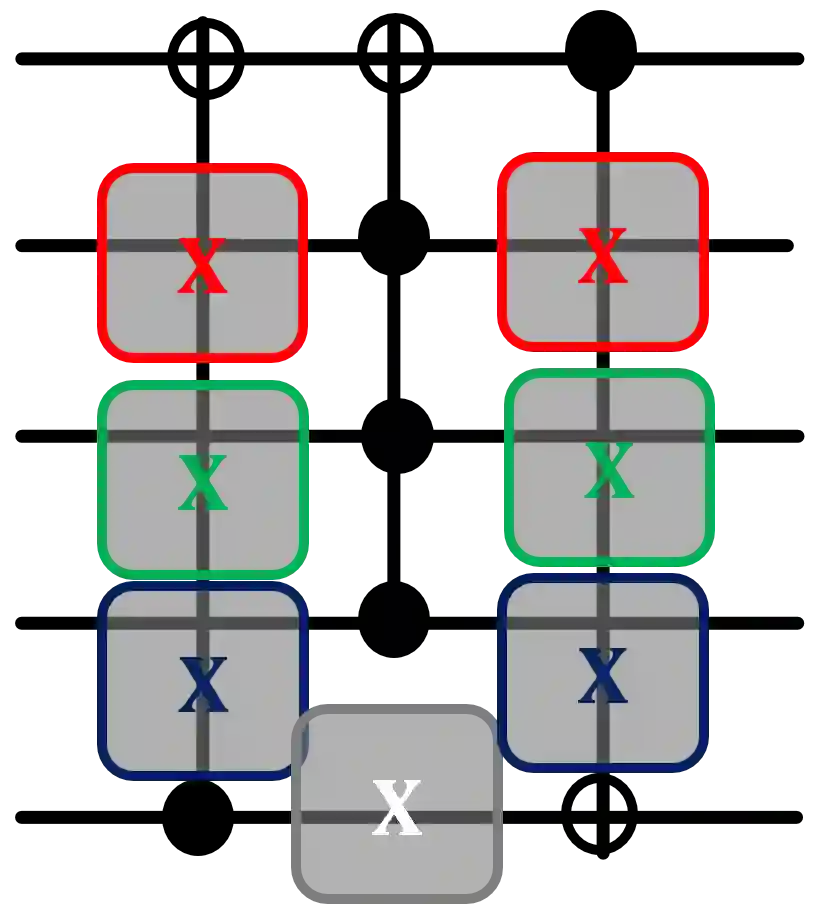
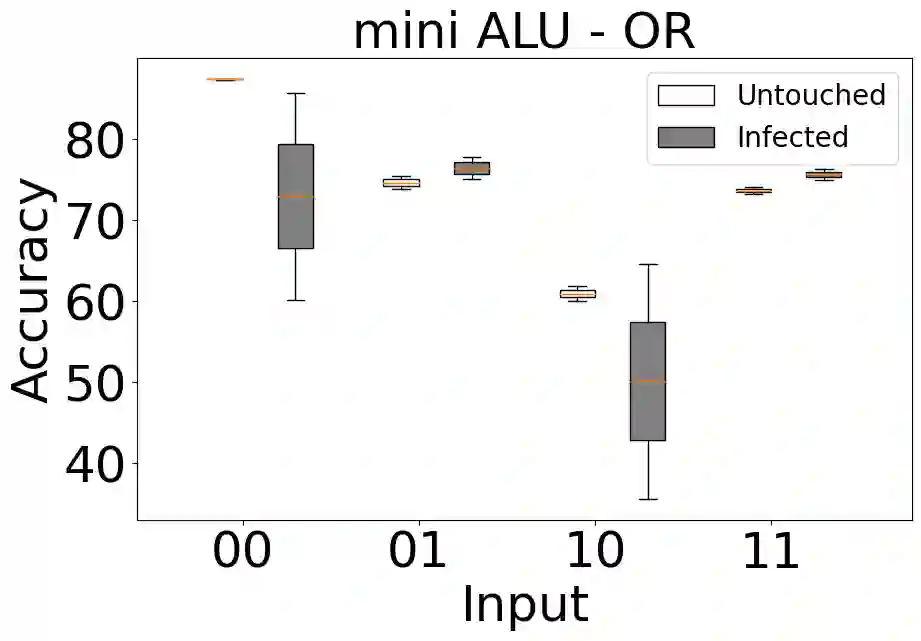
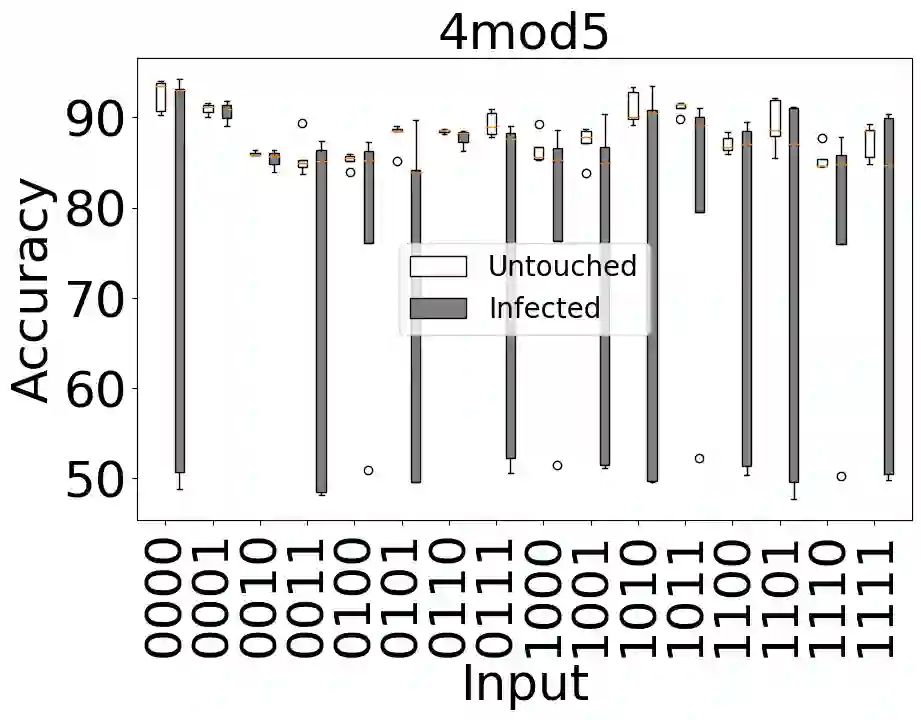
The reliability of the outcome of a quantum circuit in near-term noisy quantum computers depends on the gate count and depth for a given problem. Circuits with a short depth and lower gate count can yield the correct solution more often than the variant with a higher gate count and depth. To work successfully for Noisy Intermediate Scale Quantum (NISQ) computers, quantum circuits need to be optimized efficiently using a compiler that decomposes high-level gates to native gates of the hardware. Many 3rd party compilers are being developed for lower compilation time, reduced circuit depth, and lower gate count for large quantum circuits. Such compilers, or even a specific release version of a compiler that is otherwise trustworthy, may be unreliable and give rise to security risks such as insertion of a quantum trojan during compilation that evades detection due to the lack of a golden/Oracle model in quantum computing. Trojans may corrupt the functionality to give flipped probabilities of basis states, or result in a lower probability of correct basis states in the output. In this paper, we investigate and discuss the impact of a single qubit Trojan (we have chosen a Hadamard gate and a NOT gate) inserted one at a time at various locations in benchmark quantum circuits without changing the the depth of the circuit. Results indicate an average of 16.18% degradation for the Hadamard Trojan without noise, and 7.78% with noise. For the NOT Trojan (with noise) there is 14.6% degradation over all possible inputs. We then discuss the detection of such Trojans in a quantum circuit using CNN-based classifier achieving an accuracy of 90%.
翻译:在近期有噪声的量子计算机中,量子电路输出的可靠性取决于特定问题的门数量和电路深度。深度较浅、门数量较少的电路比门数和深度较大的电路更容易得到正确解。为了在噪声中等规模量子(NISQ)计算机上成功运行,量子电路需要通过编译器高效优化,将高级门分解为硬件的原生门。目前,许多第三方编译器正在开发中,以缩短编译时间、降低电路深度和减少大型量子电路的门数。此类编译器,甚至是原本可信的编译器特定版本,可能不可靠,并引发安全风险,例如在编译过程中插入量子木马,且由于量子计算中缺乏黄金/参考模型而难以检测。木马可能破坏功能,导致基态的概率翻转,或降低输出中正确基态的概率。本文研究并讨论了在基准量子电路中不同位置逐个插入单量子比特木马(我们选择了Hadamard门和NOT门)而不改变电路深度的影响。结果表明,无噪声情况下Hadamard木马导致平均16.18%的性能下降,有噪声情况下则为7.78%。对于NOT木马(有噪声),所有可能输入的平均性能下降为14.6%。随后,我们讨论了使用基于CNN的分类器检测此类量子电路木马的方法,准确率达到90%。






相关内容




 微信扫码咨询专知VIP会员