

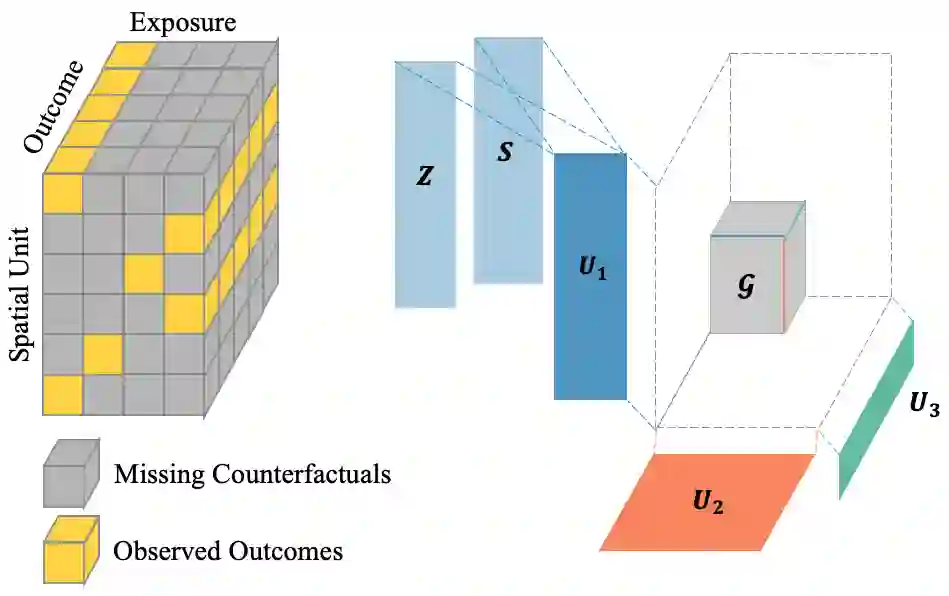
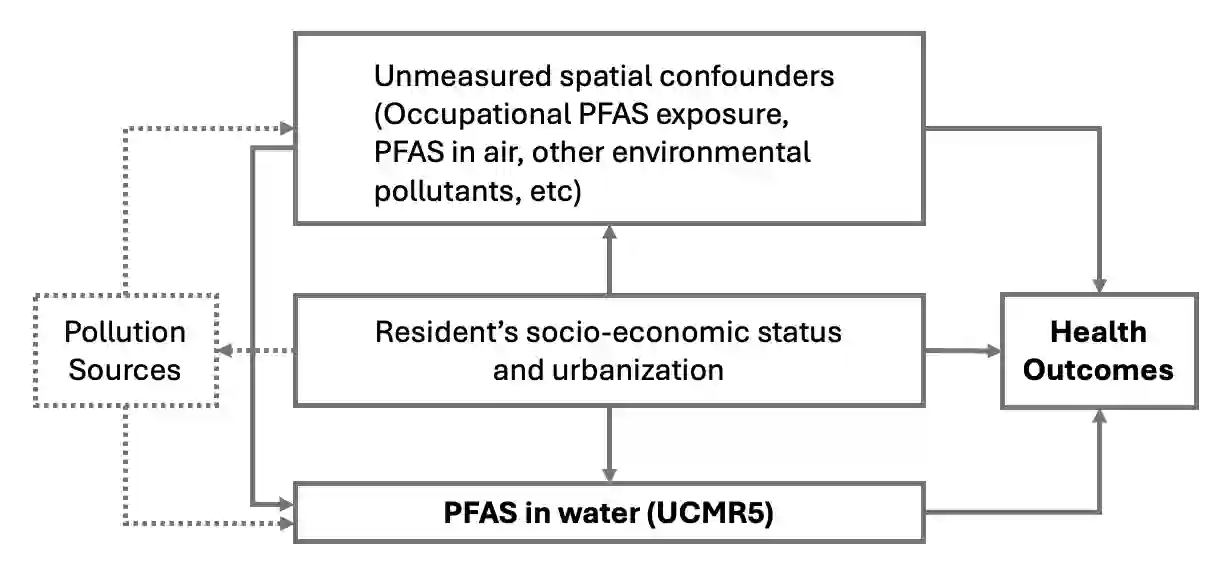
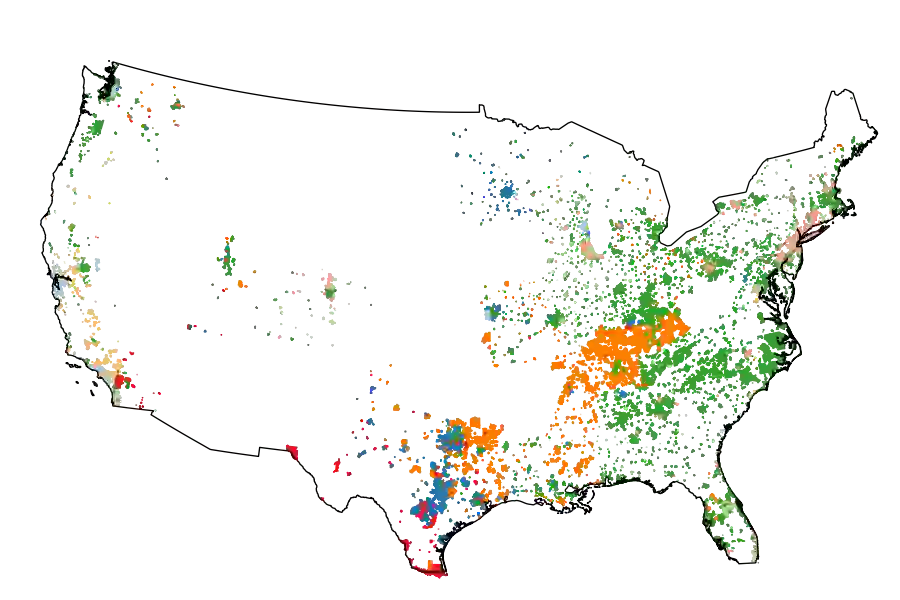
Per- and polyfluoroalkyl substances (PFAS) are typically encountered as mixtures of distinct chemicals with distinct effects on multiple health outcomes. Estimating joint causal effects using spatially-dependent observed data is challenging. We propose a spatial causal tensor completion framework that jointly models multiple exposures and outcomes within a low-rank tensor structure, while adjusting for observed confounders and latent spatial confounders. This method combines a low-rank tensor representation to pool information across exposures and outcomes with a spectral adjustment step that incorporates graph-Laplacian eigenvectors to approximate unmeasured spatial confounders, implemented via a projected-gradient descent algorithm. This framework enables causal inference in the presence of unmeasured spatial confounding and pervasive missingness of potential outcomes. We establish theoretical guarantees for the estimator and evaluate its finite-sample performance through extensive simulations. In an application to national PFAS monitoring data, our approach yields more conservative and credible causal relationships between PFOA and PFOS exposure and 13 chronic disease outcomes compared with existing alternatives.
翻译:全氟及多氟烷基化合物(PFAS)通常以混合物的形式存在,其中不同化学物质对多种健康结局具有不同影响。利用空间依赖性观测数据估计联合因果效应具有挑战性。本文提出一种空间因果张量补全框架,该框架在低秩张量结构中联合建模多重暴露与多重结局,同时调整观测混杂因子与潜在空间混杂因子。该方法结合了跨暴露与结局信息共享的低秩张量表示,以及通过图拉普拉斯特征向量逼近未测量空间混杂因子的谱调整步骤,并通过投影梯度下降算法实现。该框架能够在存在未测量空间混杂和潜在结局普遍缺失的情况下进行因果推断。我们为估计量建立了理论保证,并通过大量模拟评估了其有限样本性能。在国家PFAS监测数据的应用中,相较于现有方法,本方法在PFOA和PFOS暴露与13种慢性疾病结局之间获得了更保守且更可信的因果关系。




相关内容



 微信扫码咨询专知VIP会员