

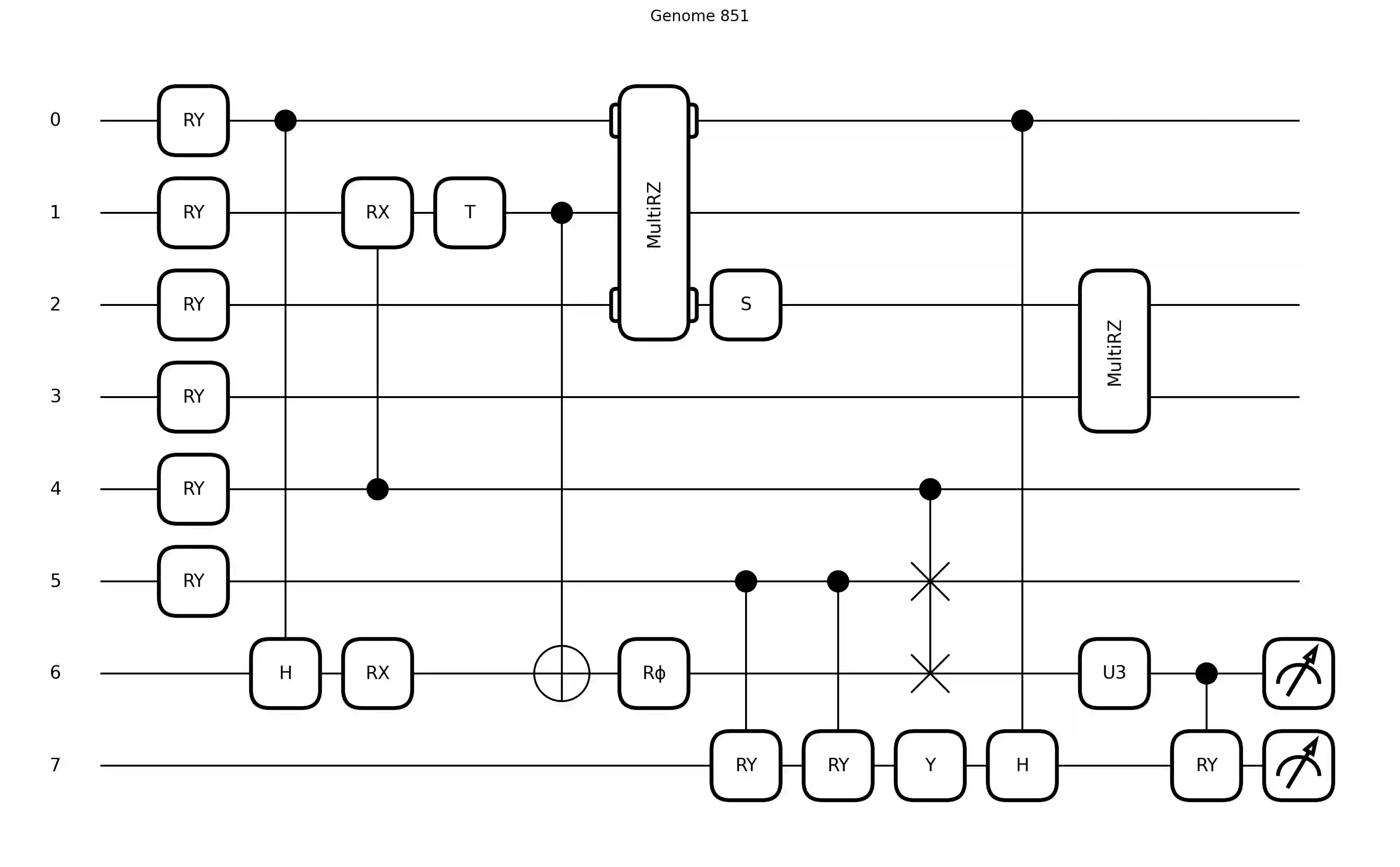
Designing effective quantum circuits remains a central challenge in quantum computing, as circuit structure strongly influences expressivity, trainability, and hardware feasibility. Current approaches, whether using manually designed circuit templates, fixed heuristics, or automated rules, face limitations in scalability, flexibility, and adaptability, often producing circuits that are poorly matched to the specific problem or quantum hardware. In this work, we propose the Evolutionary eXploration of Augmenting Quantum Circuits (EXAQC), an evolutionary approach to the automated design and training of parameterized quantum circuits (PQCs) which leverages and extends on strategies from neuroevolution and genetic programming. The proposed method jointly searches over gate types, qubit connectivity, parameterization, and circuit depth while respecting hardware and noise constraints. The method supports both Qiskit and Pennylane libraries, allowing the user to configure every aspect. This work highlights evolutionary search as a critical tool for advancing quantum machine learning and variational quantum algorithms, providing a principled pathway toward scalable, problem-aware, and hardware-efficient quantum circuit design. Preliminary results demonstrate that circuits evolved on classification tasks are able to achieve over 90% accuracy on most of the benchmark datasets with a limited computational budget, and are able to emulate target circuit quantum states with high fidelity scores.
翻译:设计高效的量子电路仍然是量子计算中的核心挑战,因为电路结构强烈影响表达能力、可训练性和硬件可行性。当前方法,无论是使用手动设计的电路模板、固定启发式规则还是自动化规则,都在可扩展性、灵活性和适应性方面面临局限,常常产生与具体问题或量子硬件匹配不佳的电路。在本工作中,我们提出增强量子电路的进化探索方法(EXAQC),这是一种用于参数化量子电路(PQCs)自动化设计与训练的进化方法,该方法借鉴并扩展了神经进化和遗传编程的策略。所提出的方法在遵循硬件和噪声约束的同时,联合搜索门类型、量子比特连接性、参数化方案和电路深度。该方法支持Qiskit和Pennylane两种库,允许用户配置所有方面。本工作强调进化搜索作为推进量子机器学习和变分量子算法的关键工具,为可扩展、问题感知且硬件高效的量子电路设计提供了原则性路径。初步结果表明,在分类任务上演化得到的电路能够在有限计算预算下,在大多数基准数据集上实现超过90%的准确率,并且能够以高保真度分数模拟目标电路的量子态。




相关内容




 微信扫码咨询专知VIP会员