

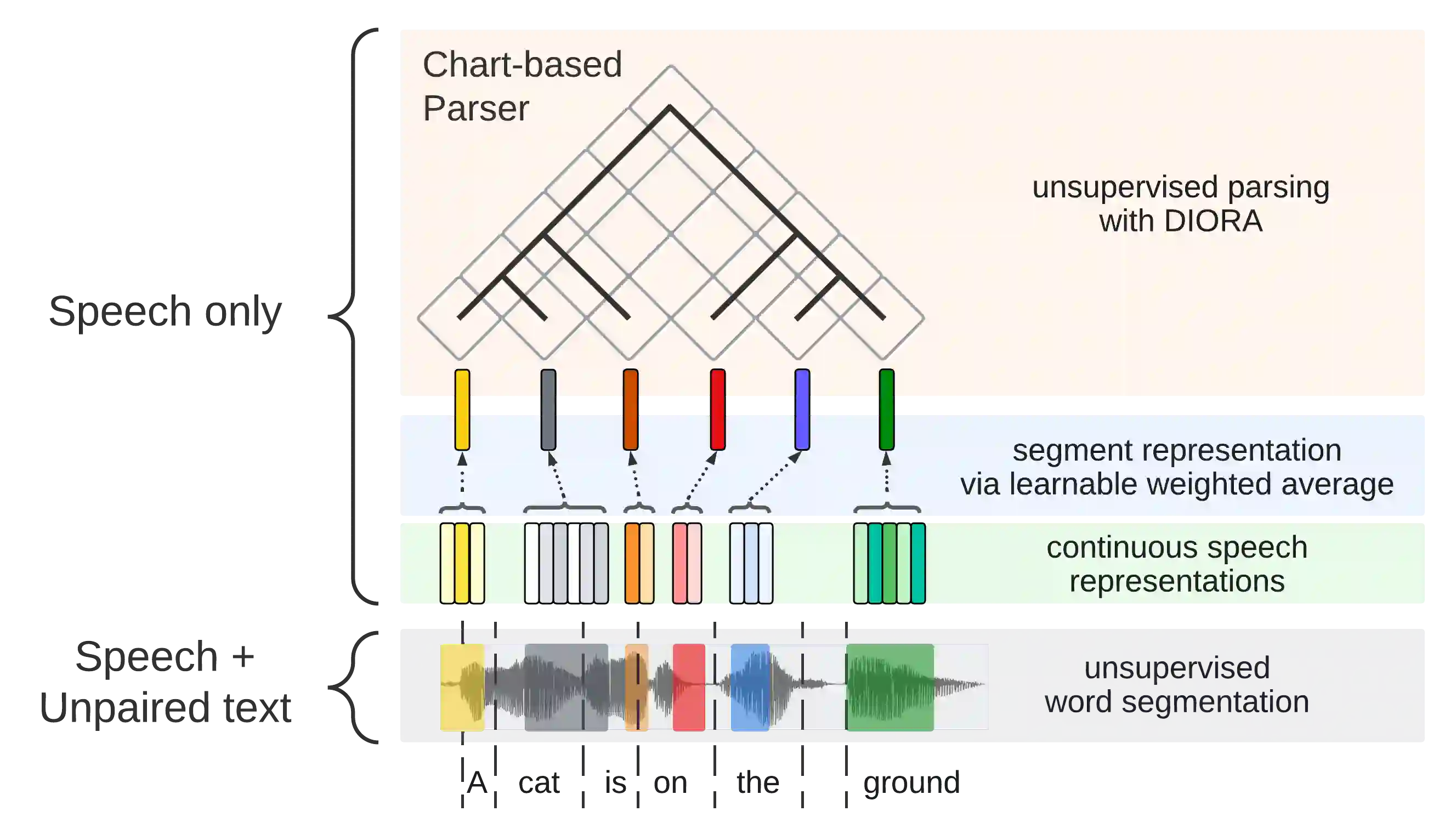
Past work on unsupervised parsing is constrained to written form. In this paper, we present the first study on unsupervised spoken constituency parsing given unlabeled spoken sentences and unpaired textual data. The goal is to determine the spoken sentences' hierarchical syntactic structure in the form of constituency parse trees, such that each node is a span of audio that corresponds to a constituent. We compare two approaches: (1) cascading an unsupervised automatic speech recognition (ASR) model and an unsupervised parser to obtain parse trees on ASR transcripts, and (2) direct training an unsupervised parser on continuous word-level speech representations. This is done by first splitting utterances into sequences of word-level segments, and aggregating self-supervised speech representations within segments to obtain segment embeddings. We find that separately training a parser on the unpaired text and directly applying it on ASR transcripts for inference produces better results for unsupervised parsing. Additionally, our results suggest that accurate segmentation alone may be sufficient to parse spoken sentences accurately. Finally, we show the direct approach may learn head-directionality correctly for both head-initial and head-final languages without any explicit inductive bias.
翻译:过往的无监督句法分析研究局限于书面语形式。本文首次针对无标注口语语句及无配对文本数据,提出无监督口语成分句法分析研究。其目标是以成分句法树形式确定口语语句的层级句法结构,使每个节点对应一个成分的音频片段。我们对比了两种方法:(1) 级联无监督自动语音识别(ASR)模型与无监督解析器,从ASR转写文本中获取句法树;(2) 在连续的词级语音表征上直接训练无监督解析器。具体实现时,首先将话语切分为词级片段序列,聚合各片段内的自监督语音表征以获取片段嵌入。实验发现:对未配对文本单独训练解析器并直接应用于ASR转写文本进行推理,可获得更优的无监督解析效果。此外,结果表明仅依赖精确的片段切分即可准确解析口语语句。最终,我们证实直接方法能在不引入显式归纳偏好的情况下,正确学习头初始语和头最终语两种语言的头方向性规则。






相关内容




 微信扫码咨询专知VIP会员