

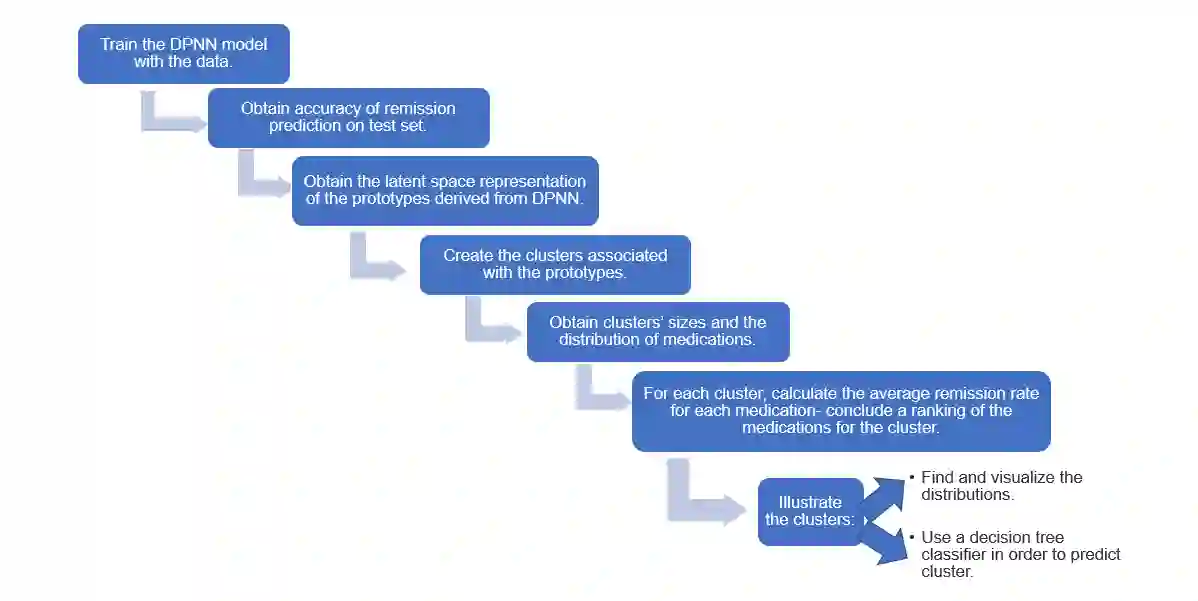
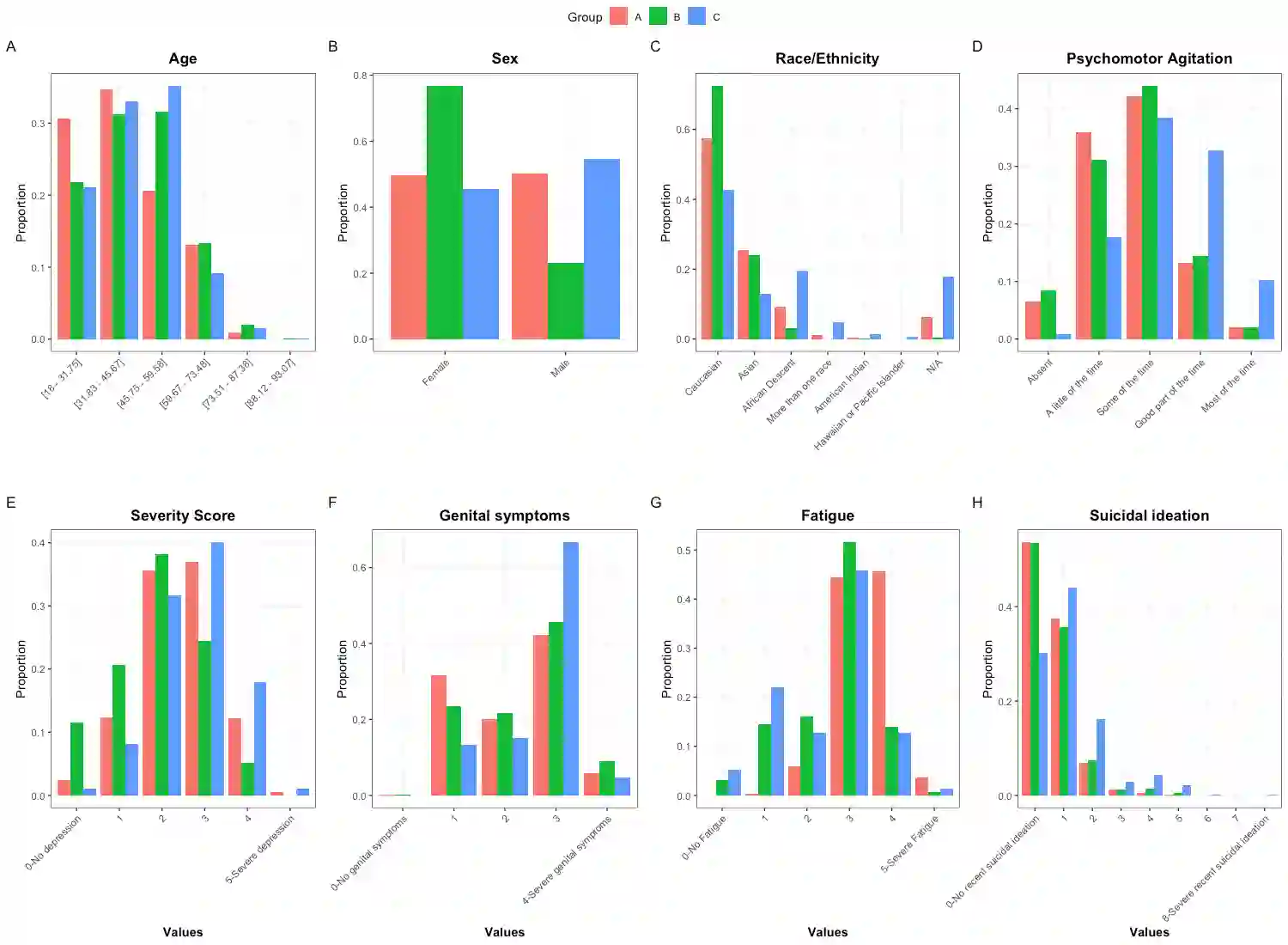
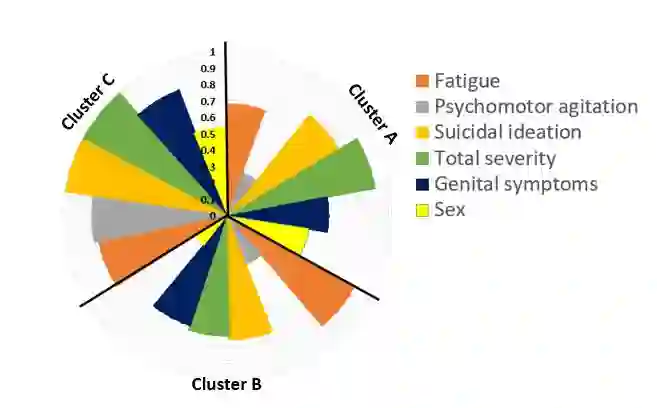
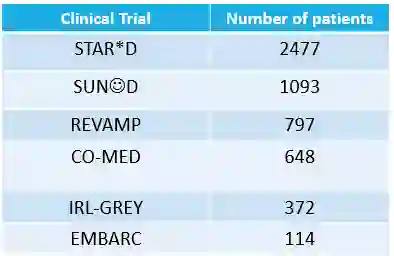
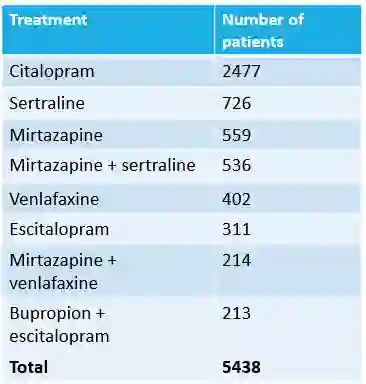
Major depressive disorder (MDD) is a heterogeneous condition; multiple underlying neurobiological substrates could be associated with treatment response variability. Understanding the sources of this variability and predicting outcomes has been elusive. Machine learning has shown promise in predicting treatment response in MDD, but one limitation has been the lack of clinical interpretability of machine learning models. We analyzed data from six clinical trials of pharmacological treatment for depression (total n = 5438) using the Differential Prototypes Neural Network (DPNN), a neural network model that derives patient prototypes which can be used to derive treatment-relevant patient clusters while learning to generate probabilities for differential treatment response. A model classifying remission and outputting individual remission probabilities for five first-line monotherapies and three combination treatments was trained using clinical and demographic data. Model validity and clinical utility were measured based on area under the curve (AUC) and expected improvement in sample remission rate with model-guided treatment, respectively. Post-hoc analyses yielded clusters (subgroups) based on patient prototypes learned during training. Prototypes were evaluated for interpretability by assessing differences in feature distributions and treatment-specific outcomes. A 3-prototype model achieved an AUC of 0.66 and an expected absolute improvement in population remission rate compared to the sample remission rate. We identified three treatment-relevant patient clusters which were clinically interpretable. It is possible to produce novel treatment-relevant patient profiles using machine learning models; doing so may improve precision medicine for depression. Note: This model is not currently the subject of any active clinical trials and is not intended for clinical use.
翻译:重度抑郁症(MDD)是一种异质性疾病;多种潜在的神经生物学底物可能与治疗应答的变异性相关。理解这种变异性的来源并预测结局一直颇具挑战。机器学习在预测MDD治疗应答方面展现出潜力,但其局限性之一在于机器学习模型缺乏临床可解释性。我们利用差分原型神经网络(DPNN)分析了六项抑郁症药物治疗临床试验的数据(总样本量n=5438)。该神经网络模型可推导出患者原型,进而用于在学习生成差异化治疗应答概率的同时,提取与治疗相关的患者聚类。研究人员利用临床和人口统计学数据训练了一个模型,该模型可分类缓解状态并输出五种一线单药治疗和三种联合治疗方案的个体化缓解概率。模型的有效性通过曲线下面积(AUC)衡量,临床效用则通过模型引导治疗下样本缓解率的预期改善程度评估。事后分析基于训练过程中学习的患者原型生成了聚类(亚组)。通过评估特征分布差异和治疗特异性结局,对原型的可解释性进行了评价。一个三原型模型实现了0.66的AUC,相较于样本缓解率,人群缓解率的预期绝对改善值被计算得出。我们识别出三个与治疗相关的患者聚类,且这些聚类具有临床可解释性。利用机器学习模型有可能生成新的治疗相关患者画像;此举或可改善抑郁症的精准医学。注:该模型目前未作为任何活跃临床试验的研究对象,亦不适用于临床使用。




相关内容



 微信扫码咨询专知VIP会员