

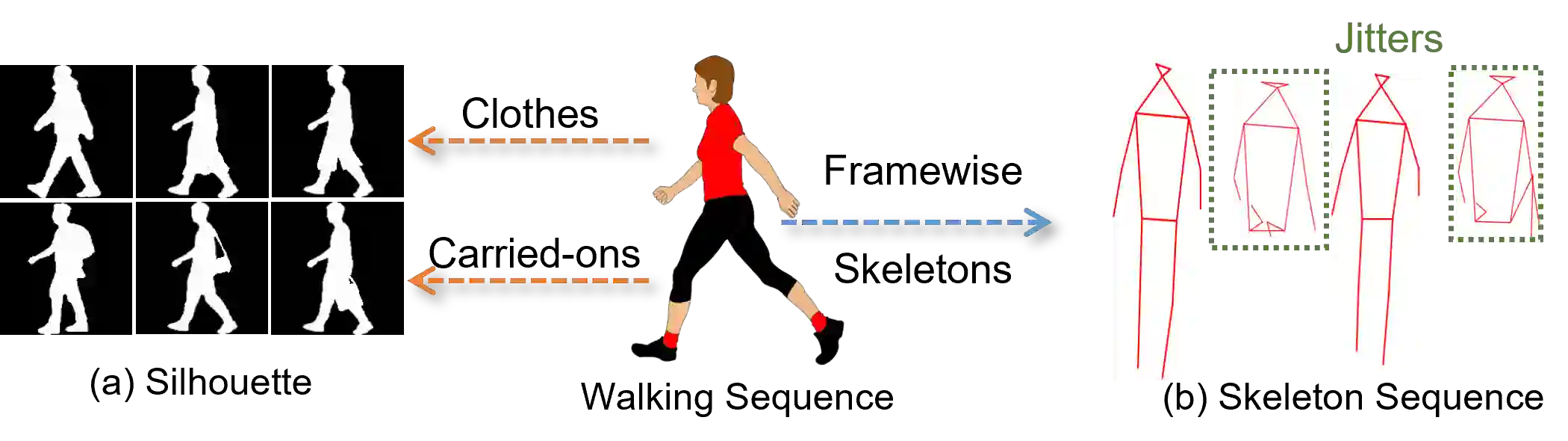
Identifying humans with their walking sequences, known as gait recognition, is a useful biometric understanding task as it can be observed from a long distance and does not require cooperation from the subject. Two common modalities used for representing the walking sequence of a person are silhouettes and joint skeletons. Silhouette sequences, which record the boundary of the walking person in each frame, may suffer from the variant appearances from carried-on objects and clothes of the person. Framewise joint detections are noisy and introduce some jitters that are not consistent with sequential detections. In this paper, we combine the silhouettes and skeletons and refine the framewise joint predictions for gait recognition. With temporal information from the silhouette sequences, we show that the refined skeletons can improve gait recognition performance without extra annotations. We compare our methods on four public datasets, CASIA-B, OUMVLP, Gait3D and GREW, and show state-of-the-art performance.
翻译:步态识别是一种通过行走序列进行身份识别的生物特征理解任务,其优势在于可在远距离观测且无需被测者配合。当前用于表征人体行走序列的两种常见模态为轮廓和关节骨架。记录每帧步行者边界的轮廓序列,易受手持物品及衣着等外观变化干扰。逐帧关节检测存在噪声,且会产生与序列化检测不一致的抖動。本文融合轮廓与骨架信息,对逐帧关节点预测进行精细化处理以实现步态识别。利用轮廓序列中的时序信息,我们证明在不依赖额外标注条件下,精细化骨架可有效提升步态识别性能。在CASIA-B、OUMVLP、Gait3D与GREW四个公开数据集上的实验表明,我们提出的方法达到了当前最优性能。





相关内容




 微信扫码咨询专知VIP会员