

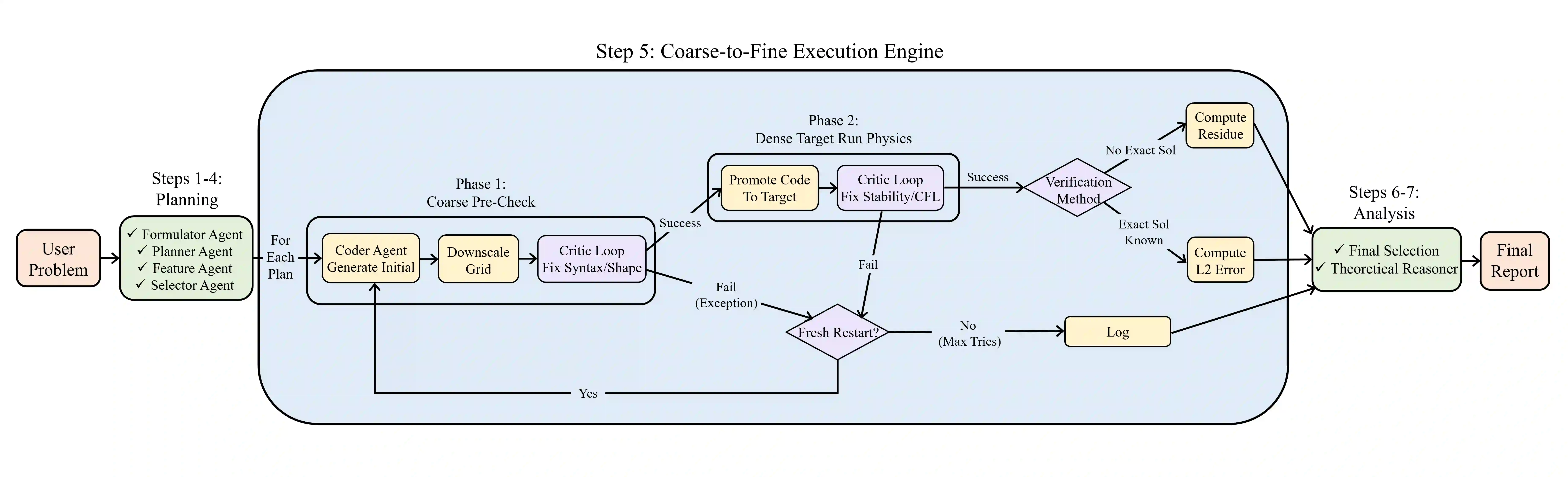
PDEs are central to scientific and engineering modeling, yet designing accurate numerical solvers typically requires substantial mathematical expertise and manual tuning. Recent neural network-based approaches improve flexibility but often demand high computational cost and suffer from limited interpretability. We introduce \texttt{AutoNumerics}, a multi-agent framework that autonomously designs, implements, debugs, and verifies numerical solvers for general PDEs directly from natural language descriptions. Unlike black-box neural solvers, our framework generates transparent solvers grounded in classical numerical analysis. We introduce a coarse-to-fine execution strategy and a residual-based self-verification mechanism. Experiments on 24 canonical and real-world PDE problems demonstrate that \texttt{AutoNumerics} achieves competitive or superior accuracy compared to existing neural and LLM-based baselines, and correctly selects numerical schemes based on PDE structural properties, suggesting its viability as an accessible paradigm for automated PDE solving.
翻译:偏微分方程(PDE)是科学与工程建模的核心,然而设计精确的数值求解器通常需要深厚的数学专业知识与大量人工调参。近期基于神经网络的方法提升了灵活性,但往往计算成本高昂且可解释性有限。本文提出 \texttt{AutoNumerics},一种多智能体框架,能够直接从自然语言描述出发,自主设计、实现、调试并验证通用偏微分方程的数值求解器。与黑箱神经求解器不同,本框架生成的求解器基于经典数值分析原理,具有透明性。我们提出了一种由粗到精的执行策略以及基于残差的自验证机制。在24个经典与现实偏微分方程问题上的实验表明,\texttt{AutoNumerics} 相比现有神经方法与基于大语言模型的基线取得了相当或更优的精度,并能依据偏微分方程的结构特性正确选择数值格式,这预示着其有望成为一种易于使用的自动化偏微分方程求解范式。




相关内容



 微信扫码咨询专知VIP会员