

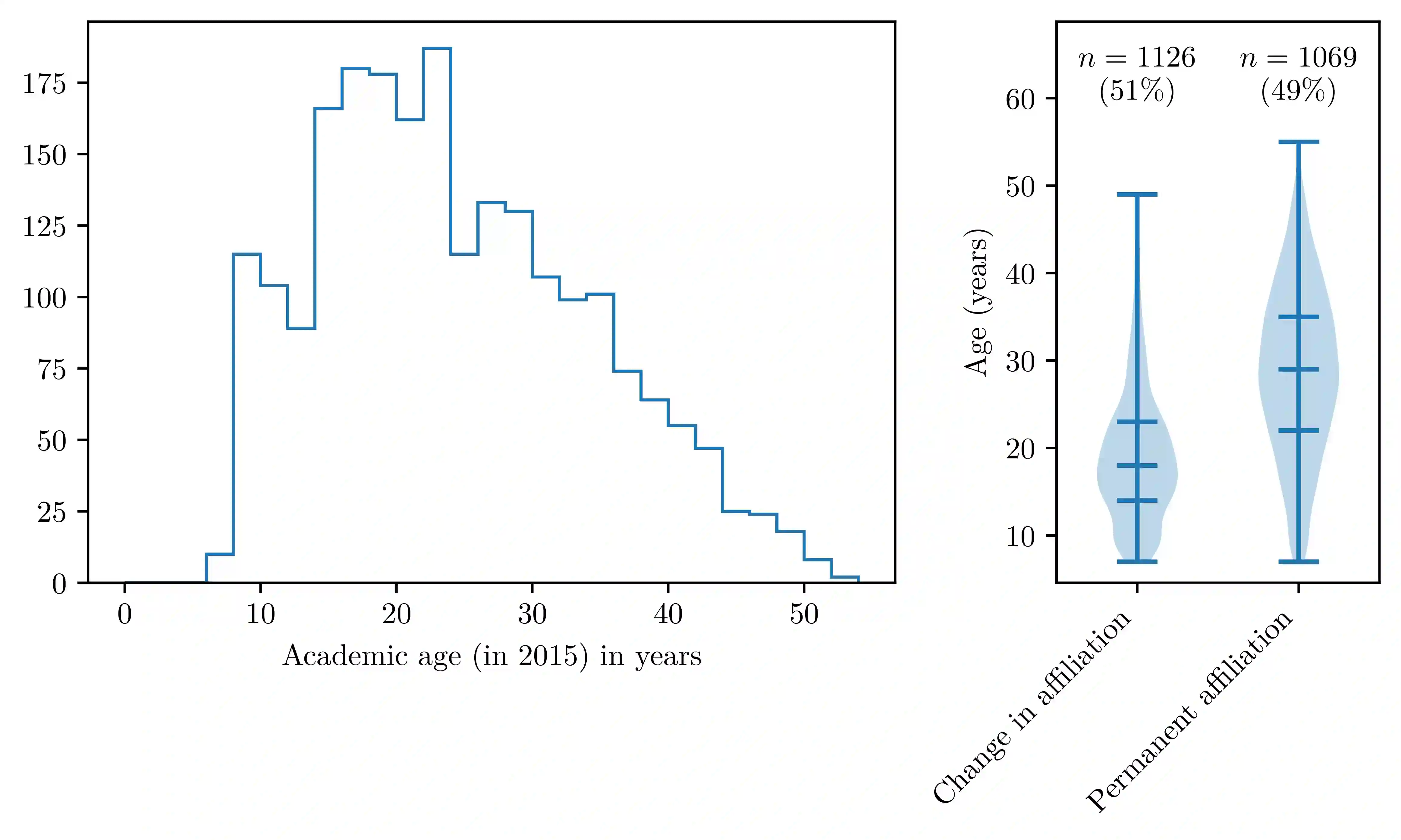
How scientists navigate between the need to capitalize on their prior knowledge by specializing, and the urge to adapt to evolving research opportunities? Drawing from diverse perspectives on adaptation, in particular from institutional change and cultural evolution, this paper proposes an unsupervised Bayesian model of the evolution of scientists' research portfolios in response to transformations in their field. The model relies on scientific abstracts and authorship data to evaluate the influence of intellectual, social, and institutional resources on scientists' trajectories within a cohort of $2\,195$ high-energy physicists between 2000 and 2019. The reallocation of research efforts is shown to be shaped by learning costs, thus enhancing the utility of the scientific capital disseminated among scientists. Two dimensions of social capital, namely ``diversity'' and ``power'', have opposite effects on the magnitude of change in scientists' research interests: while ``diversity'' disrupts and expands research interests, ``power'' stabilizes physicists' research agendas -- as does institutional stability. Social capital plays a more crucial role in shifts between cognitively distant research areas. This contribution paves the way for further investigation of science and scientific communities as adaptative systems.
翻译:科学家如何在利用先前知识进行专业化与适应不断演变的研究机遇之间做出抉择?本文借鉴适应性的多元视角(特别是制度变革与文化演化理论),提出了一种无监督贝叶斯模型,用以描述科学家研究组合随领域变革而演化的过程。该模型基于科学摘要与作者署名数据,评估智力资本、社会资本与制度资本对2000至2019年间2195名高能物理学家科研轨迹的影响。研究表明,研究精力的重新配置受制于学习成本,从而提升了科学家群体中科学资本的效用。社会资本的两个维度——“多样性”与“影响力”——对科学家研究兴趣变化的幅度产生相反效应:“多样性”打破并扩展研究兴趣,而“影响力”与制度稳定性共同固化物理学家的研究议程。当研究领域在认知层面相距较远时,社会资本的调节作用更为显著。本研究为将科学与科学社群视为适应性系统进行深入探究铺平了道路。







相关内容





 微信扫码咨询专知VIP会员