

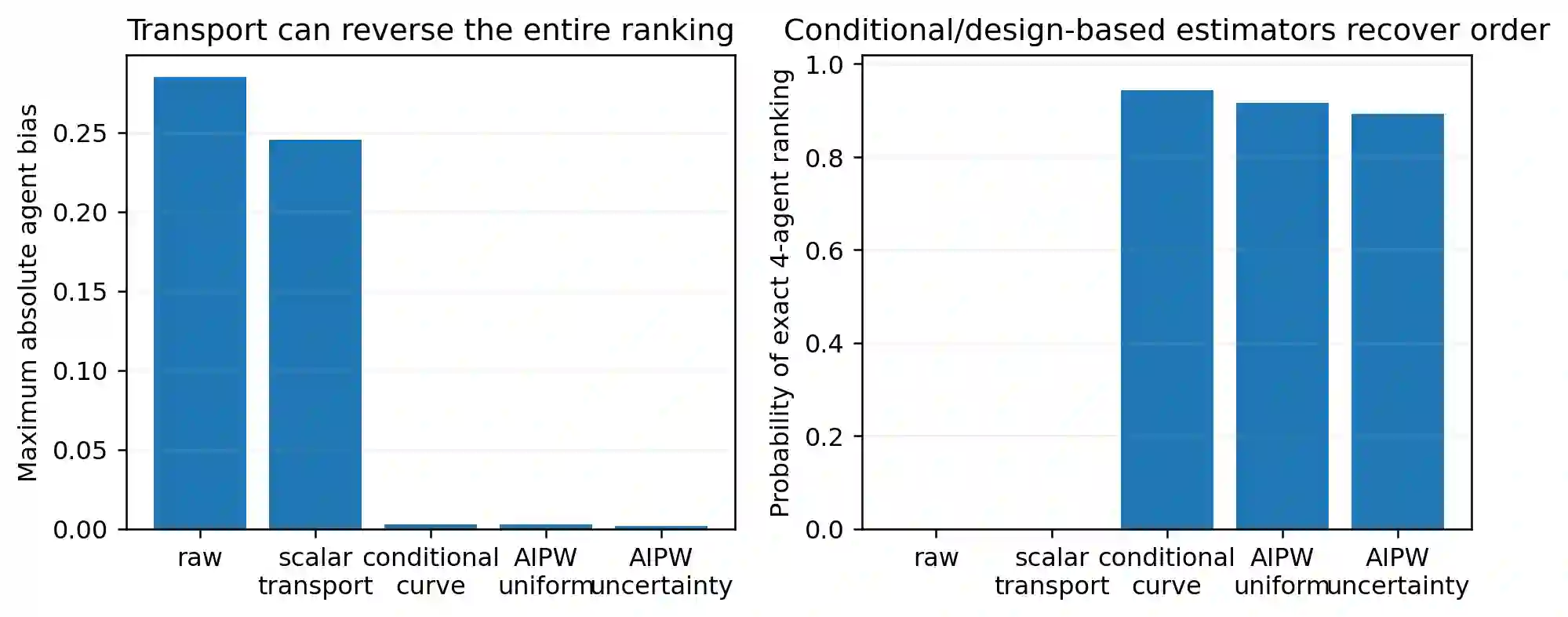
Large language model (LLM) agents are often ranked by an LLM judge whose error rates are measured once and reused for every agent. The corrected success rates can then be biased when the judge's errors depend on the trajectory and agents differ in the trajectories they produce for successes or failures. We derive the exact asymptotic bias and give a chain of checks from identification to simultaneous ranks. On a four-agent semi-synthetic benchmark, a scalar correction with oracle calibration has maximum bias 0.245 and mean pointwise coverage 0.016, and never recovers the full ranking (0/250 replications). Augmented inverse-probability weighting (AIPW) with a uniform or a design-aware random audit keeps the maximum bias below 0.003, with mean pointwise coverage of 0.939 and 0.950. In a 48-cell stress test, effective target support rises only from 0.209 to 0.805 as calibration grows from 600 to 4,800 labels, while audited AIPW keeps a mean absolute error of 0.018-0.020. Without calibration support, or with judge dependence within an externally justified bound, we report valid bounds or sensitivity sets and carry them into rank sets. An e-process confidence sequence stays valid, for a stable target, under predictable adaptive auditing and arbitrary stopping.
翻译:暂无翻译




相关内容



 微信扫码咨询专知VIP会员