

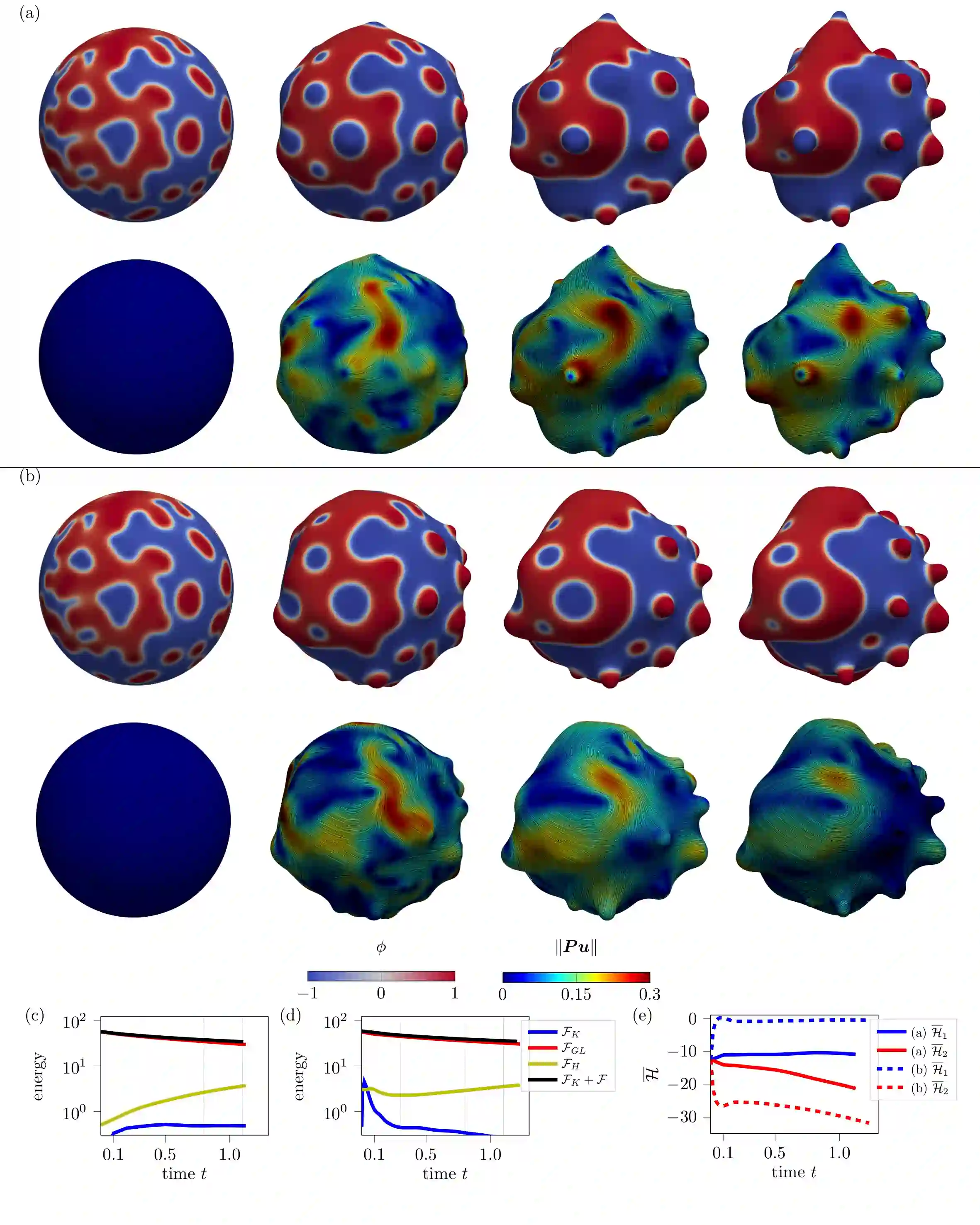
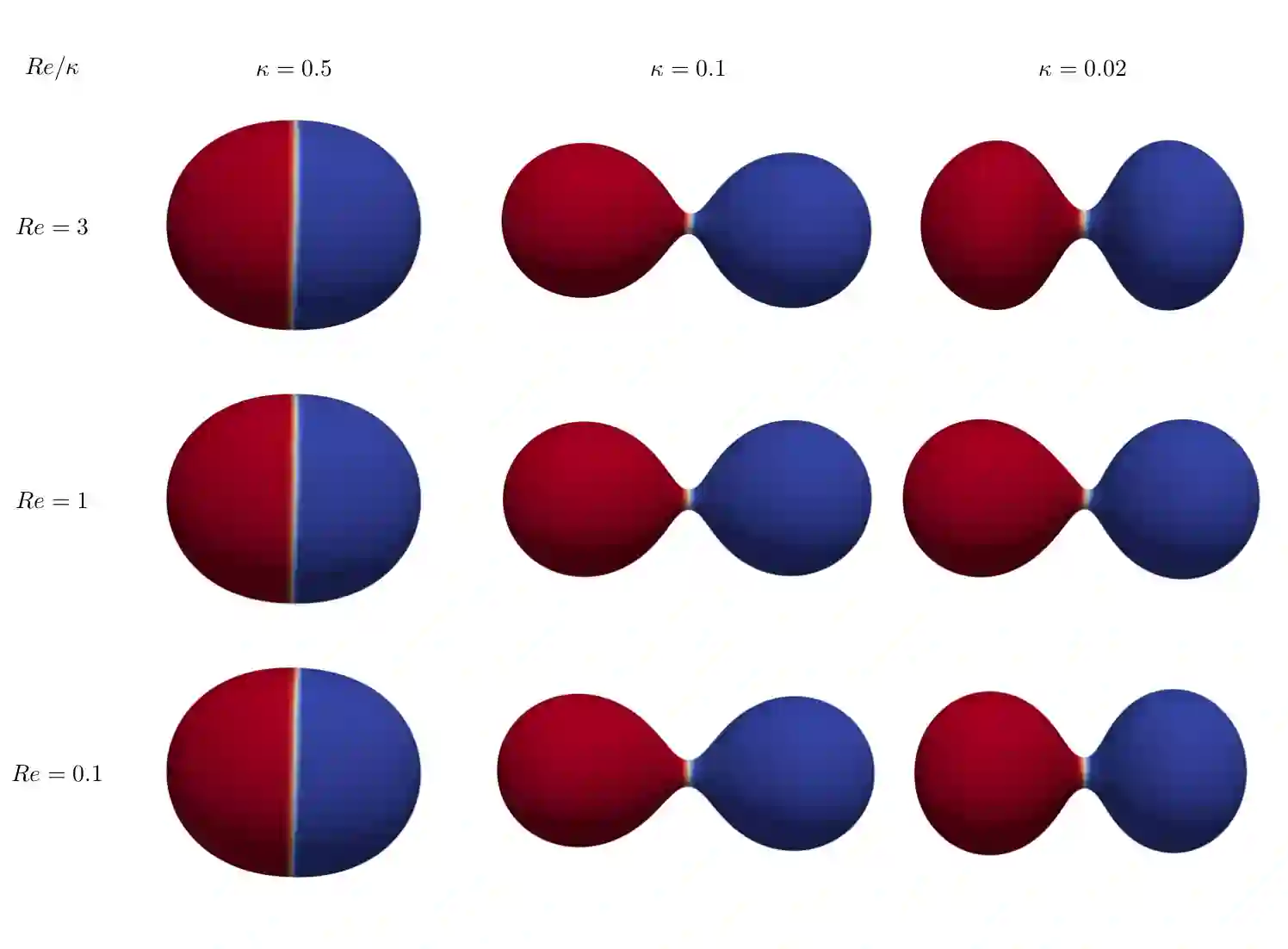
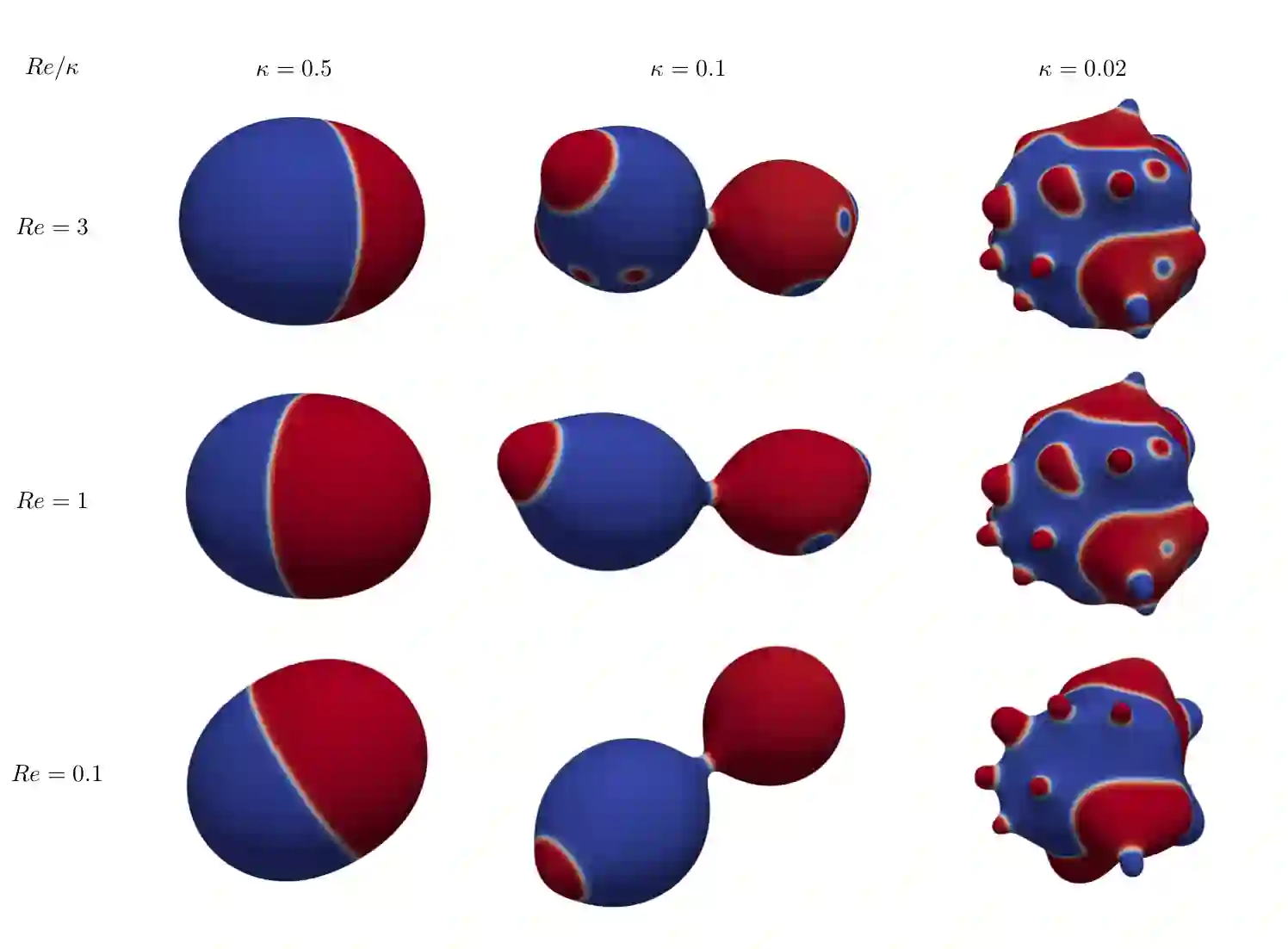
We consider two-phase fluid deformable surfaces as model systems for biomembranes. Such surfaces are modeled by incompressible surface Navier-Stokes-Cahn-Hilliard-like equations with bending forces. We derive this model using the Lagrange-D'Alembert principle considering various dissipation mechanisms. The highly nonlinear model is solved numerically to explore the tight interplay between surface evolution, surface phase composition, surface curvature and surface hydrodynamics. It is demonstrated that hydrodynamics can enhance bulging and furrow formation, which both can further develop to pinch-offs. The numerical approach builds on a Taylor-Hood element for the surface Navier-Stokes part, a semi-implicit approach for the Cahn-Hilliard part, higher order surface parametrizations, appropriate approximations of the geometric quantities, and mesh redistribution. We demonstrate convergence properties that are known to be optimal for simplified sub-problems.
翻译:我们以两相流体可变形表面作为生物膜模型系统进行研究。该类表面由包含弯曲力的不可压缩表面Navier-Stokes-Cahn-Hilliard型方程进行建模。通过考虑多种耗散机制,我们利用Lagrange-D'Alembert原理推导出该模型。对该高度非线性模型进行数值求解,以探索表面演化、表面相组成、表面曲率与表面流体动力学之间的紧密耦合关系。研究表明,流体动力学可促进凸起和沟槽结构的形成,这些结构均可能进一步发展为缩颈断裂。数值方法采用:表面Navier-Stokes部分的Taylor-Hood单元、Cahn-Hilliard部分的半隐式格式、高阶表面参数化、几何量的适当近似以及网格重分布技术。对于简化子问题已知具有最优性的收敛性质,我们验证了其适用性。




相关内容





 微信扫码咨询专知VIP会员