

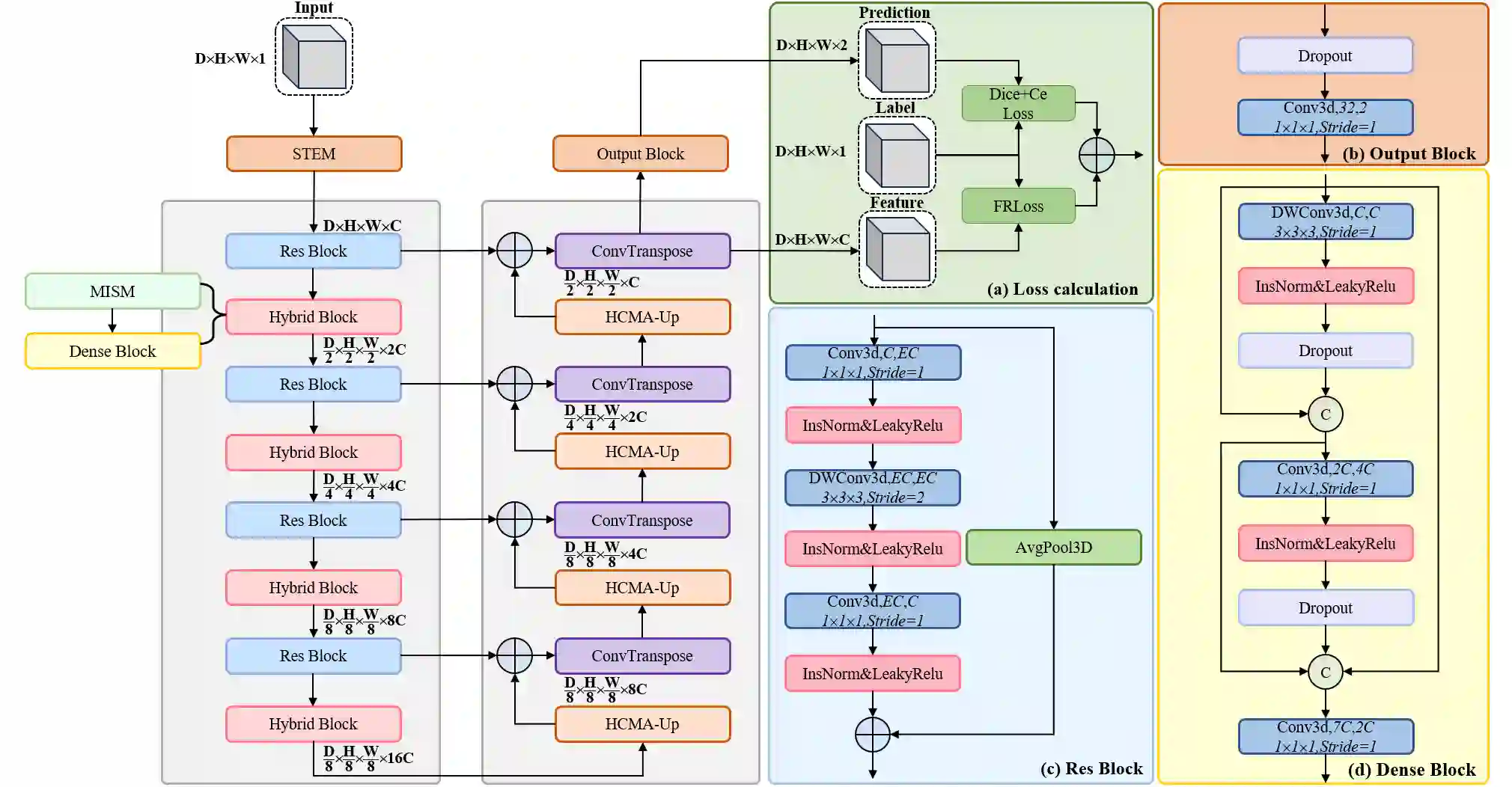
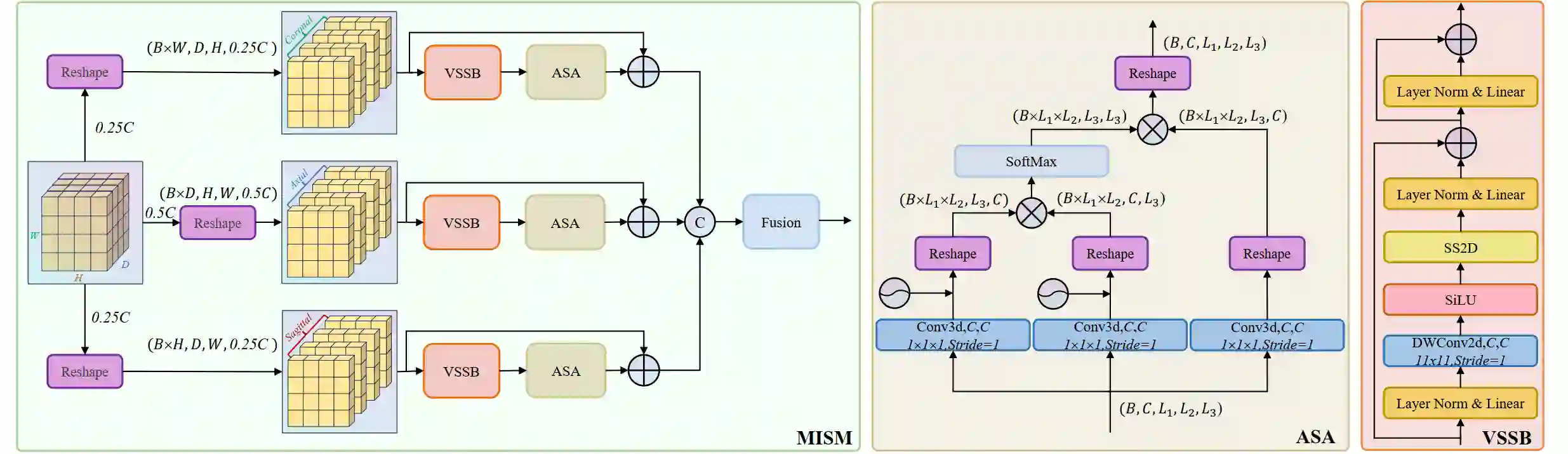
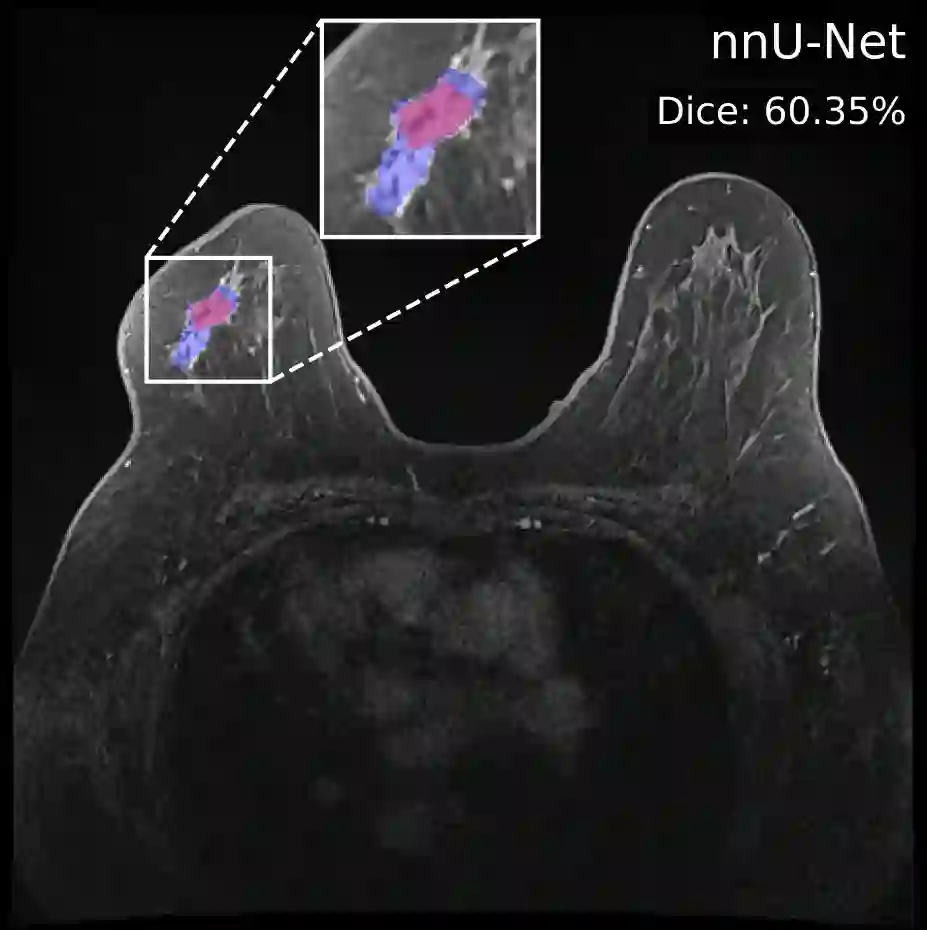
Breast cancer lesion segmentation in DCE-MRI remains challenging due to heterogeneous tumor morphology and indistinct boundaries. To address these challenges, this study proposes a novel hybrid segmentation network, HCMA-UNet, for lesion segmentation of breast cancer. Our network consists of a lightweight CNN backbone and a Multi-view Axial Self-Attention Mamba (MISM) module. The MISM module integrates Visual State Space Block (VSSB) and Axial Self-Attention (ASA) mechanism, effectively reducing parameters through Asymmetric Split Channel (ASC) strategy to achieve efficient tri-directional feature extraction. Our lightweight model achieves superior performance with 2.87M parameters and 126.44 GFLOPs. A Feature-guided Region-aware loss function (FRLoss) is proposed to enhance segmentation accuracy. Extensive experiments on one private and two public DCE-MRI breast cancer datasets demonstrate that our approach achieves state-of-the-art performance while maintaining computational efficiency. FRLoss also exhibits good cross-architecture generalization capabilities. The source code is available at https://github.com/Haoxuanli-Thu/HCMA-UNet.
翻译:在动态对比增强磁共振成像(DCE-MRI)中,由于肿瘤形态的异质性和边界模糊,乳腺癌病灶分割仍然具有挑战性。为解决这些挑战,本研究提出了一种新颖的混合分割网络HCMA-UNet,用于乳腺癌病灶分割。我们的网络由一个轻量级CNN主干和一个多视图轴向自注意力Mamba(MISM)模块组成。MISM模块集成了视觉状态空间块(VSSB)和轴向自注意力(ASA)机制,并通过非对称分割通道(ASC)策略有效减少参数量,以实现高效的三向特征提取。我们的轻量级模型仅需2.87M参数和126.44 GFLOPs即可实现卓越性能。此外,提出了一种特征引导的区域感知损失函数(FRLoss)以提升分割精度。在一个私有和两个公开的DCE-MRI乳腺癌数据集上进行的大量实验表明,我们的方法在保持计算效率的同时,达到了最先进的性能。FRLoss也展现出良好的跨架构泛化能力。源代码发布于 https://github.com/Haoxuanli-Thu/HCMA-UNet。




相关内容


 微信扫码咨询专知VIP会员