

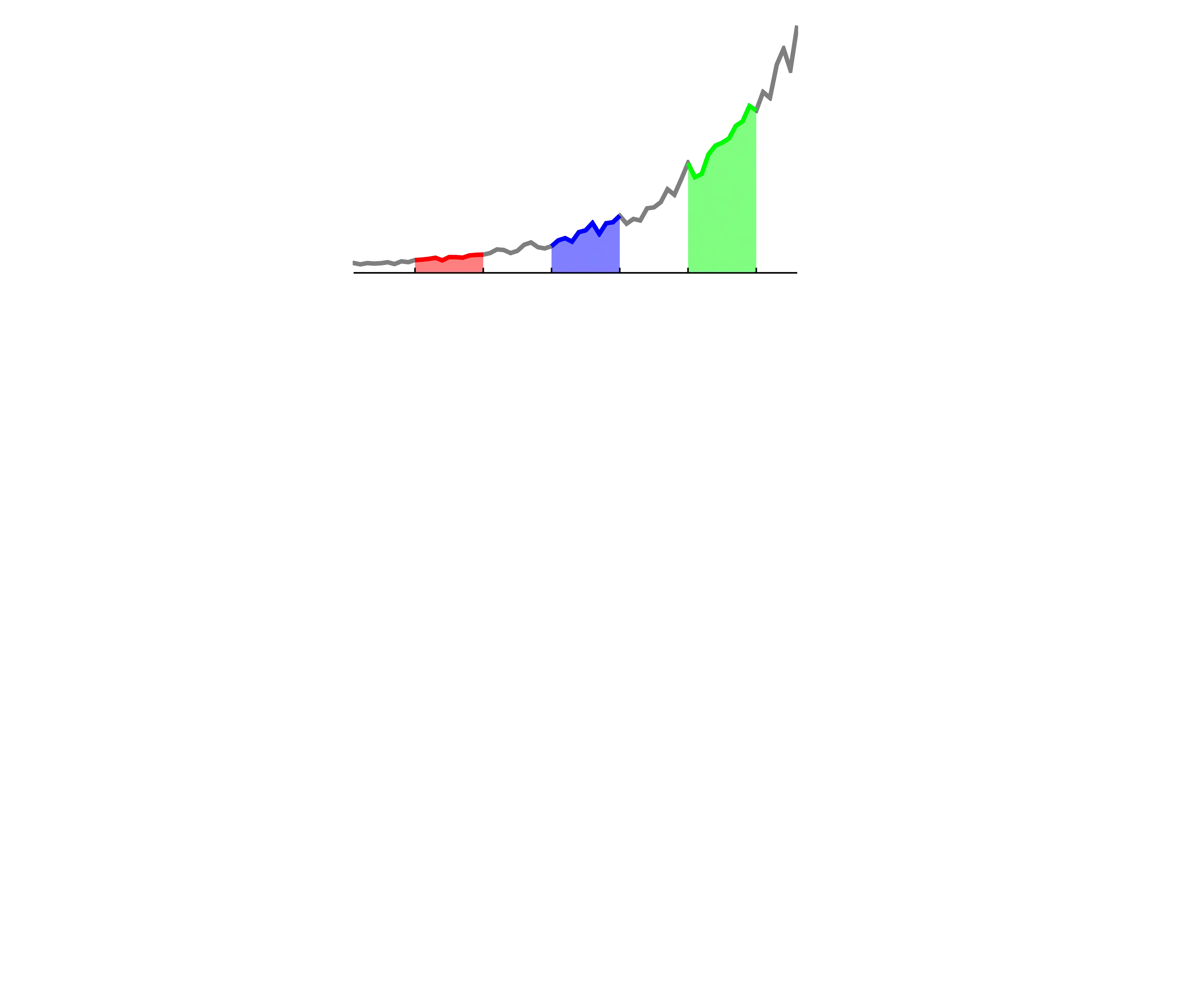
Measuring the rate of innovation in academia and industry is fundamental to monitoring the efficiency and competitiveness of the knowledge economy. To this end, a disruption index (CD) was recently developed and applied to publication and patent citation networks (Wu et al., Nature 2019; Park et al., Nature 2023). Here we show that CD systematically decreases over time due to secular growth in research and patent production, following two distinct mechanisms unrelated to innovation -- one behavioral and the other structural. Whereas the behavioral explanation reflects shifts associated with techno-social factors (e.g. self-citation practices), the structural explanation follows from `citation inflation' (CI), an inextricable feature of real citation networks attributable to increasing reference list lengths, which causes CD to systematically decrease. We demonstrate this causal link by way of mathematical deduction, computational simulation, multi-variate regression, and quasi-experimental comparison of the disruptiveness of PNAS versus PNAS Plus articles, which differ only in their lengths. Accordingly, we analyze CD data available in the SciSciNet database and find that disruptiveness incrementally increased from 2005-2015, and that the negative relationship between disruption and team-size is remarkably small in overall magnitude effect size, and shifts from negative to positive for team size $\geq$ 8 coauthors.
翻译:衡量学术界与工业界的创新速率对于监测知识经济效率与竞争力至关重要。为此,近期开发了破坏性指数(CD)并将其应用于出版物与专利引用网络(Wu等人,《自然》2019;Park等人,《自然》2023)。本文揭示,由于研究与专利产出的长期增长,CD随时间推移呈现系统性下降,这一现象遵循两种与创新无关的独立机制——一种为行为性机制,另一种为结构性机制。行为性解释反映了与技术社会因素(如自引实践)相关的变迁,而结构性解释则源于“引文膨胀”(CI)——这是真实引用网络中因参考文献列表长度增加而产生的固有特征,其导致CD系统性下降。我们通过数学推导、计算模拟、多元回归分析,以及对PNAS与PNAS Plus文章(两者仅存在篇幅差异)破坏性的准实验比较,论证了这种因果关系。基于此,我们分析了SciSciNet数据库中可获取的CD数据,发现破坏性在2005-2015年间逐步提升,且破坏性与团队规模之间的负向关系在整体效应量上非常微弱,当团队规模≥8位合著者时,该关系由负转正。





相关内容





 微信扫码咨询专知VIP会员