

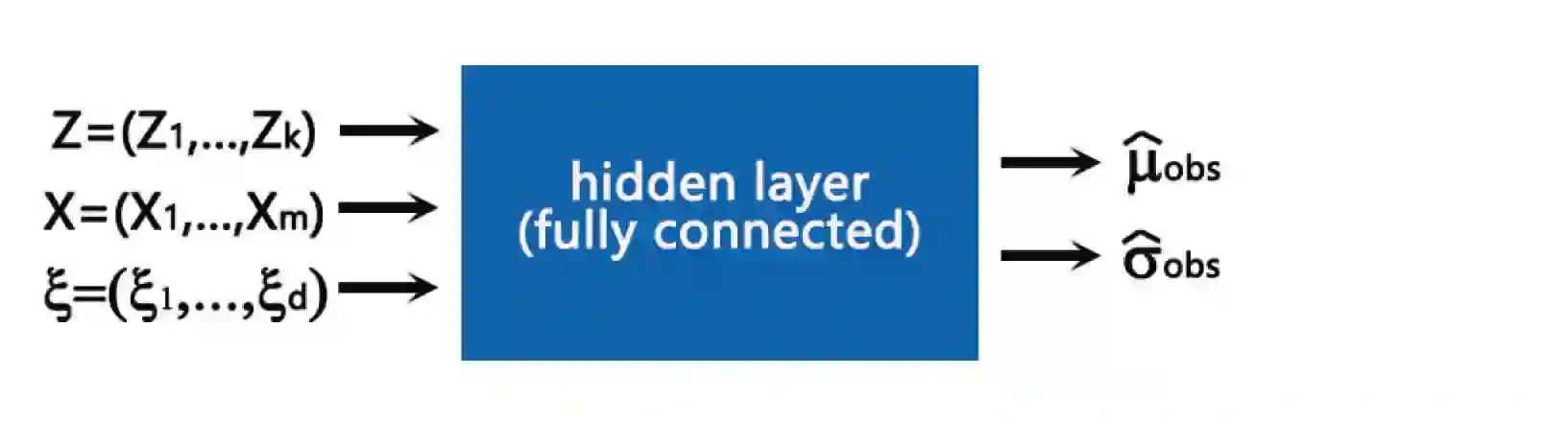
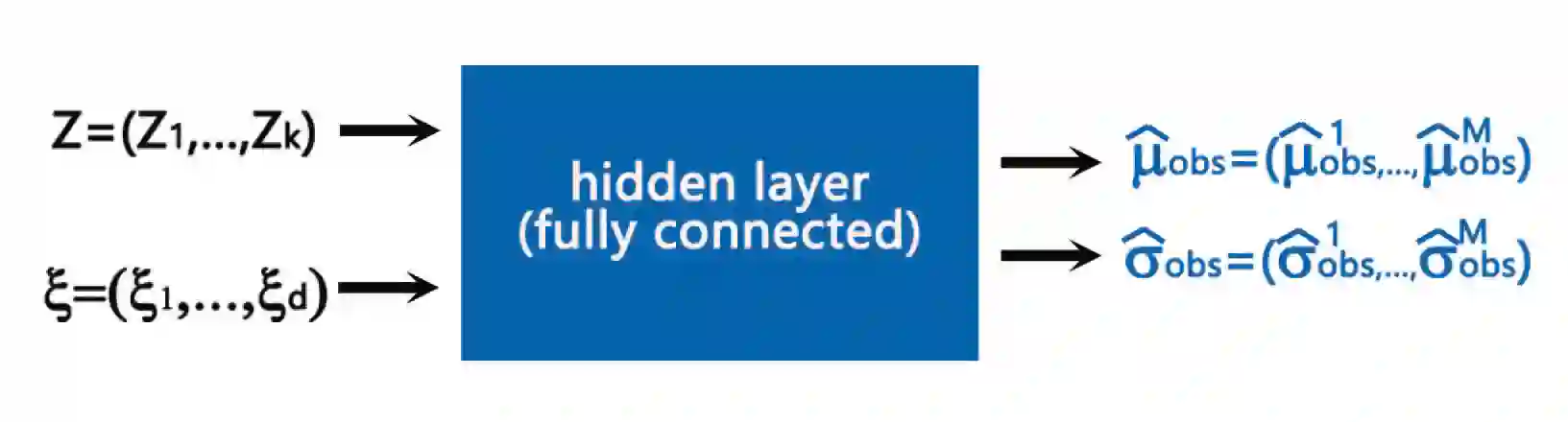
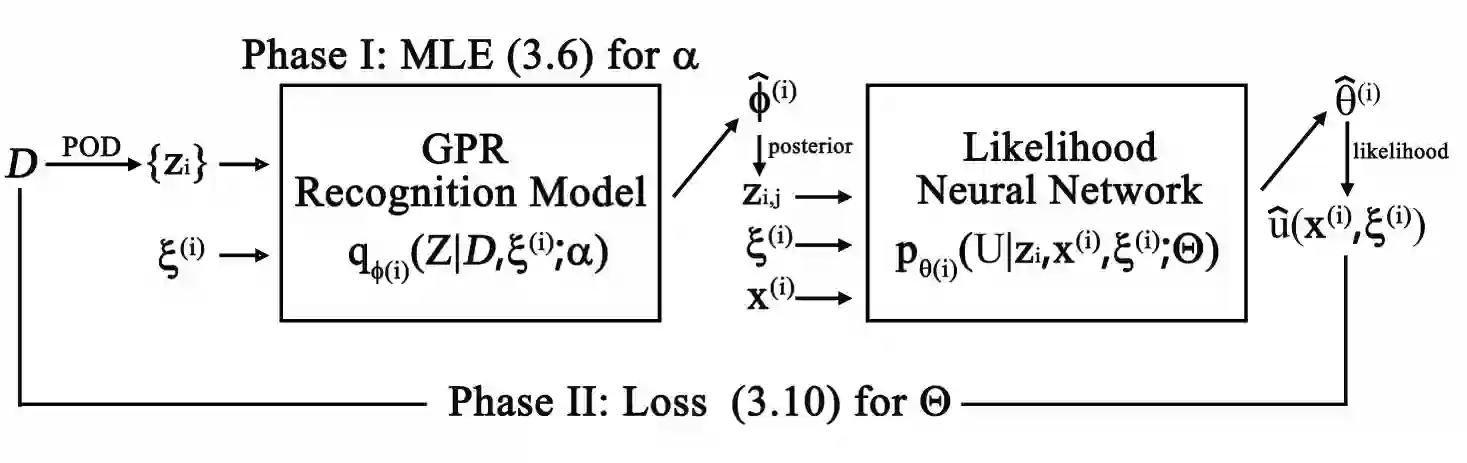
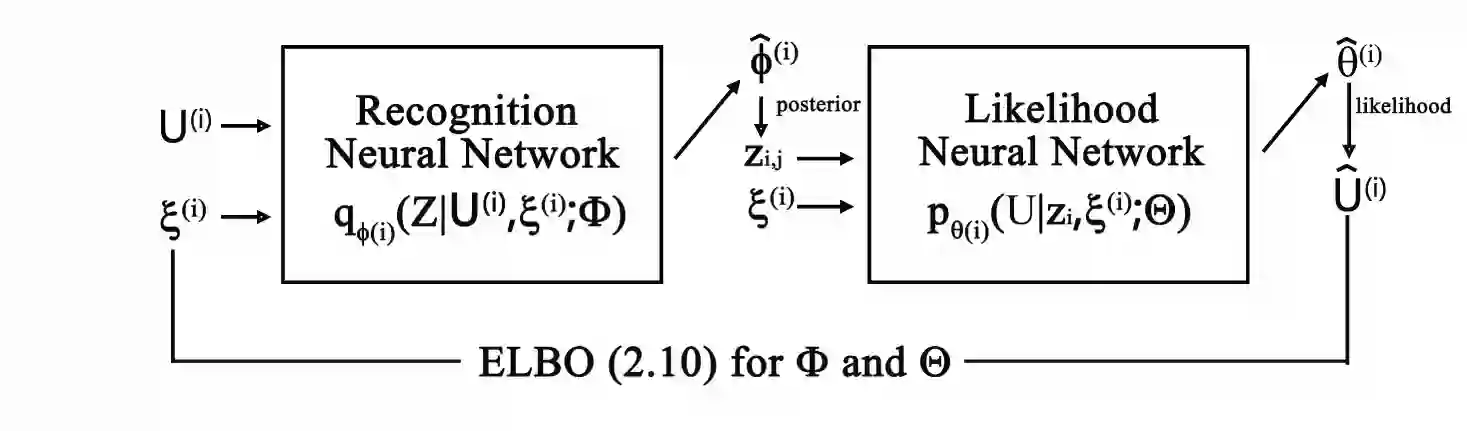
In this article, we present a data-driven method for parametric models with noisy observation data. Gaussian process regression based reduced order modeling (GPR-based ROM) can realize fast online predictions without using equations in the offline stage. However, GPR-based ROM does not perform well for complex systems since POD projection are naturally linear. Conditional variational autoencoder (CVAE) can address this issue via nonlinear neural networks but it has more model complexity, which poses challenges for training and tuning hyperparameters. To this end, we propose a framework of CVAE with Gaussian process regression recognition (CVAE-GPRR). The proposed method consists of a recognition model and a likelihood model. In the recognition model, we first extract low-dimensional features from data by POD to filter the redundant information with high frequency. And then a non-parametric model GPR is used to learn the map from parameters to POD latent variables, which can also alleviate the impact of noise. CVAE-GPRR can achieve the similar accuracy to CVAE but with fewer parameters. In the likelihood model, neural networks are used to reconstruct data. Besides the samples of POD latent variables and input parameters, physical variables are also added as the inputs to make predictions in the whole physical space. This can not be achieved by either GPR-based ROM or CVAE. Moreover, the numerical results show that CVAE-GPRR may alleviate the overfitting issue in CVAE.
翻译:本文提出了一种面向含噪声观测数据的参数化模型数据驱动方法。基于高斯过程回归的降阶建模(GPR-based ROM)可在离线阶段无需方程即可实现快速在线预测。然而,由于POD投影天然具有线性特性,GPR-based ROM对复杂系统的处理效果不佳。条件变分自编码器(CVAE)可通过非线性神经网络解决该问题,但其模型复杂度较高,给训练和超参数调优带来挑战。为此,我们提出了基于高斯过程回归识别的CVAE框架(CVAE-GPRR)。该方法由识别模型和似然模型组成。在识别模型中,我们首先通过POD从数据中提取低维特征以滤除高频冗余信息,随后使用非参数模型GPR学习参数到POD隐变量的映射,这也能减轻噪声的影响。CVAE-GPRR能以更少的参数达到与CVAE相近的精度。在似然模型中,使用神经网络重构数据。除POD隐变量样本和输入参数外,还将物理变量作为输入以在全物理空间进行预测。这一点是GPR-based ROM或CVAE均无法实现的。此外,数值结果表明,CVAE-GPRR能够缓解CVAE中的过拟合问题。




相关内容





 微信扫码咨询专知VIP会员