

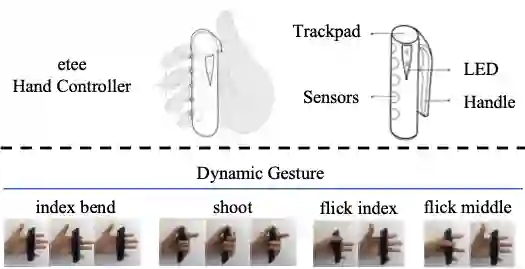
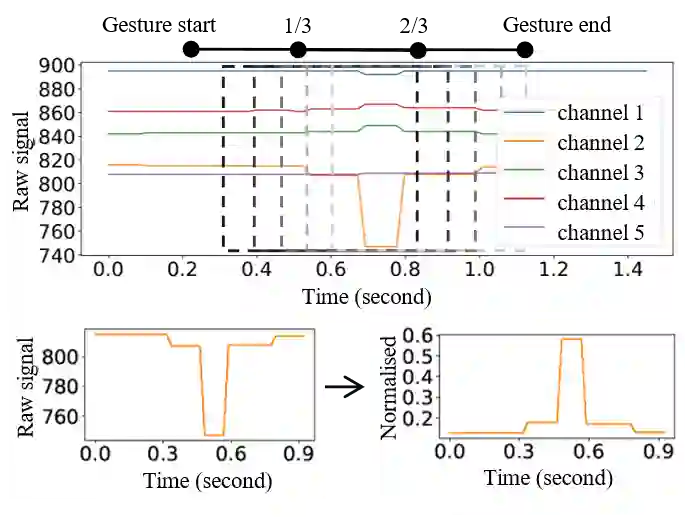
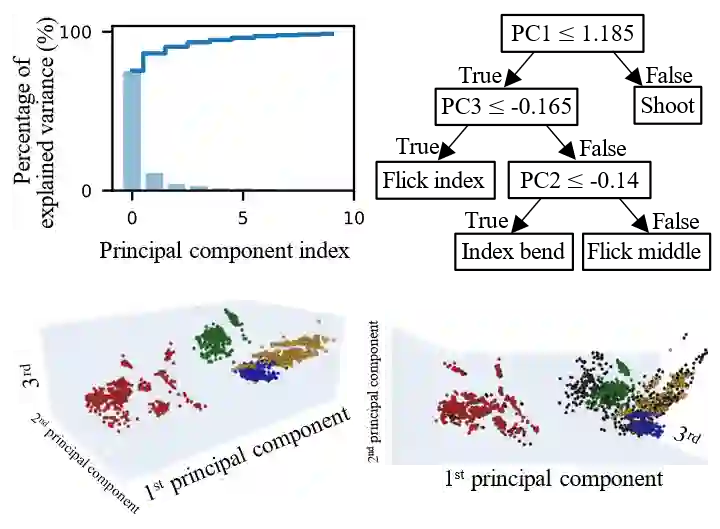
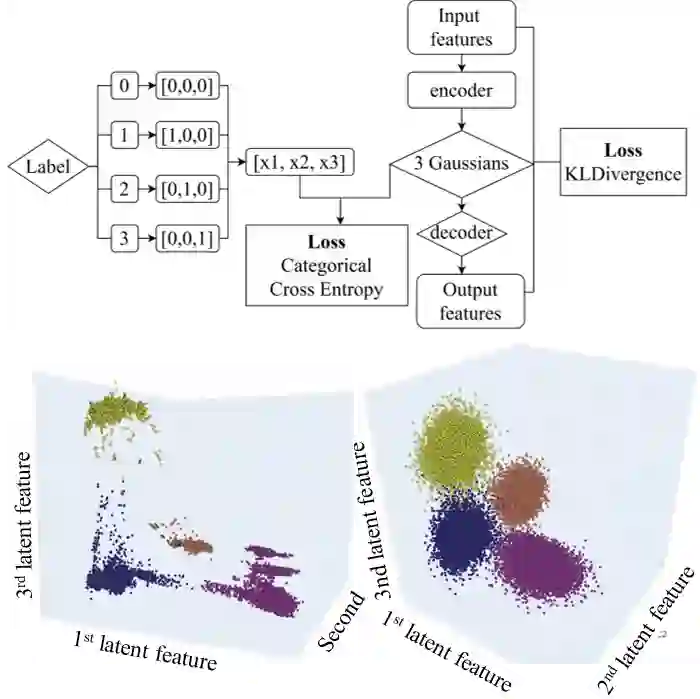
Automated hand gesture recognition has been a focus of the AI community for decades. Traditionally, work in this domain revolved largely around scenarios assuming the availability of the flow of images of the user hands. This has partly been due to the prevalence of camera-based devices and the wide availability of image data. However, there is growing demand for gesture recognition technology that can be implemented on low-power devices using limited sensor data instead of high-dimensional inputs like hand images. In this work, we demonstrate a hand gesture recognition system and method that uses signals from capacitive sensors embedded into the etee hand controller. The controller generates real-time signals from each of the wearer five fingers. We use a machine learning technique to analyse the time series signals and identify three features that can represent 5 fingers within 500 ms. The analysis is composed of a two stage training strategy, including dimension reduction through principal component analysis and classification with K nearest neighbour. Remarkably, we found that this combination showed a level of performance which was comparable to more advanced methods such as supervised variational autoencoder. The base system can also be equipped with the capability to learn from occasional errors by providing it with an additional adaptive error correction mechanism. The results showed that the error corrector improve the classification performance in the base system without compromising its performance. The system requires no more than 1 ms of computing time per input sample, and is smaller than deep neural networks, demonstrating the feasibility of agile gesture recognition systems based on this technology.
翻译:自动手势识别一直是人工智能领域数十年来的研究焦点。传统上,该领域的工作主要围绕假设用户手部图像流可用性的场景展开,这在一定程度上归因于基于摄像头的设备普及以及图像数据的广泛可获取性。然而,对于可在低功耗设备上实现的手势识别技术的需求日益增长,这类技术依赖于有限的传感器数据,而非高维度的输入(如手部图像)。本文展示了一套手势识别系统及方法,该系统利用嵌入etee手部控制器中的电容传感器信号。该控制器可实时生成佩戴者每只手指的信号。我们采用机器学习技术分析时间序列信号,并识别出能在500毫秒内表征五根手指的三个特征。该分析包含两阶段训练策略,包括通过主成分分析进行降维以及利用K近邻进行分类。值得注意的是,我们发现这种组合的性能水平可与更先进的监督变分自编码器等方法相媲美。基础系统还可配备额外自适应纠错机制,通过学习偶然误差来提升能力。结果表明,纠错器能在不损害基础系统性能的前提下改善其分类表现。该系统每输入样本仅需不超过1毫秒的计算时间,且体积小于深度神经网络,从而验证了基于该技术的敏捷手势识别系统的可行性。




相关内容


 微信扫码咨询专知VIP会员