

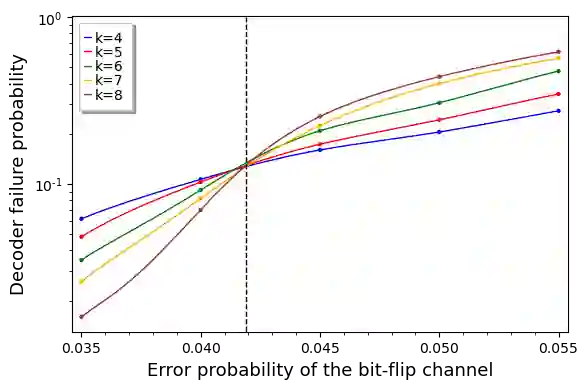
Kitaev's toric code is arguably the most studied quantum code and is expected to be implemented in future generations of quantum computers. The renormalisation decoders introduced by Duclos-Cianci and Poulin exhibit one of the best trade-offs between efficiency and speed, but one question that was left open is how they handle worst-case or adversarial errors, i.e. what is the order of magnitude of the smallest weight of an error pattern that will be wrongly decoded. We initiate such a study involving a simple hard-decision and deterministic version of a renormalisation decoder. We exhibit an uncorrectable error pattern whose weight scales like $d^{1/2}$ and prove that the decoder corrects all error patterns of weight less than $\frac{5}{6} d^{\log_{2}(6/5)}$, where $d$ is the minimum distance of the toric code.
翻译:Kitaev环面码可被视为研究最深入的量子码,有望在未来量子计算机中实现。Duclos-Cianci与Poulin提出的重正化解码器在效率与速度间展现出最优权衡之一,但一个悬而未决的问题是:它们如何处理最坏情况或对抗性错误,即被错误解码的最小错误模式权重量级为何?我们从重正化解码器的一种简单硬判决确定性版本入手开展此类研究。我们给出一个无法纠正的错误模式,其权重尺度为$d^{1/2}$,并证明该解码器能纠正所有权重小于$\frac{5}{6} d^{\log_{2}(6/5)}$的错误模式,其中$d$为环面码的最小距离。




相关内容




 微信扫码咨询专知VIP会员