

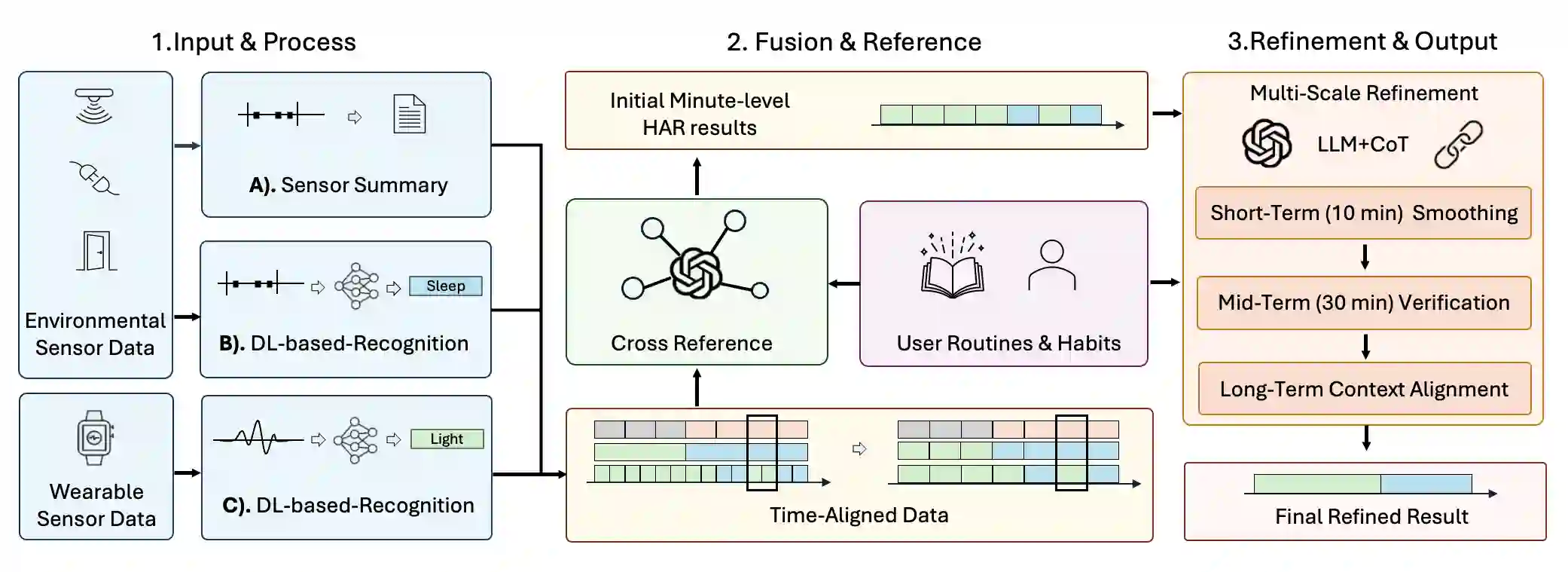
Human activity recognition (HAR) in smart homes remains challenging because many daily activities exhibit similar local sensor patterns, while minimally intrusive sensing provides sparse and ambiguous observations. As a result, methods based on short temporal or event windows often fail to capture the broader temporal and behavioral context needed for reliable activity understanding. We present TRACE (Temporal Reasoning over Context and Evidence), a contextual activity recognition framework for smart homes that integrates multi-source sensor evidence with user-specific contextual priors to improve activity interpretation. Rather than treating recognition as a local classification problem, TRACE leverages contextual reasoning to resolve ambiguities, reduce fragmented predictions, and infer more semantically specific activities. We evaluate TRACE on public benchmarks and in a deployment study conducted in our smart-home environment. Results show that TRACE improves recognition accuracy for semantically complex activities, produces more temporally coherent predictions that better align with user-specific routines, and maintains robust performance under cross-domain transfer and missing-modality conditions. These findings demonstrate the value of contextual reasoning for advancing smart-home HAR.
翻译:智能家居中的人类活动识别仍具挑战性,原因在于许多日常活动在局部传感器模式上具有相似性,而低侵入式传感仅提供稀疏且模糊的观测数据。因此,基于短时时间窗口或事件窗口的方法往往难以捕捉可靠活动理解所需的广义时间与行为上下文。本文提出TRACE(基于上下文与证据的时序推理)——一种面向智能家居的上下文活动识别框架,该框架整合多源传感器证据与用户特定的上下文先验知识,以提升活动解析能力。TRACE并非将识别视为局部分类问题,而是利用上下文推理消除歧义、减少碎片化预测,并推断更具语义特异性的活动。我们在公开基准数据集以及基于自建智能家居环境的部署研究中评估TRACE。结果表明,TRACE在语义复杂活动的识别精度上有所提升,能生成更符合用户日常习惯的时序一致性预测,并在跨域迁移及传感器缺失条件下保持稳健性能。这些发现证明了上下文推理对推动智能家居人类活动识别发展的价值。




相关内容



 微信扫码咨询专知VIP会员