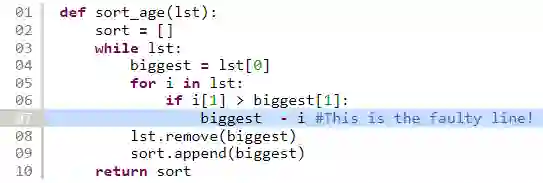
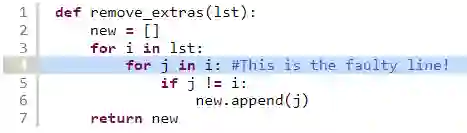
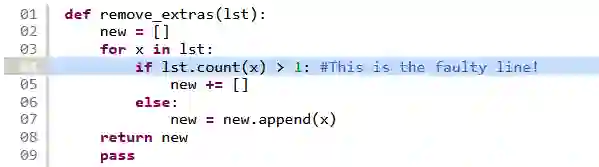
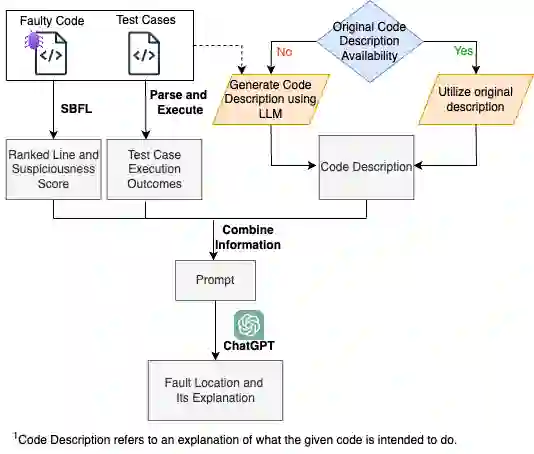
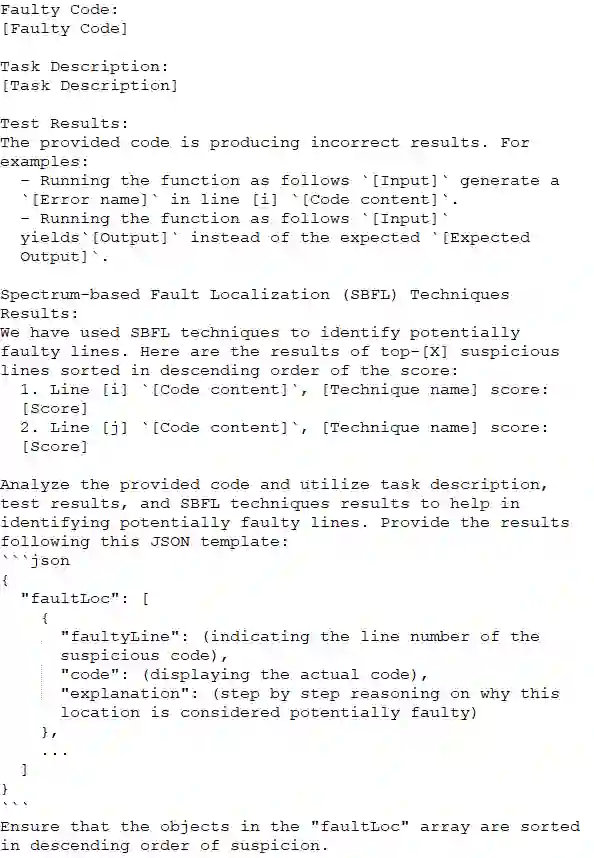
Fault localization is a critical process that involves identifying specific program elements responsible for program failures. Manually pinpointing these elements, such as classes, methods, or statements, which are associated with a fault is laborious and time-consuming. To overcome this challenge, various fault localization tools have been developed. These tools typically generate a ranked list of suspicious program elements. However, this information alone is insufficient. A prior study emphasized that automated fault localization should offer a rationale. In this study, we investigate the step-by-step reasoning for explainable fault localization. We explore the potential of Large Language Models (LLM) in assisting developers in reasoning about code. We proposed FuseFL that utilizes several combinations of information to enhance the LLM results which are spectrum-based fault localization results, test case execution outcomes, and code description (i.e., explanation of what the given code is intended to do). We conducted our investigation using faulty code from Refactory dataset. First, we evaluate the performance of the automated fault localization. Our results demonstrate a more than 30% increase in the number of successfully localized faults at Top-1 compared to the baseline. To evaluate the explanations generated by FuseFL, we create a dataset of human explanations that provide step-by-step reasoning as to why specific lines of code are considered faulty. This dataset consists of 324 faulty code files, along with explanations for 600 faulty lines. Furthermore, we also conducted human studies to evaluate the explanations. We found that for 22 out of the 30 randomly sampled cases, FuseFL generated correct explanations.


翻译:故障定位是一个关键过程,涉及识别导致程序失败的特定程序元素。手动定位与故障相关的类、方法或语句等元素既费力又耗时。为克服这一挑战,已开发出多种故障定位工具。这些工具通常生成可疑程序元素的排序列表,但仅凭这些信息并不足够。先前的研究强调,自动化故障定位应提供推理依据。在本研究中,我们探讨了可解释故障定位的逐步推理方法。我们探索利用大型语言模型(LLM)辅助开发者进行代码推理的潜力。我们提出了FuseFL,该模型利用多种信息组合(包括基于频谱的故障定位结果、测试用例执行结果和代码描述,即对给定代码预期功能的解释)来增强LLM的表现。我们使用Refactory数据集中的故障代码开展研究。首先,我们评估了自动化故障定位的性能。结果表明,与基线相比,成功定位的故障数在Top-1位置上提升了30%以上。为评估FuseFL生成的解释,我们创建了一个人工解释数据集,提供关于为何特定代码行被视为故障的逐步推理。该数据集包含324个故障代码文件及600个故障行的解释。此外,我们还进行了人工研究以评估解释质量。发现30个随机采样案例中,有22个案例的FuseFL生成了正确的解释。
0
下载
关闭预览

相关内容

大语言模型是基于海量文本数据训练的深度学习模型。它不仅能够生成自然语言文本,还能够深入理解文本含义,处理各种自然语言任务,如文本摘要、问答、翻译等。2023年,大语言模型及其在人工智能领域的应用已成为全球科技研究的热点,其在规模上的增长尤为引人注目,参数量已从最初的十几亿跃升到如今的一万亿。参数量的提升使得模型能够更加精细地捕捉人类语言微妙之处,更加深入地理解人类语言的复杂性。在过去的一年里,大语言模型在吸纳新知识、分解复杂任务以及图文对齐等多方面都有显著提升。随着技术的不断成熟,它将不断拓展其应用范围,为人类提供更加智能化和个性化的服务,进一步改善人们的生活和生产方式。
FlowQA: Grasping Flow in History for Conversational Machine Comprehension
专知会员服务
34+阅读 · 2019年10月18日
Stabilizing Transformers for Reinforcement Learning
专知会员服务
60+阅读 · 2019年10月17日
《DeepGCNs: Making GCNs Go as Deep as CNNs》
专知会员服务
32+阅读 · 2019年10月17日
Keras François Chollet 《Deep Learning with Python 》, 386页pdf
专知会员服务
164+阅读 · 2019年10月12日
【SIGGRAPH2019】TensorFlow 2.0深度学习计算机图形学应用
专知会员服务
41+阅读 · 2019年10月9日
Transferring Knowledge across Learning Processes
CreateAMind
29+阅读 · 2019年5月18日
Unsupervised Learning via Meta-Learning
CreateAMind
44+阅读 · 2019年1月3日
meta learning 17年:MAML SNAIL
CreateAMind
11+阅读 · 2019年1月2日
A Technical Overview of AI & ML in 2018 & Trends for 2019
待字闺中
18+阅读 · 2018年12月24日
disentangled-representation-papers
CreateAMind
26+阅读 · 2018年9月12日
Single-Shot Object Detection with Enriched Semantics
统计学习与视觉计算组
14+阅读 · 2018年8月29日
STRCF for Visual Object Tracking
统计学习与视觉计算组
15+阅读 · 2018年5月29日
Hierarchical Imitation - Reinforcement Learning
CreateAMind
19+阅读 · 2018年5月25日
Focal Loss for Dense Object Detection
统计学习与视觉计算组
12+阅读 · 2018年3月15日
IJCAI | Cascade Dynamics Modeling with Attention-based RNN
KingsGarden
13+阅读 · 2017年7月16日
国家自然科学基金
2+阅读 · 2017年12月31日
国家自然科学基金
13+阅读 · 2017年12月31日
国家自然科学基金
18+阅读 · 2017年12月31日
国家自然科学基金
2+阅读 · 2015年12月31日
国家自然科学基金
47+阅读 · 2015年12月31日
国家自然科学基金
2+阅读 · 2015年12月31日
国家自然科学基金
0+阅读 · 2015年12月31日
国家自然科学基金
0+阅读 · 2014年12月31日
国家自然科学基金
0+阅读 · 2014年12月31日
国家自然科学基金
2+阅读 · 2014年12月31日
VIP会员
最新内容
无人机自主控制与人工智能:系统性综述
专知会员服务
6+阅读 · 今天7:25
巡飞弹与反无人机系统——现代战场的两大支柱
专知会员服务
2+阅读 · 今天6:54
《打造“黄金舰队”》57页报告
专知会员服务
1+阅读 · 今天6:52
《北约数字教官网络发展路径》128页报告
专知会员服务
1+阅读 · 今天6:33
ECCV 2026 | MIMFlow:MIM与归一化流统一图像生成
专知会员服务
6+阅读 · 6月25日
网状网络及其在军事领域的运用
专知会员服务
7+阅读 · 6月25日
无美国参与的欧洲战争方式(万字长文)
专知会员服务
8+阅读 · 6月25日
《国防领域敏感性分析白皮书》
专知会员服务
9+阅读 · 6月25日
综述 | 从问答到任务完成:Agent系统与Harness设计
专知会员服务
10+阅读 · 6月24日
Agentic RL:框架、实践与长程智能体训练
专知会员服务
10+阅读 · 6月24日
相关资讯
Transferring Knowledge across Learning Processes
CreateAMind
29+阅读 · 2019年5月18日
Unsupervised Learning via Meta-Learning
CreateAMind
44+阅读 · 2019年1月3日
meta learning 17年:MAML SNAIL
CreateAMind
11+阅读 · 2019年1月2日
A Technical Overview of AI & ML in 2018 & Trends for 2019
待字闺中
18+阅读 · 2018年12月24日
disentangled-representation-papers
CreateAMind
26+阅读 · 2018年9月12日
Single-Shot Object Detection with Enriched Semantics
统计学习与视觉计算组
14+阅读 · 2018年8月29日
STRCF for Visual Object Tracking
统计学习与视觉计算组
15+阅读 · 2018年5月29日
Hierarchical Imitation - Reinforcement Learning
CreateAMind
19+阅读 · 2018年5月25日
Focal Loss for Dense Object Detection
统计学习与视觉计算组
12+阅读 · 2018年3月15日
IJCAI | Cascade Dynamics Modeling with Attention-based RNN
KingsGarden
13+阅读 · 2017年7月16日
相关基金
国家自然科学基金
2+阅读 · 2017年12月31日
国家自然科学基金
13+阅读 · 2017年12月31日
国家自然科学基金
18+阅读 · 2017年12月31日
国家自然科学基金
2+阅读 · 2015年12月31日
国家自然科学基金
47+阅读 · 2015年12月31日
国家自然科学基金
2+阅读 · 2015年12月31日
国家自然科学基金
0+阅读 · 2015年12月31日
国家自然科学基金
0+阅读 · 2014年12月31日
国家自然科学基金
0+阅读 · 2014年12月31日
国家自然科学基金
2+阅读 · 2014年12月31日
Top
微信扫码咨询专知VIP会员