

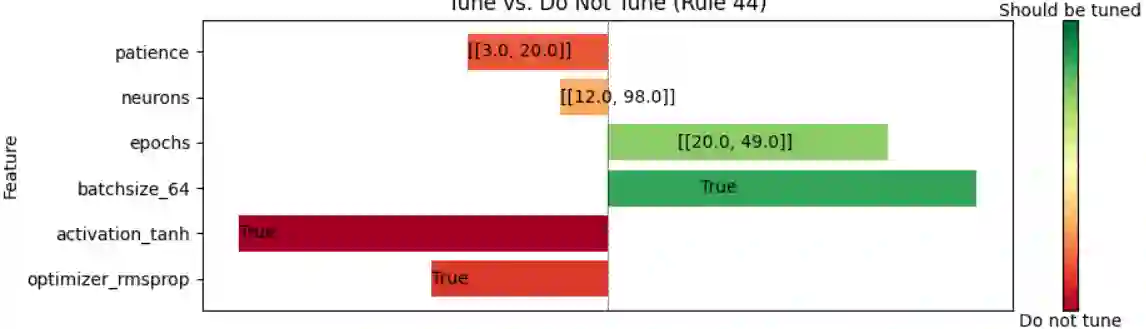
Manual parameter tuning of cyber-physical systems is a common practice, but it is labor-intensive. Bayesian Optimization (BO) offers an automated alternative, yet its black-box nature reduces trust and limits human-BO collaborative system tuning. Experts struggle to interpret BO recommendations due to the lack of explanations. This paper addresses the post-hoc BO explainability problem for cyber-physical systems. We introduce TNTRules (Tune-No-Tune Rules), a novel algorithm that provides both global and local explanations for BO recommendations. TNTRules generates actionable rules and visual graphs, identifying optimal solution bounds and ranges, as well as potential alternative solutions. Unlike existing explainable AI (XAI) methods, TNTRules is tailored specifically for BO, by encoding uncertainty via a variance pruning technique and hierarchical agglomerative clustering. A multi-objective optimization approach allows maximizing explanation quality. We evaluate TNTRules using established XAI metrics (Correctness, Completeness, and Compactness) and compare it against adapted baseline methods. The results demonstrate that TNTRules generates high-fidelity, compact, and complete explanations, significantly outperforming three baselines on 5 multi-objective testing functions and 2 hyperparameter tuning problems.
翻译:信息物理系统的手动参数调优是常见实践,但过程劳动密集。贝叶斯优化(BO)提供了一种自动化替代方案,但其黑盒特性降低了可信度,限制了人机协同的系统调优能力。由于缺乏解释机制,专家难以理解BO的推荐结果。本文针对信息物理系统提出事后贝叶斯优化可解释性解决方案。我们提出TNTRules(调优-非调优规则)——一种为BO推荐提供全局与局部解释的新算法。该算法通过生成可操作的规则与可视化图表,既能识别最优解边界与区间,也能发现潜在替代解。与现有可解释人工智能(XAI)方法不同,TNTRules专为BO设计:通过方差剪枝技术和层次聚合聚类编码不确定性,并采用多目标优化方法最大化解释质量。我们使用成熟的XAI评估指标(正确性、完备性、紧凑性)对TNTRules进行验证,并与改进的基线方法比较。实验结果表明,在5个多目标测试函数和2个超参数调优问题上,TNTRules生成的解释具有高保真度、紧凑性和完备性,显著优于三种基线方法。





相关内容



 微信扫码咨询专知VIP会员