

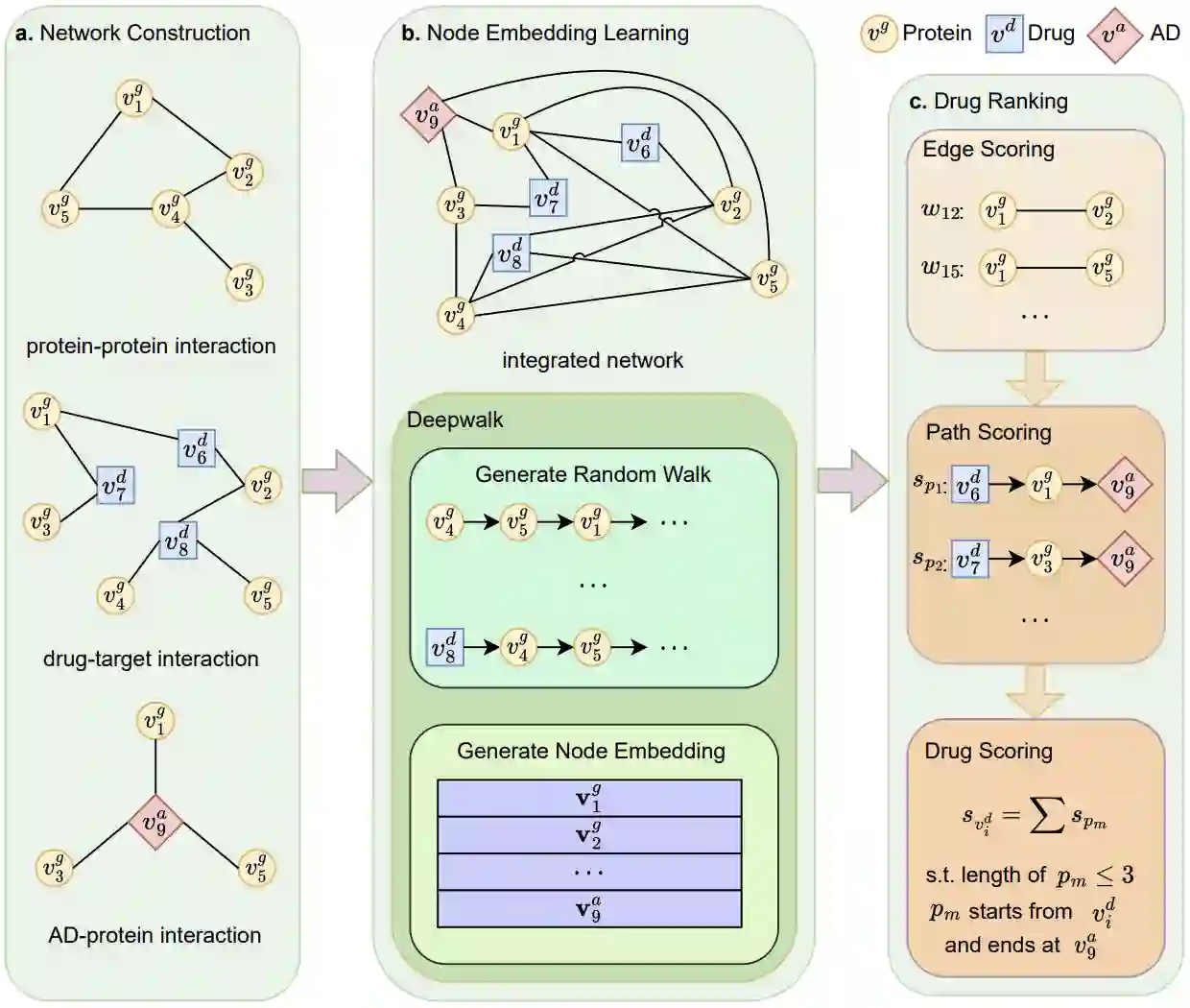
Recently, drug repurposing has emerged as an effective and resource-efficient paradigm for AD drug discovery. Among various methods for drug repurposing, network-based methods have shown promising results as they are capable of leveraging complex networks that integrate multiple interaction types, such as protein-protein interactions, to more effectively identify candidate drugs. However, existing approaches typically assume paths of the same length in the network have equal importance in identifying the therapeutic effect of drugs. Other domains have found that same length paths do not necessarily have the same importance. Thus, relying on this assumption may be deleterious to drug repurposing attempts. In this work, we propose MPI (Modeling Path Importance), a novel network-based method for AD drug repurposing. MPI is unique in that it prioritizes important paths via learned node embeddings, which can effectively capture a network's rich structural information. Thus, leveraging learned embeddings allows MPI to effectively differentiate the importance among paths. We evaluate MPI against a commonly used baseline method that identifies anti-AD drug candidates primarily based on the shortest paths between drugs and AD in the network. We observe that among the top-50 ranked drugs, MPI prioritizes 20.0% more drugs with anti-AD evidence compared to the baseline. Finally, Cox proportional-hazard models produced from insurance claims data aid us in identifying the use of etodolac, nicotine, and BBB-crossing ACE-INHs as having a reduced risk of AD, suggesting such drugs may be viable candidates for repurposing and should be explored further in future studies.
翻译:摘要:近年来,药物重定位已成为阿尔茨海默病(AD)药物发现中一种高效且资源节约的范式。在各类药物重定位方法中,基于网络的方法展现出显著优势,其能够利用整合多种相互作用类型(如蛋白质-蛋白质相互作用)的复杂网络,更有效地识别候选药物。然而,现有方法通常假设网络中相同长度的路径在识别药物治疗效果时具有同等重要性。其他领域已发现,等长路径未必具有相同的重要性,因此依赖该假设可能对药物重定位尝试产生负面影响。本研究提出MPI(路径重要性建模),一种基于网络的新型AD药物重定位方法。MPI的独特之处在于通过学习的节点嵌入优先处理重要路径,该方法能有效捕获网络的丰富结构信息,从而利用学习到的嵌入区分不同路径的重要性。我们以网络中药物与AD间最短路径为主要依据的传统基线方法为对照,评估MPI在识别抗AD候选药物中的表现。结果显示,在排名前50的药物中,MPI优先筛选出更多具有抗AD证据的药物,数量较基线方法提升20.0%。最终,基于保险理赔数据构建的Cox比例风险模型有助于识别依托度酸、尼古丁及可穿透血脑屏障的ACE抑制剂类药物,这些药物与AD风险降低相关,提示其可能成为药物重定位的可行候选,值得在未来研究中进一步探索。




相关内容




 微信扫码咨询专知VIP会员