

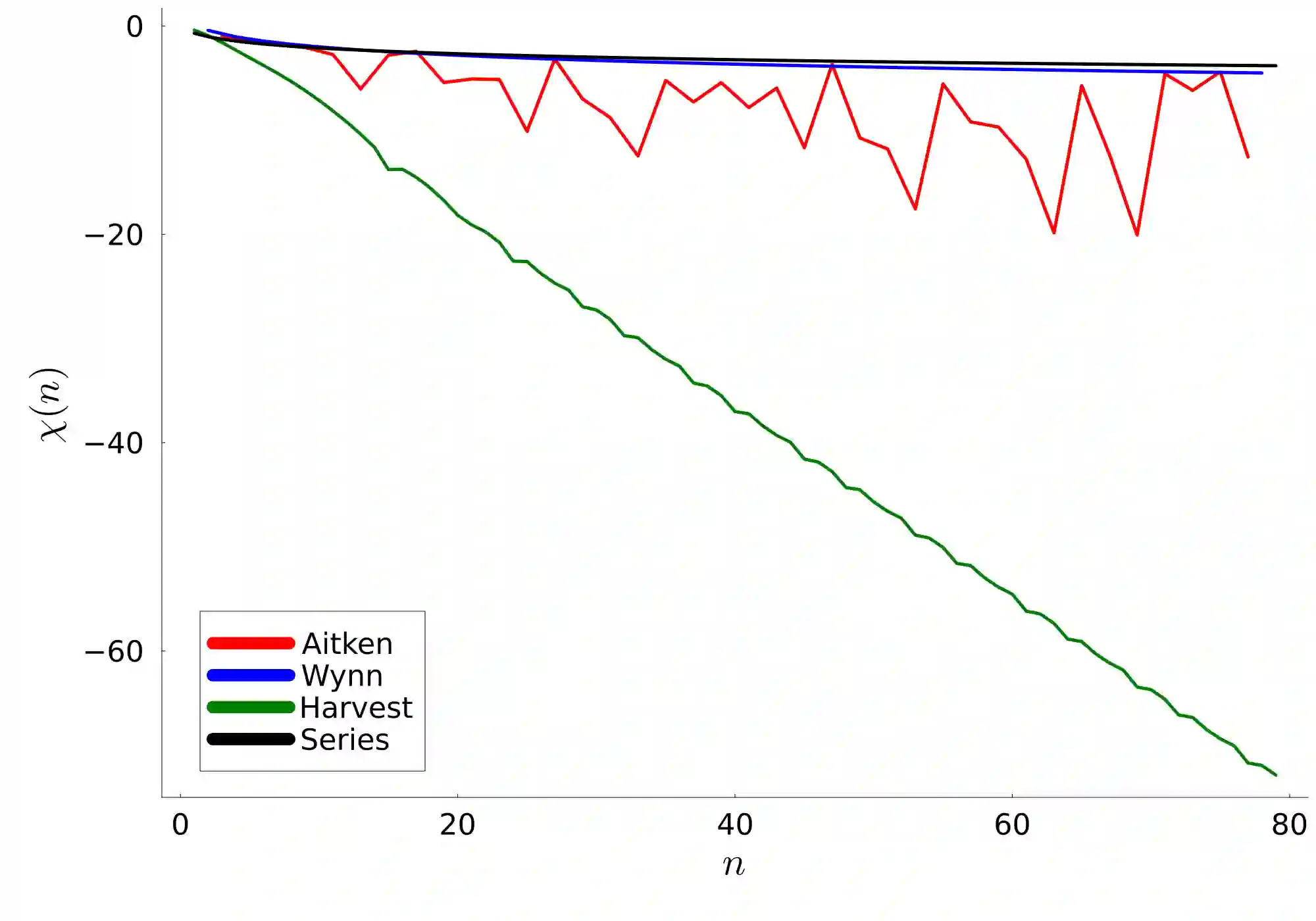
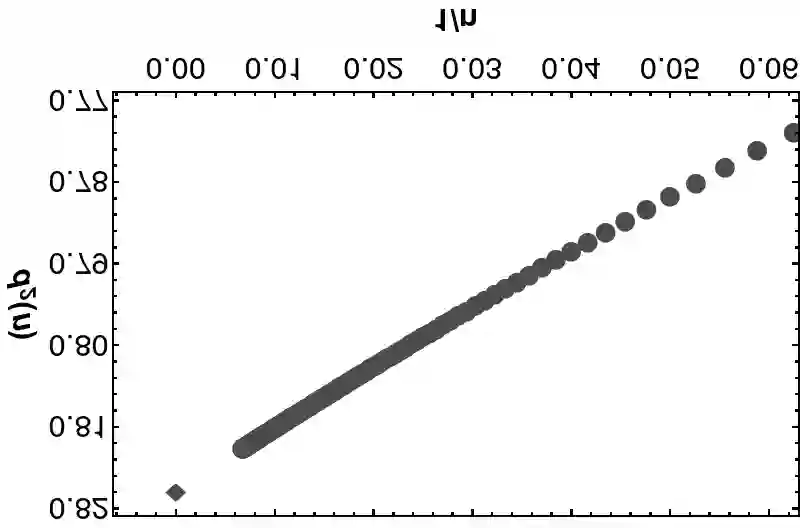
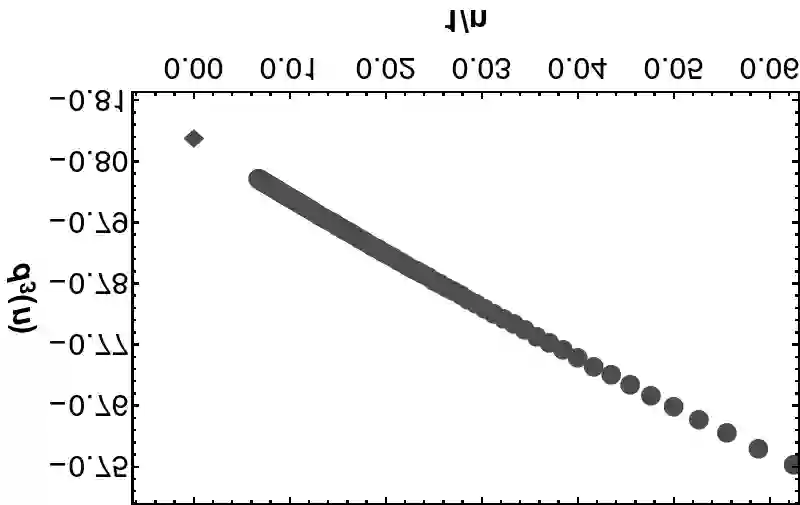
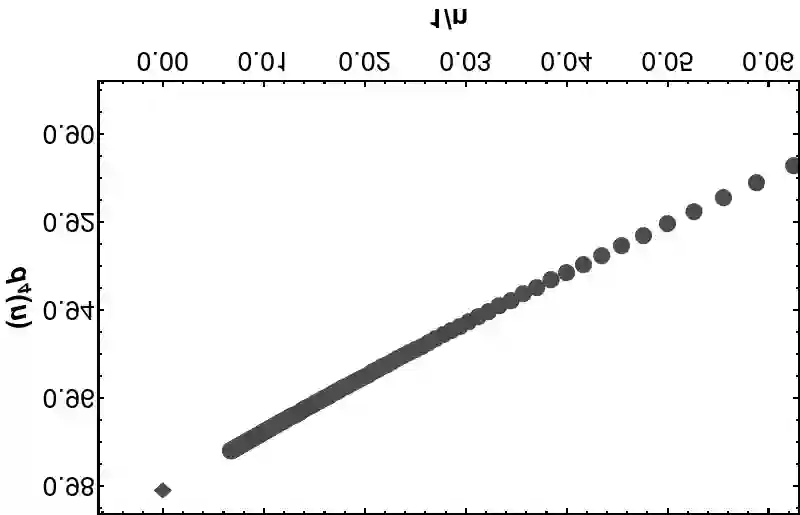
The recursive Neville algorithm allows one to calculate interpolating functions recursively. Upon a judicious choice of the abscissas used for the interpolation (and extrapolation), this algorithm leads to a method for convergence acceleration. For example, one can use the Neville algorithm in order to successively eliminate inverse powers of the upper limit of the summation from the partial sums of a given, slowly convergent input series. Here, we show that, for a particular choice of the abscissas used for the extrapolation, one can replace the recursive Neville scheme by a simple one-step transformation, while also obtaining access to subleading terms for the transformed series after convergence acceleration. The matrix-based, unified formulas allow one to estimate the rate of convergence of the partial sums of the input series to their limit. In particular, Bethe logarithms for hydrogen are calculated to 100 decimal digits.
翻译:递归内维尔算法允许递归地计算插值函数。通过明智选择用于插值(和外推)的横坐标,该算法可发展出一种加速收敛的方法。例如,可运用内维尔算法从给定缓收敛输入级数的部分和中逐次消除求和上限的逆幂次。本文证明,对于外推所用横坐标的特定选择,可将递归内维尔方案替换为简单的单步变换,同时还能获取加速收敛后变换级数的次主导项。基于矩阵的统一公式可估算输入级数部分和趋近其极限的收敛速率。特别地,氢原子的贝特对数被计算到100位十进制数字。




相关内容



 微信扫码咨询专知VIP会员