

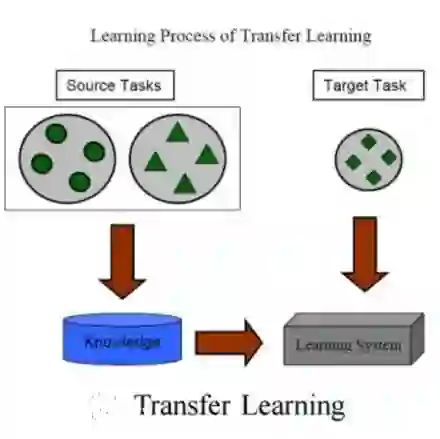
Deep learning algorithms provide a new paradigm to study high-dimensional dynamical behaviors, such as those in fusion plasma systems. Development of novel model reduction methods, coupled with detection of abnormal modes with plasma physics, opens a unique opportunity for building efficient models to identify plasma instabilities for real-time control. Our Fusion Transfer Learning (FTL) model demonstrates success in reconstructing nonlinear kink mode structures by learning from a limited amount of nonlinear simulation data. The knowledge transfer process leverages a pre-trained neural encoder-decoder network, initially trained on linear simulations, to effectively capture nonlinear dynamics. The low-dimensional embeddings extract the coherent structures of interest, while preserving the inherent dynamics of the complex system. Experimental results highlight FTL's capacity to capture transitional behaviors and dynamical features in plasma dynamics -- a task often challenging for conventional methods. The model developed in this study is generalizable and can be extended broadly through transfer learning to address various magnetohydrodynamics (MHD) modes.
翻译:摘要:深度学习算法为研究高维动力学行为(如聚变等离子体系统中的行为)提供了新范式。新型模型降阶方法的发展,结合等离子体物理中异常模式的检测,为构建高效模型以实现等离子体不稳定性实时控制开辟了独特机遇。我们的聚变迁移学习(FTL)模型通过从有限非线性模拟数据中学习,成功重构了非线性扭结模结构。知识迁移过程利用了预训练的神经编码器-解码器网络(初始基于线性模拟训练),有效捕获非线性动力学特性。低维嵌入在保留复杂系统固有动力学特征的同时,提取了感兴趣的相干结构。实验结果表明,FTL具备捕捉等离子体动力学中过渡行为及动态特征的能力——这通常是传统方法面临的挑战。本研究所开发的模型具有泛化性,可通过迁移学习广泛扩展,应用于多种磁流体动力学(MHD)模式。




相关内容




 微信扫码咨询专知VIP会员