

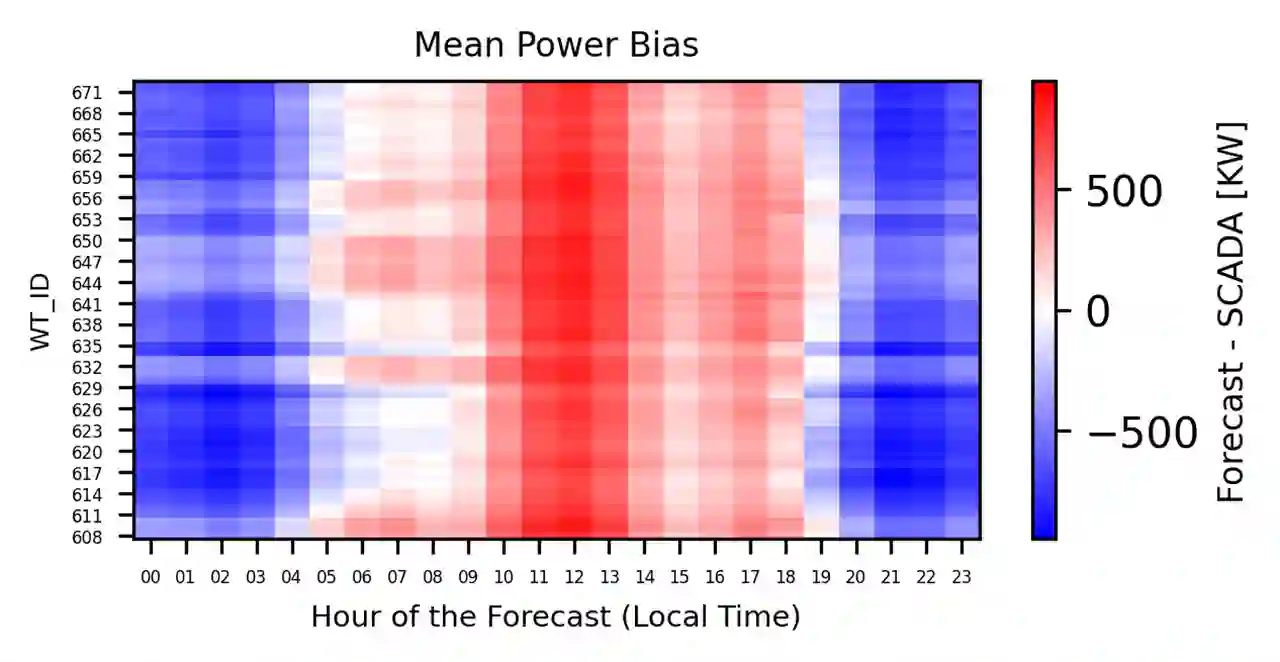
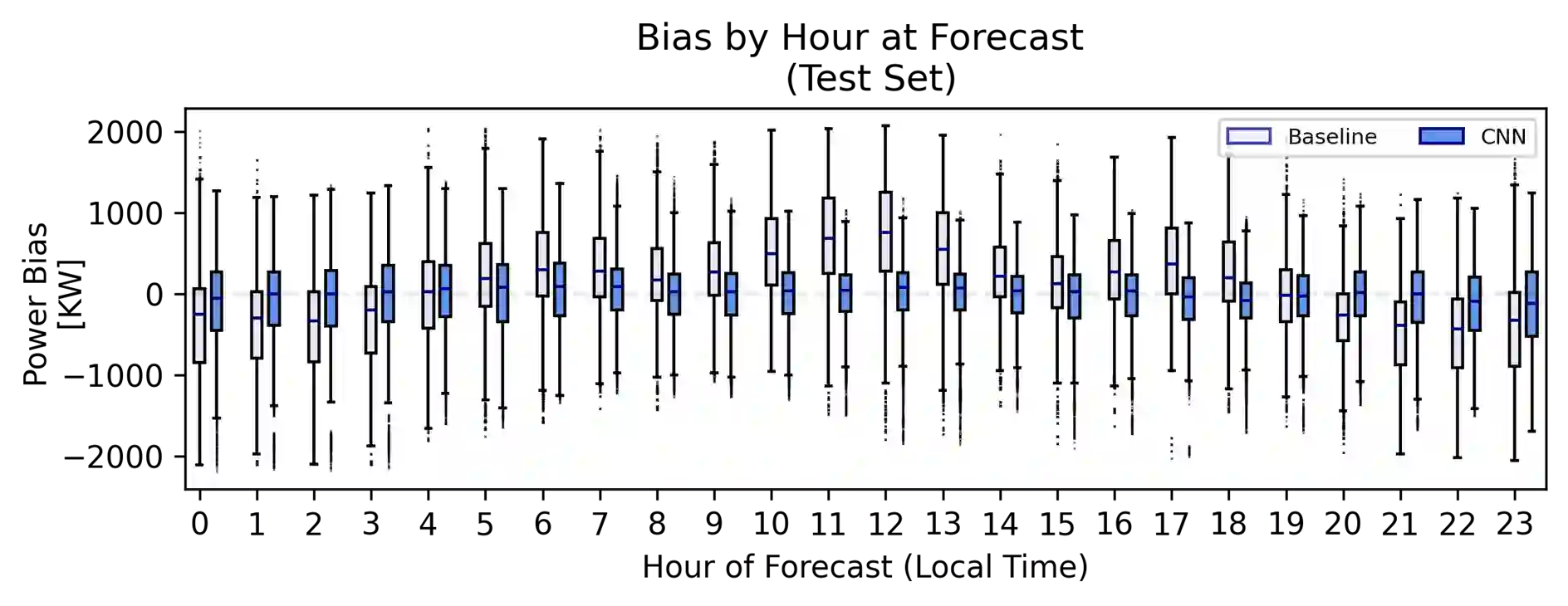
Wind energy plays a critical role in the transition towards renewable energy sources. However, the uncertainty and variability of wind can impede its full potential and the necessary growth of wind power capacity. To mitigate these challenges, wind power forecasting methods are employed for applications in power management, energy trading, or maintenance scheduling. In this work, we present, evaluate, and compare four machine learning-based wind power forecasting models. Our models correct and improve 48-hour forecasts extracted from a numerical weather prediction (NWP) model. The models are evaluated on datasets from a wind park comprising 65 wind turbines. The best improvement in forecasting error and mean bias was achieved by a convolutional neural network, reducing the average NRMSE down to 22%, coupled with a significant reduction in mean bias, compared to a NRMSE of 35% from the strongly biased baseline model using uncorrected NWP forecasts. Our findings further indicate that changes to neural network architectures play a minor role in affecting the forecasting performance, and that future research should rather investigate changes in the model pipeline. Moreover, we introduce a continuous learning strategy, which is shown to achieve the highest forecasting performance improvements when new data is made available.
翻译:风能在向可再生能源转型中发挥着关键作用。然而,风能的不确定性和可变性可能阻碍其潜力充分释放以及风电装机容量的必要增长。为缓解这些挑战,风电功率预测方法被应用于电力管理、能源交易或维护调度等领域。本研究提出、评估并比较了四种基于机器学习的风电功率预测模型。这些模型能够校正并改进从数值天气预报(NWP)模型中提取的48小时预测结果。模型基于某包含65台风力发电机组的风电场数据集进行评估。在预测误差和平均偏差方面,卷积神经网络取得了最佳改进效果,将平均归一化均方根误差(NRMSE)降至22%,同时平均偏差显著降低——相比之下,采用未校正NWP预测的强偏差基线模型的NRMSE高达35%。研究结果进一步表明,神经网络架构的改变对预测性能影响较小,未来研究应更多关注模型流程的优化。此外,我们引入了一种持续学习策略,该策略在新数据可用时能够实现最高的预测性能提升。






相关内容





 微信扫码咨询专知VIP会员