

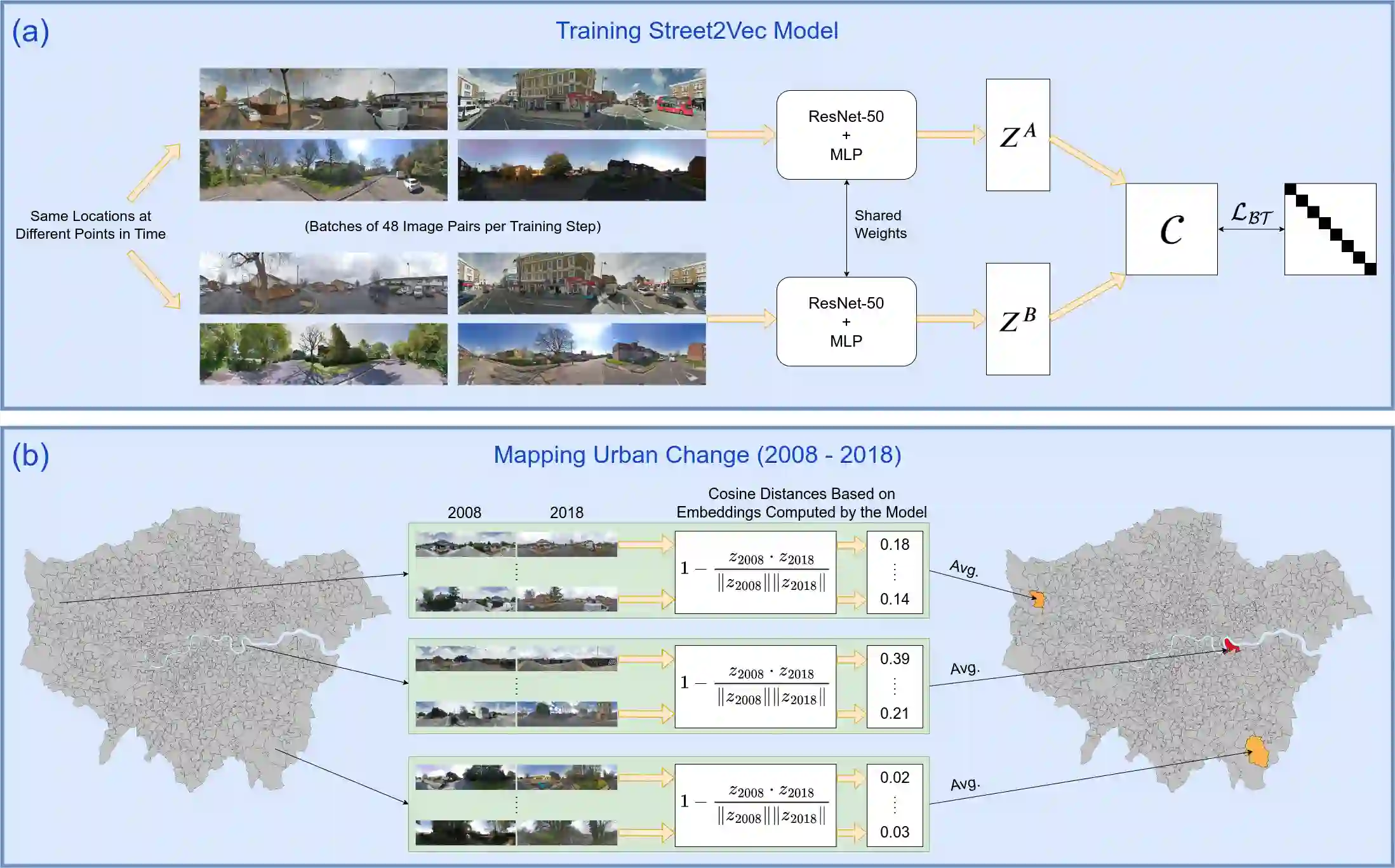
Cities around the world face a critical shortage of affordable and decent housing. Despite its critical importance for policy, our ability to effectively monitor and track progress in urban housing is limited. Deep learning-based computer vision methods applied to street-level images have been successful in the measurement of socioeconomic and environmental inequalities but did not fully utilize temporal images to track urban change as time-varying labels are often unavailable. We used self-supervised methods to measure change in London using 15 million street images taken between 2008 and 2021. Our novel adaptation of Barlow Twins, Street2Vec, embeds urban structure while being invariant to seasonal and daily changes without manual annotations. It outperformed generic embeddings, successfully identified point-level change in London's housing supply from street-level images, and distinguished between major and minor change. This capability can provide timely information for urban planning and policy decisions toward more liveable, equitable, and sustainable cities.
翻译:全球城市面临可负担且体面住房的严重短缺。尽管这对政策制定至关重要,但我们有效监测和追踪城市住房进展的能力仍然有限。基于深度学习的计算机视觉方法应用于街景图像已成功测量社会经济与环境不平等,但未能充分利用时序图像追踪城市变化,因为时变标签往往难以获取。我们采用自监督方法,利用2008年至2021年间拍摄的1500万张伦敦街景图像测量城市变化。我们提出的Barlow Twins创新改编版Street2Vec,能在无需人工标注的条件下嵌入城市结构,同时不受季节与日常变化影响。该模型优于通用嵌入方法,成功从街景图像中识别伦敦住房供给的点级变化,并区分重大与微小变化。这一能力可为城市规划与政策决策提供及时信息,助力建设更宜居、公平和可持续的城市。






相关内容



 微信扫码咨询专知VIP会员