

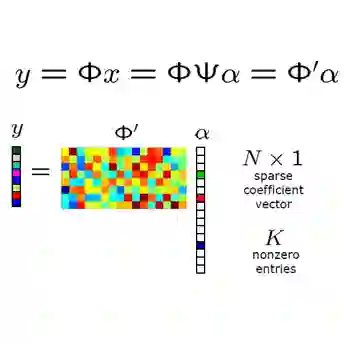
We study the Compressed Sensing (CS) problem, which is the problem of finding the most sparse vector that satisfies a set of linear measurements up to some numerical tolerance. We introduce an $\ell_2$ regularized formulation of CS which we reformulate as a mixed integer second order cone program. We derive a second order cone relaxation of this problem and show that under mild conditions on the regularization parameter, the resulting relaxation is equivalent to the well studied basis pursuit denoising problem. We present a semidefinite relaxation that strengthens the second order cone relaxation and develop a custom branch-and-bound algorithm that leverages our second order cone relaxation to solve small-scale instances of CS to certifiable optimality. When compared against solutions produced by three state of the art benchmark methods on synthetic data, our numerical results show that our approach produces solutions that are on average $6.22\%$ more sparse. When compared only against the experiment-wise best performing benchmark method on synthetic data, our approach produces solutions that are on average $3.10\%$ more sparse. On real world ECG data, for a given $\ell_2$ reconstruction error our approach produces solutions that are on average $9.95\%$ more sparse than benchmark methods ($3.88\%$ more sparse if only compared against the best performing benchmark), while for a given sparsity level our approach produces solutions that have on average $10.77\%$ lower reconstruction error than benchmark methods ($1.42\%$ lower error if only compared against the best performing benchmark). When used as a component of a multi-label classification algorithm, our approach achieves greater classification accuracy than benchmark compressed sensing methods. This improved accuracy comes at the cost of an increase in computation time by several orders of magnitude.
翻译:我们研究压缩感知(CS)问题,即寻找最稀疏向量以满足一组线性测量(在给定数值容差范围内)的问题。我们引入一种CS的ℓ₂正则化形式,并将其重构为混合整数二阶锥规划。我们推导了该问题的二阶锥松弛,并证明在正则化参数满足温和条件下,所得松弛等价于被广泛研究的基追踪去噪问题。我们提出一种可增强二阶锥松弛的半定松弛,并开发了一种定制分支定界算法,该算法利用我们的二阶锥松弛来求解小规模CS问题的可验证最优解。在合成数据上与三种先进基准方法生成的解相比,我们的数值结果表明,本方法所得解的平均稀疏度提高了6.22%。若仅与合成数据上实验表现最佳的基准方法相比,本方法所得解的平均稀疏度提高了3.10%。在真实世界ECG数据中,对于给定的ℓ₂重构误差,本方法所得解的平均稀疏度较基准方法提高9.95%(若仅与最佳基准方法相比则提高3.88%);而对于给定的稀疏度水平,本方法所得解的平均重构误差较基准方法降低10.77%(若仅与最佳基准方法相比则降低1.42%)。当作为多标签分类算法的组件时,本方法相比基准压缩感知方法获得了更高的分类准确率。这种准确率的提升是以计算时间增加数个数量级为代价的。




相关内容



 微信扫码咨询专知VIP会员