

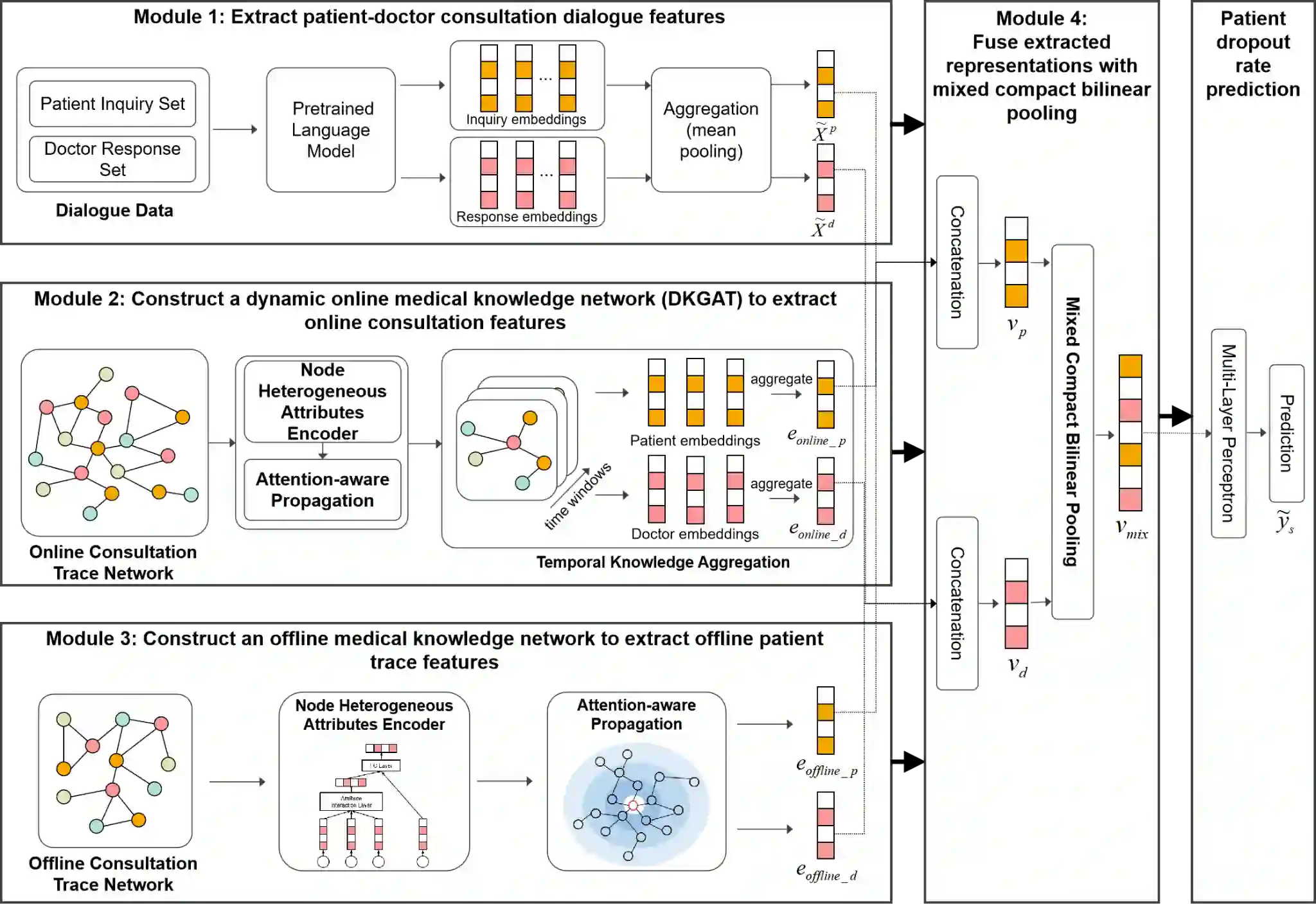
Virtual health has been acclaimed as a transformative force in healthcare delivery. Yet, its dropout issue is critical that leads to poor health outcomes, increased health, societal, and economic costs. Timely prediction of patient dropout enables stakeholders to take proactive steps to address patients' concerns, potentially improving retention rates. In virtual health, the information asymmetries inherent in its delivery format, between different stakeholders, and across different healthcare delivery systems hinder the performance of existing predictive methods. To resolve those information asymmetries, we propose a Multimodal Dynamic Knowledge-driven Dropout Prediction (MDKDP) framework that learns implicit and explicit knowledge from doctor-patient dialogues and the dynamic and complex networks of various stakeholders in both online and offline healthcare delivery systems. We evaluate MDKDP by partnering with one of the largest virtual health platforms in China. MDKDP improves the F1-score by 3.26 percentage points relative to the best benchmark. Comprehensive robustness analyses show that integrating stakeholder attributes, knowledge dynamics, and compact bilinear pooling significantly improves the performance. Our work provides significant implications for healthcare IT by revealing the value of mining relations and knowledge across different service modalities. Practically, MDKDP offers a novel design artifact for virtual health platforms in patient dropout management.
翻译:虚拟健康被誉为医疗服务的变革性力量。然而,其患者流失问题至关重要,会导致不良健康结果及健康、社会和经济成本的增加。及时预测患者流失使利益相关者能够主动采取措施解决患者关切,从而提高留存率。在虚拟健康中,其服务形式本身固有的信息不对称——存在于不同利益相关者之间以及不同医疗服务系统之间——阻碍了现有预测方法的性能。为解决这些信息不对称问题,我们提出了一种多模态动态知识驱动的流失预测框架,该框架从医患对话以及在线和离线医疗服务系统中各利益相关者的动态复杂网络中学习隐性和显性知识。我们通过与国内最大虚拟健康平台之一合作评估了MDKDP。相较于最佳基准,MDKDP将F1分数提高了3.26个百分点。全面的鲁棒性分析表明,整合利益相关者属性、知识动态和紧凑型双线性池显著提升了性能。本研究通过揭示跨不同服务模态挖掘关系与知识的价值,对医疗信息技术具有重要意义。在实际应用中,MDKDP为虚拟健康平台的患者流失管理提供了一种新颖的设计方案。






相关内容





 微信扫码咨询专知VIP会员